AI Agents Step Outside the Chat Box: Devin Security Swarm, Microsoft Quicksand, and NVIDIA LongLive

AI agents are stepping outside the chat box — and the real battleground is now isolation, verification, and long-horizon reliability.
Three developments — Devin Security Swarm, Microsoft Quicksand, and NVIDIA LongLive — signal a shift from smarter chatbots to agents that act continuously in real systems. Devin's multi-agent parallel auditing turns security reviews into evidence-backed, actionable loops. Quicksand provides rootless VM isolation with checkpoint rollback, giving agents a safe space to operate. LongLive tackles long-horizon state coherence for video and robotics, with open weights for community reproducibility. Together, they redefine AI evaluation from "how smart" to "how safe, controllable, and sustained in production."
From "Smarter Chatbots" to "Software That Actually Works"
The heart of this current AI wave is no longer about building a chatbot that gives better answers — it's about software that can work continuously, test itself, and execute operations inside real systems. This shift means AI agents are leaving the familiar chat interface behind and stepping into actual engineering and production environments. The core questions have changed accordingly: it's no longer "is the answer good enough?" but rather "can it be safely isolated, can its outputs be verified, and can it run reliably for hours instead of seconds?"
This briefing focuses on three representative developments: Devin's Security Swarm, Microsoft's Quicksand, and NVIDIA's LongLive. Together, they sketch out the real challenges of deploying agents in production — across three dimensions: security auditing, runtime isolation, and long-horizon persistence.
Devin Security Swarm: Breaking a Codebase into Parallel Security Investigations
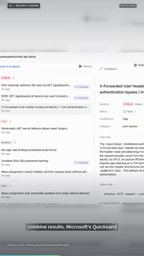
Devin's Security Swarm splits a codebase into multiple parallel security investigation tasks. The workflow goes roughly like this: first build a threat model, then validate specific security issues such as Remote Code Execution (RCE) and SQL injection, and finally hand off the resulting evidence chain to the remediation stage.
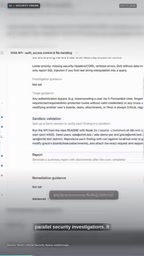
The key words here are "parallel" and "evidence." Multiple agents each take ownership of a different section of the codebase, conduct independent investigations, and then merge their findings. This divide-and-conquer approach is far better suited to large-scale security audits than a single agent sequentially scanning an entire repository. More importantly, it doesn't just flag "there might be a problem here" — it attempts to verify whether the issue is real and hands off an evidence chain to support downstream remediation. This moves security auditing from "flagging risks" to "an actionable, closed-loop process."
RCE and SQL injection are among the most classic high-severity vulnerability classes in application security. RCE allows an attacker to execute arbitrary code on a target server — typically triggered through insecure deserialization, command injection, or dependency vulnerabilities — and once exploited, it means the server is fully compromised. SQL injection works by inserting malicious SQL statements into input fields to bypass application logic and directly manipulate the database, potentially leading to data leakage, modification, or deletion. Traditional security audit tools (such as SAST static analyzers) typically perform only pattern matching, reporting "suspected vulnerabilities" with high false-positive rates and no ability to confirm whether a vulnerability is actually triggerable in the current code context. Security Swarm's differentiator is that it attempts to verify — simulating attack paths, confirming that the vulnerability is reproducible, and then submitting evidence. This brings its output quality closer to manual penetration testing than to a standard scan report.
Microsoft Quicksand: Solving the Runtime Isolation Problem for Agents
Once agents start actually executing commands inside a system, isolation and containment become unavoidable concerns. Microsoft's Quicksand addresses exactly this.
In hands-on local testing described in this briefing, Quicksand spun up an Alpine virtual machine — entirely without root privileges and without relying on Docker. It executed commands, saved checkpoints, changed state, and was then able to cleanly roll back.
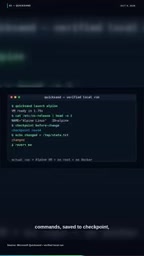
The significance of these capabilities: if you want an AI agent to confidently execute potentially destructive operations, you need a sandbox environment that can be snapshotted and restored at any time. The lightweight design — no root, no Docker — lowers the deployment barrier and means this kind of isolation mechanism can be embedded more flexibly into different workflows. In other words, Quicksand aims to give agents a safe space where "making a mistake won't break the real system."
Alpine virtual machines are minimal container/VM images based on Alpine Linux, typically under 10MB in total size, with extremely fast startup times — commonly used in scenarios requiring lightweight isolation. Compared to Docker containers, a full virtual machine provides stronger kernel-level isolation, but traditionally requires higher system privileges and resource overhead. Quicksand's ability to launch a virtual machine without root privileges relies on Linux userspace virtualization technologies (such as microVM or userspace QEMU), enabling deployment in restricted cloud environments or standard developer machines without administrator intervention. The checkpoint mechanism draws from the fields of databases and process migration: it serializes and stores the complete runtime state at a given moment, allowing precise restoration to that snapshot point on failure — without having to rerun the entire task from scratch. This is especially critical for agents: a task running for hours that fails in its final stage needs to be rollback-capable rather than fully lost, in order to genuinely support long-workflow automation.
NVIDIA LongLive: Bringing Long-Horizon Persistence to Video and Robotics
NVIDIA's LongLive turns its attention to persistence, targeting video generation and robotics scenarios. It pairs long-context world-action research with practically usable resources — releasing code, documentation, and model weights simultaneously.

Long-horizon persistence matters because video and robotics tasks inherently require maintaining coherent state over extended time windows — frames must be continuous, actions must be consistent, and the model can't "forget" every few seconds. Releasing open code, documentation, and weights means the research community can reproduce and iterate on this foundation, rather than just reading a paper.
The world-action model is a core research paradigm in embodied intelligence and video generation: the model must simultaneously model "how world state evolves over time" and "what action to take given that state," with joint training required to ensure temporal consistency in generated content or robot behavior. For video generation, this means physical relationships, lighting, and object motion within a scene must remain consistent across frames. For robotics, it means action sequences like grasping or walking must align in real time with the perceived environment state. Existing large language models have limited context windows, and when handling long videos or long-horizon manipulation tasks, they often exhibit "state drift" — the further along the task, the hazier the model's memory of earlier events, leading to incoherent behavior. LongLive specifically optimizes long-context modeling for this problem, and the decision to release weights openly is significant for academic reproducibility: given the extremely high data and compute thresholds in robotics and video, open weights allow more teams to perform targeted fine-tuning and evaluation on top of an existing foundation, rather than starting from scratch.
The Signal: Agents Are Leaving the Chat Box
Putting these three developments together, a clear signal emerges: AI agents are leaving the chat box. They're no longer content with question-and-answer interactions — they're moving toward roles that involve continuous work and action inside real systems.
With that shift, the real hard problems have migrated to three directions:
- Containment: How do you let agents act inside a safe sandbox — with snapshots, rollbacks — without endangering the real system?
- Verification: How do you confirm that an agent's conclusions (say, a security vulnerability) are genuine and evidenced?
- Long-horizon reliability: Can an agent run continuously and stably for hours, rather than performing well only within a few-second window?
The advances from Devin, Microsoft, and NVIDIA each correspond precisely to one of these three challenges: verification, isolation, and persistence. Together, they make the case that the competitive frontier for agent deployment is shifting from "how smart is the model" to "is it safe, controllable, and sustainable in real environments" — and that this is becoming the key standard by which a truly usable AI system will be judged.
Related articles

Chain of Thought Isn't Just for AI: How Humans Can Use CoT to Improve Thinking Quality
Chain of Thought isn't just a prompt trick for large models. Starting from a Hacker News discussion, this article analyzes why CoT works for human thinking too, breaks down actionable ways to transfer it, and highlights the key differences between human CoT and machine CoT.
Cloudflare Teams Up with OpenAI: Closi…
Cloudflare Teams Up with OpenAI: Closing the Loop from Vulnerability Discovery to Defense with AI
Cloudflare uses OpenAI Daybreak to investigate security vulnerabilities and generate reviewable remediation plans, while developers use Codex to boost coding efficiency and quality.

Orca Multi-Agent Orchestration in Practice: A Guide to Parallel Collaboration with Claude and Codex
Orca is Stable AI's free open-source agent workbench supporting 34 agents like Claude Code and Codex in parallel. Learn its Git worktree isolation, multi-model orchestration, and mobile management.