AI Agents Take Over 38% of Code Merges: The Engineering Revolution from 0.1% to 38%
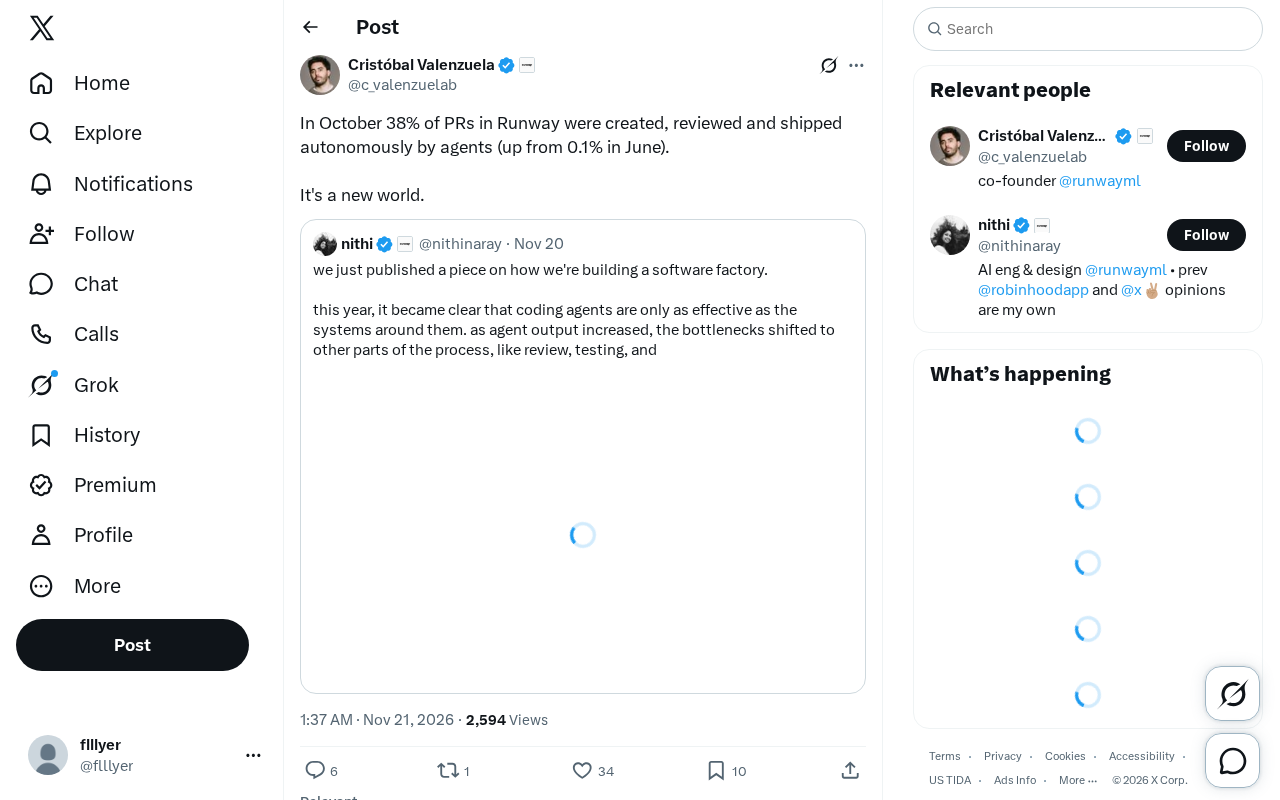
Runway's AI agents raised the proportion of autonomously completed PRs from 0.1% to 38% in four months, marking a new phase in engineering pipeline automation.
Runway's published data shows that in October 2024, 38% of PRs were autonomously created, reviewed, and merged by AI agents through the entire pipeline, compared to just 0.1% in June. This growth curve indicates that agents have moved from occasional success to scaled application, breaking through the bottlenecks of the complete engineering pipeline. The article argues that the most suitable changes for agent takeover are highly patterned ones such as dependency upgrades, test supplementation, and lint fixes, while cross-module architectural changes and business semantic judgments still require human leadership. Autonomous review is the most controversial stage, involving a shift in the role of quality gatekeeper. For engineering teams, review focus will shift to complex and ambiguous changes, efficiency metrics need redefinition, and governance mechanisms such as tiered authorization, rollback, and circuit breakers should be established to manage risk.
AI Agents Take Over 38% of Code Merges: The Engineering Revolution from 0.1% to 38%
While most teams are still debating whether AI can write code, Runway has already delivered a more radical answer with data: AI agents can not only write code, but also complete the entire pipeline from creation and review to merge and release.
According to data published by Runway on X (formerly Twitter), in October 38% of PRs (Pull Requests) were completed entirely autonomously by agents—created, reviewed, and merged with no human intervention. In June, that figure was just 0.1%.
The significance of this number isn't the 38% itself, but the rate of growth. Going from 0.1% to 38% took only about four months. If this curve continues, next year we may not be discussing "how much code AI can write" but "how much code humans still write."
From Assistive Tools to Autonomous Execution: What Changed
Over the past two years, the dominant form of AI coding tools has been the "copilot" model: Copilot autocompletes, Chat fills in code snippets, Cursor helps you refactor functions. What all these tools share is that key decisions and final merge authority always remain with humans.
Runway's data points to a different model: agents are no longer just generating code snippets—they're taking over the entire engineering pipeline.
According to Runway's official description, these agents can autonomously create PRs, perform code reviews, and complete merge and deployment. This means agents need several key capabilities: understanding task context, generating code that conforms to repository standards, self- or cross-validating during review, and judging whether changes can be safely merged.
A detail worth noting is that 0.1% starting point. In June, agents could barely complete a PR independently—0.1% is essentially at the level of "occasional success." Reaching 38% four months later shows that engineering bottlenecks are being rapidly overcome.
PR (Pull Request) is a formal proposal in distributed version control systems (such as Git) where a developer requests that changes on their branch be merged into the main branch. On platforms like GitHub and GitLab, a PR typically includes code diffs, comment discussions, and automated tests, and serves as the core vehicle for team collaborative review. A PR often requires human review, CI pipeline validation, and conflict resolution from creation to merge. When the article says "agents autonomously complete PRs," it means AI not only generates code but also independently completes the entire chain: submitting changes, responding to review comments, triggering and interpreting test results, and finally clicking the merge button.
Behind the 38%: Which Stages Are Most Susceptible to Agent Takeover
Runway did not disclose which types of work the 38% of PRs concentrated on, but reasonable inferences can be made from an engineering practice perspective.
Most suitable for agent takeover are highly patterned changes: dependency upgrades, configuration adjustments, test supplementation, small-scale refactoring, documentation updates, lint fixes. These PRs are characterized by clear boundaries and well-defined validation criteria, allowing agents to self-correct within closed-loop feedback.
Harder to take over are cross-module architectural changes, changes involving business semantic judgment, and scenarios requiring negotiation with people on product decisions. The core value of human review is often not "is the code syntactically correct" but "is this what we actually want to do."
This layering suggests that 38% is likely not a "uniformly distributed" 38%, but rather coverage of highly patterned work far above average. The management implication is: rather than pursuing full pipeline automation, first identify which PR types are suitable for delegation to agents.
CI (Continuous Integration) and automated testing are the infrastructure that enables agents to autonomously validate changes. CI systems automatically pull code, run builds and test suites on each PR submission, and return pass or fail results. For AI agents, CI feedback constitutes a programmable closed-loop signal: if tests fail, the agent can read logs, locate the problem, modify code, and resubmit until the pipeline turns green. This is precisely the technical prerequisite for what the article calls "self-correction within closed-loop feedback." Without mature CI coverage, autonomous agent merging lacks objective validation grounds, and risk rises significantly.
"Autonomous Review" Is the Real Watershed
Among the three stages Runway describes—creation, review, and merge—automation of the review stage is the most controversial.
Code creation has long been proven feasible. Merging is essentially a mechanical action. But review means judgment: is this code safe? Does it conform to standards? Will it introduce regressions? Having agents review code is equivalent to handing the role of quality gatekeeper to AI.
From an engineering perspective, the advantages of agent review are consistency and throughput: it won't miss things due to fatigue, won't relax standards because it's familiar with a colleague, and can work at the same intensity 24/7. The disadvantage is that it may not perceive the implicit signals that human reviewers can catch—such as when a change touches on lessons from a production incident three months ago.
Runway claims agents completed the "review" stage but did not specify the review criteria or human fallback mechanisms. This is where readers should remain cautious: autonomous review does not equal replacing all quality assurance, and more likely refers to automated review running under specific rules and test coverage.
Code Review in engineering practice is not just syntax checking but also involves judgment about design soundness, boundary conditions, security vulnerabilities, and maintainability. Traditionally, review relies on the experience and contextual knowledge of human reviewers—for example, knowing that a certain piece of code once caused a production failure. Agent review is typically based on explicit signals such as static analysis rules, historical PR patterns, and test coverage, and struggles to capture the organization's implicit "lessons-learned memory." Therefore, agent review is closer to rule-driven automated gating than a complete replacement for human judgment. Understanding this distinction helps assess the actual value of the "review" stage in Runway's data.
What This Means for Engineering Teams
The impact of this data on development teams is structural.
The center of gravity of review burden shifts. When 38% of PRs are autonomously completed and merged by agents, human engineers' review work will concentrate on the remaining 62%—that is, more complex, more ambiguous changes that rely more on contextual judgment. This actually raises the "value density" of human review and raises the bar for senior engineers.
Efficiency metrics are redefined. If agents can push the autonomous PR ratio from 0.1% to 38% in four months, then the key metrics for measuring team effectiveness will shift from "lines of code submitted per capita" to "agent autonomous completion rate" and "necessity of human intervention."
Managing trust boundaries. Autonomous agent merging means production environment risk is directly triggered by AI decisions. Teams need to establish new governance mechanisms—tiered authorization, rollback strategies, anomaly circuit breakers—rather than simply flipping the switch to "fully automatic."
Runway concluded with "It's a new world," and in the context of engineering management, this statement is not an exaggeration. Going from 0.1% to 38% is not incremental optimization but a mode switch. The real question is no longer "should we let AI agents write code" but "is your team ready to redefine what engineers do?"
Tiered authorization and circuit breaker mechanisms are key governance tools for managing the risk of autonomous agent merging. Tiered authorization means setting different approval levels based on the scope of change impact—for example, only allowing agents to automatically merge low-risk dependency upgrades and documentation updates, while changes involving core modules must be manually approved. Rollback strategies ensure that if an agent merge introduces a failure, the system can quickly revert to the last stable version. Anomaly circuit breakers automatically suspend an agent's merge permissions when monitoring detects rising error rates or deployment failures. Together, these mechanisms form "safety guardrails" for autonomous agent operations, preventing production environment risk from being entirely handed over to AI decisions.
Related articles

Michael Nielsen Takes Down His Classic Neural Network Textbook, Sparking Community Discussion
Michael Nielsen's classic free textbook Neural Networks and Deep Learning has been taken offline, sparking discussion on Hacker News about the reasons and impact.

Inside the AI Training Data Market: The Trade-off Between Exclusivity and Discounts
G2i founder Gabe Greenberg reveals the dual-track pricing of the AI training data market: labs pay a premium for exclusive data or accept discounts that allow others to buy it.

SessionGraph: Unifying All Coding Agent Sessions in One Interactive Graph
SessionGraph aggregates coding agent sessions into an interactive graph, helping developers review, debug, and manage AI coding workflows across sessions. This article examines its positioning, value, and open questions.