AI Agents vs. Bot Detection in 2026: New Challenges for Benchmarking

AI agents are significantly improving their ability to bypass bot detection; defenders need to shift to multi-signal dynamic detection.
The article discusses a Hacker News benchmarking project evaluating AI agents' ability to evade bot detection. Modern AI agents have human-like browsing behavior and semantic understanding, making traditional rule-based and shallow ML detection methods ineffective. Tests show agents excel at simulating human interaction rhythms but have weaknesses in browser fingerprint consistency and active visual verification. Defenders should shift to multi-signal fusion strategies combining device fingerprints, behavioral sequence modeling, and real-time risk scoring, while benchmarks need continuous updates. The offense-defense contest is a long-term evolutionary process, and distinguishing 'good' from 'bad' automation will become increasingly complex.
As AI agents rapidly grow more capable, traditional bot detection systems are facing unprecedented pressure. A benchmarking project recently discussed on Hacker News specifically evaluates how well modern AI agents can evade bot detection systems, offering a new perspective on this offense-defense contest.
Why Bot Detection Needs New Benchmarks
Over the past decade, bot detection has relied mainly on behavioral features, browser fingerprinting, IP reputation, and CAPTCHAs. These methods performed well against simple scripts and early automation tools. But modern AI agents exhibit human-like browsing behavior, dynamic decision-making, and semantic understanding of page structure, gradually rendering detection methods based on rules and shallow machine learning ineffective.
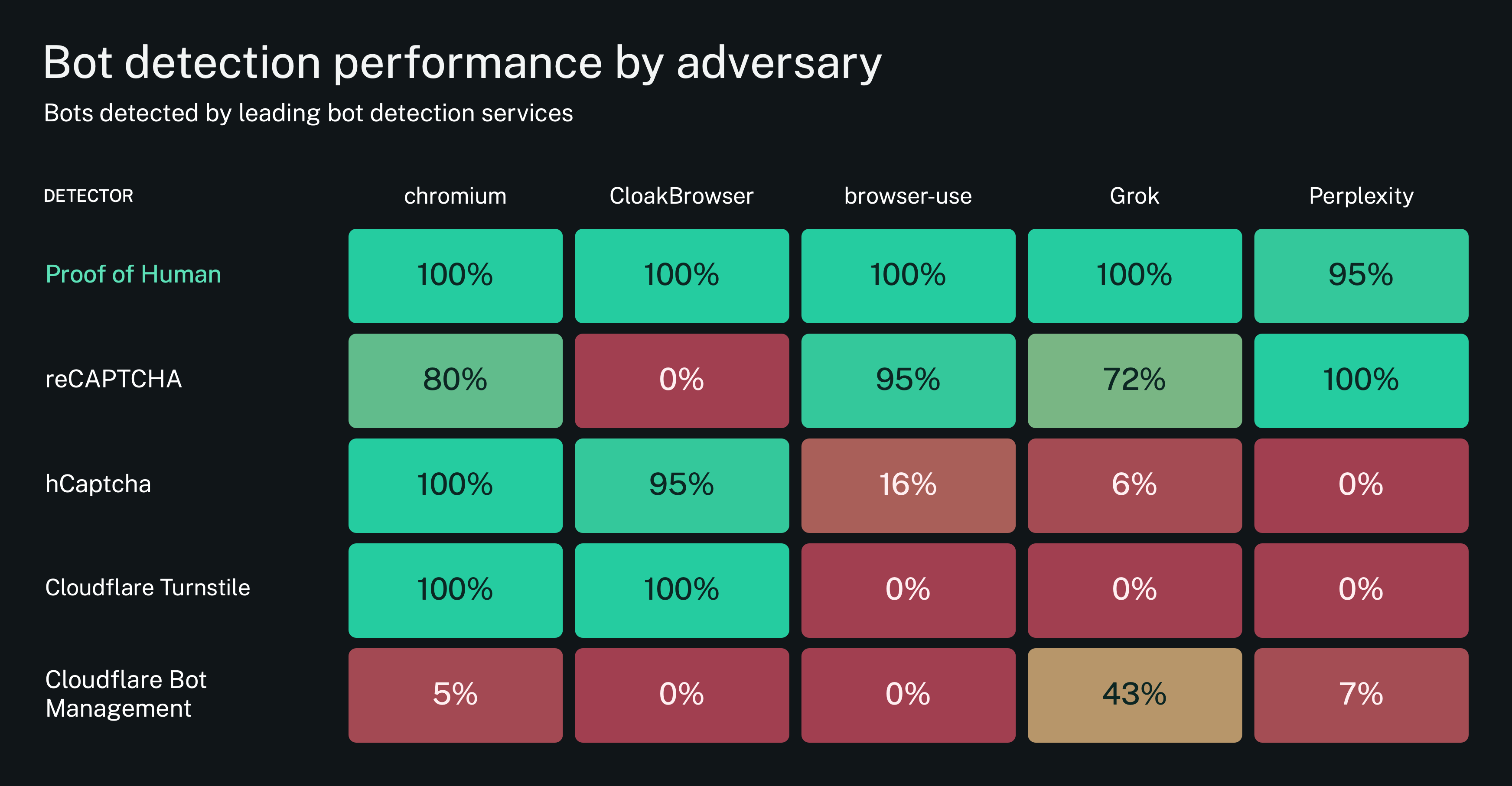
The core question of this benchmark is straightforward: when AI agents are given the goal of completing specific web tasks, to what extent can they bypass mainstream bot detection systems? The tests cover multiple detection dimensions, including mouse trajectory analysis, request header consistency, JavaScript execution environment detection, and interaction timing patterns.
Browser fingerprinting refers to websites collecting various browser attributes (such as User-Agent, screen resolution, installed fonts, Canvas rendering results, WebGL parameters, timezone, etc.) and combining them into a high-entropy identifier to distinguish different visitors. Unlike cookies, fingerprints are difficult for users to actively clear, so they are often used for cross-session tracking and bot identification. Headless browsers (such as default configurations of Puppeteer and Playwright) often show consistency deviations in these attributes—for example, missing certain fonts or Canvas rendering results that don't match real GPU environments—thus becoming an important signal source for detection systems.
Headless browsers are browser environments that run without a graphical interface, widely used for automated testing and web scraping. Their runtime exposes features different from regular browsers, such as navigator.webdriver being true, missing plugin lists, and abnormal WebGL renderer strings. Modern AI agent frameworks are mostly built on headless browsers, so these environmental features become a key突破口 for defenders to identify automated traffic.
Key Findings from the Benchmark
According to the project's preliminary framework, modern AI agents show significant evasion capabilities across multiple detection dimensions. Particularly in simulating human interaction rhythms, LLM-driven agents can dynamically adjust operation intervals and paths, making anomaly detection based on fixed thresholds difficult to trigger.
However, the tests also expose weaknesses of AI agents. For example, in browser fingerprint consistency, some agent frameworks leave identifiable environmental traces due to their reliance on headless browsers. In addition, when detection systems introduce active challenges (such as requiring completion of verification tasks that need visual reasoning), agent success rates drop noticeably.
Interaction timing pattern detection refers to analyzing the rhythm of user operations on a page (such as mouse movement speed, click intervals, scroll acceleration, keyboard input delays) to determine whether the user is human. Human operations typically exhibit nonlinearity and a degree of randomness, while early automation scripts often show fixed intervals or uniform trajectories. LLM-driven AI agents can dynamically generate operation sequences based on page context and introduce random delays to simulate human irregularity, making anomaly detection relying on fixed thresholds ineffective. This is also one of the dimensions where agents perform most prominently in this benchmark.
Implications for Defenders
The value of this benchmark lies not in declaring detection systems' failure, but in pointing out directions for improvement. Facing AI agents, defenders need to shift from static rules to dynamic, multi-signal fusion detection strategies. Single-dimension features are no longer sufficient for reliable judgments; comprehensive solutions combining device fingerprints, behavioral sequence modeling, and real-time risk scoring are more likely to remain effective.
At the same time, testing methods themselves need continuous updating. AI agents iterate far faster than traditional automation tools, and if benchmarks cannot regularly incorporate new agent frameworks and attack patterns, their conclusions will quickly become outdated.
Multi-signal fusion detection means not relying on a single feature for judgment, but feeding signals from multiple dimensions—device fingerprints, behavioral sequences, network reputation, interaction challenge results—into a real-time risk scoring model that outputs comprehensive confidence. The advantage of this strategy is that AI agents may approach human performance on some dimensions, but it's hard to stay consistent across all dimensions simultaneously. For example, even if an agent simulates human mouse trajectories, its browser environment features may still expose traces of a headless browser. Multi-signal fusion maintains detection effectiveness by raising the cost for attackers to simultaneously satisfy all signals.
The Long-Term View of the Offense-Defense Contest
The confrontation between bot detection and AI agents is essentially a continuously evolving process. Every upgrade in detection technology pushes automation tools to find new evasion paths, and vice versa. For website operators and security teams, understanding the capability boundaries revealed by this benchmark is more practical than pursuing one-size-fits-all solutions.
Although this Hacker News discussion didn't gain much traction, it touches on a rapidly accelerating real-world problem: as AI agents become more human-like, distinguishing "good" automation from "bad" automation will become more complex, requiring a joint response at the technical, strategic, and governance levels.
One-line Summary
AI agents are significantly improving their ability to bypass bot detection; defenders need to shift to multi-signal dynamic detection.
Paragraph Summary
The article centers on a benchmarking project on Hacker News that evaluates AI agents' ability to evade bot detection. Modern AI agents possess human-like browsing behavior and semantic understanding, gradually rendering traditional detection methods based on rules and shallow machine learning ineffective. Tests show that agents excel at simulating human interaction rhythms, but still have weaknesses in browser fingerprint consistency and active visual verification. The article points out that defenders should shift from static rules to multi-signal fusion strategies combining device fingerprints, behavioral sequence modeling, and real-time risk scoring, while benchmarks themselves need continuous updates to keep pace with agent framework iteration. The offense-defense contest is a long-term evolutionary process, and distinguishing "good" from "bad" automation will become increasingly complex.
Related articles

Chain of Thought Isn't Just for AI: How Humans Can Use CoT to Improve Thinking Quality
Chain of Thought isn't just a prompt trick for large models. Starting from a Hacker News discussion, this article analyzes why CoT works for human thinking too, breaks down actionable ways to transfer it, and highlights the key differences between human CoT and machine CoT.
Cloudflare Teams Up with OpenAI: Closi…
Cloudflare Teams Up with OpenAI: Closing the Loop from Vulnerability Discovery to Defense with AI
Cloudflare uses OpenAI Daybreak to investigate security vulnerabilities and generate reviewable remediation plans, while developers use Codex to boost coding efficiency and quality.

Orca Multi-Agent Orchestration in Practice: A Guide to Parallel Collaboration with Claude and Codex
Orca is Stable AI's free open-source agent workbench supporting 34 agents like Claude Code and Codex in parallel. Learn its Git worktree isolation, multi-model orchestration, and mobile management.