AI Agents vs. ChatGPT: The Paradigm Shift from Passive Responses to Autonomous Action

AI is moving from passive chatbots through preset workflows to true Agents with LLM autonomous decision-making.
Based on an analysis video from a YouTube tech channel, the article proposes a three-level framework for AI capability: Level 1 is the passive chatbot, with decision-making power entirely in human hands; Level 2 is the AI workflow, which can call tools but whose paths are hard-coded by programmers, like a train on tracks; Level 3 is the true AI Agent, with a large language model as the central brain, using the ReAct framework to alternate reasoning and action, autonomously decomposing tasks, calling tools, and iterating to correct errors when failures occur. The article uses a vacation sunscreen calculation as an example to show the Agent's multi-step coordination capability, while emphasizing that RAG is only a retrieval technique inside a workflow, not an autonomous agent. The author concludes that Agents lack human common sense and may fall into infinite loops, so human approval, activity logs, and an emergency stop button must be retained; their positioning is to augment, not replace, human capabilities.
Artificial intelligence is at a critical turning point. In the past, we were used to treating AI as a "super encyclopedia"—ask a question, get an answer; request an email, get a block of text. But a new paradigm is taking shape: AI is no longer just generating content—it's starting to "take action." According to an in-depth analysis video from a YouTube tech channel, 2024 has already been dubbed "the year of AI Agents" by the industry, and the key to understanding this shift lies in clarifying the essential differences between chatbots, AI workflows, and true AI Agents.
Three Levels of Complexity: From Passive Responses to Autonomous Exploration
The video proposes a clear tiered framework: Level 1 is the standard chatbot, Level 2 is the AI workflow, and Level 3 is the true AI Agent. The core difference among the three is not model capability but "who makes the decisions."
Level 1 chatbots are built on large language models and excel at generating text, but they are fundamentally passive—they sit and wait for your prompt and produce output based on training data. Even though modern chatbots can browse the web or connect to basic tools, they still require you to specify step by step "what to browse" and "which tool to use," with decision-making power始终 remaining in human hands.
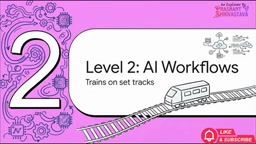
Level 2 AI workflows solve the tool-access problem, but in a mechanical way. The video uses a precise metaphor: a workflow is like a train running on preset tracks—the programmer explicitly specifies "step one, check the calendar; step two, summarize the events; step three, output the result," and the system executes perfectly but cannot deviate from the tracks. If you ask such a system about the weather in Chicago, it will simply crash, because its tracks only lead to the calendar and have no branch to a weather app. The video also specifically clarifies the popular term RAG (Retrieval-Augmented Generation)—it sounds sophisticated, but it is essentially just a retrieval technique inside a workflow, not an autonomous agent. As long as the steps are hard-coded by humans, it is a workflow.
The True Agent: The LLM Becomes the Decision-Making Brain
The tipping point for the leap from workflow to Agent is when the human decision-maker is fully replaced by the large language model itself. It is no longer a programmer saying "first do A, then do B"; instead, the LLM becomes the central brain, using its language-understanding ability to reason on its own and "talk to itself" to determine which tool to call next.
The contrast in the video is vivid: if a workflow is a train trapped on tracks, an AI Agent is an off-road explorer that dynamically surveys the terrain and independently finds the optimal route. At the core of this capability is the ReAct framework—an alternating loop of reasoning (Reason) and acting (Act).

The video demonstrates this capability with a seemingly casual vacation-planning question: "For an outdoor weekend trip to Florida next month, how many 2-ounce bottles of sunscreen should I bring?" This is actually a complex mathematical and logical problem. A Level 1 chatbot will simply fabricate a random number, because it does not know your travel dates, cannot predict the weather, and does not possess a health-dosage formula. A Level 3 Agent, by contrast, breaks the big problem into executable subtasks: first access your email to get flight confirmation information to determine the dates, then call an external weather API to obtain sunlight duration, reasonably assume based on API data that you will be outdoors during most of the sunlight hours, then retrieve application-frequency guidance from health guidelines, and finally call a calculator to complete the computation.
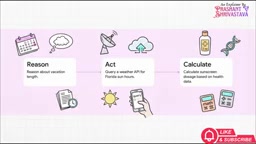
The detail that truly demonstrates the Agent's value is this: when the weather API returns an error, it observes the failure, realizes it needs a new source, and autonomously iterates to find an alternative weather tool. This closed loop of "encounter an obstacle—identify the error—switch strategy" enables self-correction without human intervention, which the video calls the "holy grail" of the current AI field.
The ReAct framework (Reasoning + Acting) is a prompt-engineering paradigm proposed in 2022 by research teams from Princeton University and Google. Its core idea is to have a large language model alternate between reasoning traces and action steps. In each round, the model first outputs a "Thought" in natural language, clarifying its current understanding of the task and its next intention; it then executes an "Action," such as calling a retrieval tool, API, or calculator; next it observes the "Observation" returned by the tool and uses it to correct or advance the next step of reasoning. This "Thought—Action—Observation" loop enables the model to dynamically incorporate the results of external tools into its reasoning process rather than generating an answer in one shot. Compared with the traditional Chain-of-Thought, the key advantage of ReAct is that it introduces feedback signals from the environment, allowing the model to actively retrieve information when it is insufficient and to adjust strategy when a tool reports an error. It is precisely this mechanism that enables the Agent, as described above, to autonomously switch data sources after a weather API failure and achieve self-correction without human intervention.
Humans Must Stay in the Loop
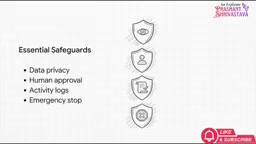
The greater the capability, the greater the risk. The video explicitly emphasizes that an Agent is not magic and will not replace humans; the positioning of this technology is to augment human capabilities. AI Agents still lack basic human common sense and may behave unpredictably, so humans must always serve as the final gatekeeper. Citing IBM research, the video points out that keeping "humans in the loop" before an Agent executes high-impact actions is a non-negotiable requirement.
Specific safety measures include: setting strict permissions on data, keeping detailed activity logs to reconstruct the Agent's "thinking process," requiring human approval for major operations, and most critically—setting up a digital emergency stop button.
The video specifically warns about the risk of "infinite feedback loops": an Agent does not always have perfect memory or flawless autonomy, and sometimes it gets stuck repeatedly calling the same tool. A runaway AI trapped in a loop and continuously buying plane tickets is enough to cause real losses in a short period of time. This reminds us that autonomy and controllability must be designed in tandem.
"Human-in-the-Loop" (HITL) is a classic concept in the fields of human-computer interaction and AI safety, referring to setting up stages in an automated system's decision-making or execution process that must involve human participation, review, or approval. In the context of AI Agents, HITL typically takes three forms: first, prior approval, meaning the Agent must obtain human confirmation before executing high-impact operations such as payments, sending emails, or modifying data; second, in-process supervision, meaning humans can view the Agent's reasoning traces and tool-call records in real time and intervene or terminate at any time; third, post-hoc auditing, meaning the Agent's decision path can be traced back through complete activity logs. Research from institutions such as IBM emphasizes that as Agent autonomy increases, HITL design needs to shift from an "optional enhancement" to an "architectural constraint." Together with the permission controls, activity logs, and emergency stop button mentioned in the article, this forms a layered protection system—its essence is to establish an adjustable balance point between autonomy and controllability, rather than simply limiting the upper bound of the Agent's capabilities.
The Distance from Tool to Collaborator
The value of this three-level framework is that it clearly disentangles the concept of "Agent," which is used interchangeably in the market. Many products billed as agents actually remain at the workflow level—they have tool calls, but the paths are preset by humans. The criterion is simple: when the environment changes and the preset path fails, can the system autonomously find a new path?
For developers and enterprises, this means that when evaluating AI products, they need to ask where decision-making power lies; for ordinary users, a true Agent means being able to hand over as a whole tasks like "arrange a coffee chat" that require multi-step coordination, cross-tool operations, and handling repeated changes—rather than merely having AI draft an email. As the question posed at the end of the video suggests: now that you see the huge gap between "merely writing text" and "being able to take action in the real world," which complex, time-consuming task are you ready to hand over to your first AI Agent?
Related articles

OpenAI Partners with Shield: How the Astra Agent Revolutionizes IT Troubleshooting
OpenAI and Shield launch the Astra agent, which autonomously logs into computers and legacy systems to fix IT issues in real time, 35-40% faster than traditional models, with humans involved only when judgment is needed.

iPhone Duo Battery Life Tested: One Charge a Day Is Unavoidable, and the Large Screen Is the Culprit
iPhone Duo battery test: heavy use needs at least one charge a day, and about 30% remains after 6.5 hours of screen-on time. How often the large screen is unfolded is key; a MagSafe battery pack helps, and long-term degradation is also worth watching.

Kimi K3.1 Pro Open-Sourced: 2.8 Trillion Parameters Close In on Opus
Moonshot releases the open-source MoE model Kimi K3.1 Pro, with 2.8T total parameters and 104B activated, trailing Opus 5.5 by under 1 point on Terminal Bench 4.0.