AI Agents vs. Traditional Automation: Why Byteflow Can Handle the Unexpected

Byteflow's AI agent handles unexpected failures through dynamic decisions and recovery loops, unlike rigid traditional automation.
Traditional automation tools like n8n and Zapier rely on fixed, predefined paths and break down whenever something unexpected occurs. Byteflow's agent approach uses a closed loop of Understand → Decide → Use Tools → Act → Recover → Continue, enabling real-time strategy adjustments — such as switching phone numbers on no-answer, then falling back to WhatsApp and booking a callback. Human approval nodes at critical steps balance autonomy with control. This represents a paradigm shift from handling repetitive tasks to navigating non-deterministic scenarios, though real-world performance remains to be validated.
When Reality Deviates from the Script, Automation Breaks Down
Most automation tools are fundamentally about "following a script." Platforms like n8n and Zapier execute your workflow step by step, exactly as designed: Trigger → API Call → Action. As long as every step behaves as expected, everything runs smoothly.
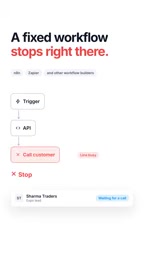
The problem is that reality rarely follows a script. Say you've built a workflow to automatically call sales leads — what happens when a line is busy or no one picks up? A fixed workflow simply stalls at that point, the lead goes cold, and the opportunity is lost.
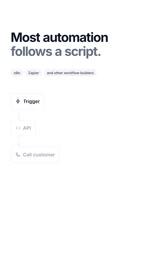
This is the structural weakness of traditional automation: it can only handle paths that were defined in advance. The moment something outside the script occurs, it has no capacity to adapt.
What Makes an Agent Different: It Thinks, Not Just Executes
According to the YouTube content this article is based on, the fundamental difference between Byteflow's Agent and traditional automation is that it decides what to do next.
Take the same scenario of an unanswered call. Byteflow's logic is entirely different: if the first number goes unanswered, it tries another number; if that also fails, it switches to sending a WhatsApp message and books a callback directly. Throughout this process, it isn't mechanically executing steps — it's adjusting its strategy based on real-time results.
This capability can be broken down into a closed loop: Understand → Decide → Use Tools → Act → Recover → Continue. By contrast, traditional automation is missing precisely the "Decide" and "Recover" steps — it neither evaluates the situation nor finds an alternative path after a failure.
In the AI field, this architecture is commonly known as the "ReAct" pattern (Reasoning + Acting), or more broadly, the "Agentic Loop." The core idea is to use a large language model (LLM) as a reasoning engine that evaluates the current state after each step and decides which tool to invoke next. This is fundamentally different from the Directed Acyclic Graph (DAG) structure of traditional automation — in a DAG, paths are fixed at design time, whereas an agent's execution path is generated dynamically at runtime. The Function Calling / Tool Use capabilities from companies like OpenAI and Anthropic are the underlying technical foundation that makes these agents possible: the model doesn't just output text — it can also "call" external systems in a structured way and incorporate the results into the next round of reasoning.
Balancing Autonomy and Control
The biggest concern with agents is often a loss of control — if it's making all the decisions, can users really trust it?

Byteflow addresses this by preserving human intervention points in the workflow: before executing any significant action, it waits for user approval. This means the agent retains autonomous judgment while keeping critical decisions in human hands. This "autonomous execution + human approval" design is a pragmatic compromise that reflects how AI agents are being integrated into real business workflows today.
This "Human-in-the-Loop" design is one of the industry's current consensus approaches for deploying AI agents. Fully autonomous agents operating in high-stakes areas — involving money, contracts, or customer relationships — carry risks where the cost of errors can be unacceptable. As a result, mainstream frameworks like LangGraph and AutoGen provide "breakpoint" or "approval node" mechanisms that allow humans to step in and confirm at critical steps. This is essentially a risk-tiered strategy: low-risk, reversible operations (like querying information or drafting messages) can be fully automated, while high-risk, irreversible actions (like sending official emails or triggering payments) retain human oversight. As agent reliability improves, this "human intervention threshold" is expected to gradually shift further back.
What the Shift from "Automation" to "Agent" Really Means
This content points to a product paradigm shift that is actively underway: automation tools solve repetitive labor, while agents aim to solve decision-making labor in non-deterministic scenarios.
For work like sales outreach and customer follow-up — which depends heavily on real-time feedback — the fragility of fixed workflows is especially apparent. Any unexpected event at any node breaks the entire chain. An agent equipped with the ability to understand, decide, and recover can maintain task continuity even when things go wrong in the real world.
It's worth noting that this article is based on Byteflow's official promotional content, and the capability descriptions above come primarily from their product demos. Actual performance still needs to be validated in real business environments. But the direction it represents — keeping automation from breaking down when reality does — genuinely points toward the core competitive advantage of the next generation of workflow tools.
Related articles

JobRunner MCP Server: AI Agents Can Now Fix Failed Java Jobs
JobRunner launches an open-source MCP server enabling AI agents to view cluster status, diagnose failures, and recover Java jobs—incident response from any cloud coding environment or existing agent.

MLAI Digital Launches 9 Security Agents: MCP Server Safeguards the Full Lifecycle of Agentic AI
MLAI Digital launches Security MCP Server with nine built-in specialized security agents covering vulnerability discovery, attack simulation, prompt injection detection, API and infrastructure assessment, and accelerated remediation—embedding security validation across the full Agentic AI lifecycle from development to production.

Running Isaac Lab on H100 GPUs: Exploring Better Approaches
Exploring optimization methods for running Isaac Lab on NVIDIA H100 GPUs, including MIG configuration, mixed precision, TensorRT acceleration, and community experience to improve robotics simulation and reinforcement learning efficiency.