AI API Proxy Platforms: One Key to Access All Major LLMs

AI API proxy platforms aggregate multiple LLM APIs, solving overseas access pain points for developers.
AI API proxy platforms use a reverse proxy architecture to aggregate APIs from OpenAI, Anthropic, Google, and other major LLM providers into a unified interface, solving network instability, payment difficulties, and high pricing challenges. They offer centralized key management, roughly 20% cost savings, comprehensive task logs, and cost tracking — making them especially useful with AI coding tools like Cursor. However, users should be aware of data security and service reliability considerations.
What Is an AI API Proxy Platform?
Developers in China frequently run into issues when directly calling overseas AI model APIs — unstable network connections, difficulty paying with credit cards, and higher-than-expected pricing. AI API proxy platforms emerged to solve exactly these pain points. They aggregate APIs from multiple major LLMs into a single service, so users only need to register one account and generate one API key to access all available models — no more signing up and topping up separately on OpenAI, Anthropic, and Google.
From a technical standpoint, these platforms are essentially built on a reverse proxy architecture. Unlike a forward proxy (where users manually configure a proxy server to access overseas services), a reverse proxy is completely transparent to the client — developers simply point their code to the proxy platform's domain without needing to know the actual API endpoint behind it. The platform deploys an interface layer on its own servers that is fully compatible with the official APIs from OpenAI, Anthropic, and others. Requests first reach the proxy server, which then forwards them to the original API endpoints. This architecture also delivers additional engineering value: the proxy layer can handle load balancing, request retries, rate limiting, and circuit breaking. When an upstream model service experiences instability, the platform can automatically switch to backup routes — completely transparent to the developer. Since these platforms typically deploy nodes in regions like Hong Kong and Singapore and maintain dedicated connections with multiple cloud providers, the network quality far exceeds what users in mainland China experience when connecting directly to overseas servers.
The core advantages of these platforms lie in cost savings (typically around 20% cheaper than official pricing) and centralized management. For developers and content creators who need to frequently call various AI capabilities, this can save considerable time and money.
Platform Core Features Explained
Model Marketplace and Category Navigation
The major LLM API providers today include OpenAI (GPT series), Anthropic (Claude series), Google (Gemini series), as well as domestic Chinese providers like Baidu's ERNIE and Alibaba's Tongyi. These platforms all use a token-based billing model — a token is the basic unit the model uses to process text. Roughly speaking, 1,000 tokens equals about 750 English words or 500 Chinese characters.
Understanding the nature of tokens helps developers control costs more precisely. Tokens are not simply equivalent to characters or words — they are language fragments split by a tokenizer based on statistical frequency. Common words (like "the" or "is") are typically one token, while rare words or Chinese characters may be split into multiple tokens. This explains why processing Chinese content often consumes more tokens than an equivalent amount of English content. Additionally, LLM billing is usually split into input tokens (the prompts and context you send) and output tokens (the responses the model generates), with output tokens generally priced higher than input tokens — because the generation process is more computationally intensive than encoding. Pricing varies significantly across models; for example, the per-million-token price of GPT-4o and Claude 3.5 Sonnet can differ by several times. The aggregation capability of proxy platforms allows developers to flexibly choose the most cost-effective model based on task requirements.
The platform offers a rich model classification system covering text generation, image generation, video generation, and more. On the API marketplace page, a clear category navigation panel on the left lets you quickly locate the right model for your needs.
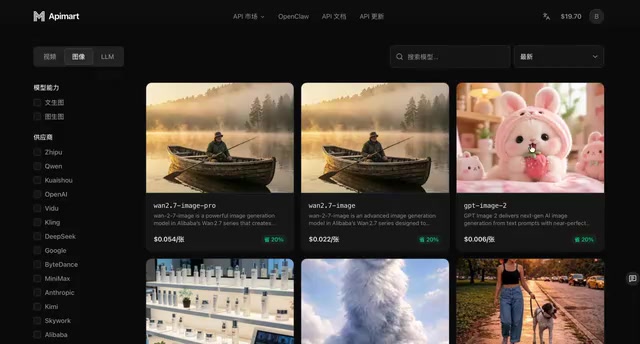
Take image generation as an example — the platform integrates image generation capabilities from mainstream models like GPT. On a specific model's page, model parameters are displayed on the left while a prompt input area on the right supports direct online testing, making it easy to evaluate model performance before formal integration.
Complete Workflow from Registration to API Calls
The overall workflow is remarkably simple — just four steps:
- Register an account: Sign up on the platform's homepage
- Top up your balance: Complete prepayment on the billing page
- Generate an API key: Obtain your unified API Key
- Start using it: Configure the key in development tools like Cursor, VS Code, etc.
This means you no longer need to maintain separate accounts and balances across OpenAI, Anthropic, Google, and other platforms — one key handles all LLM calls.
Documentation and FAQ Support
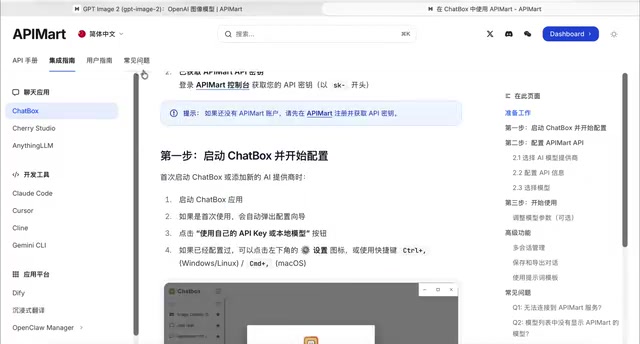
The platform provides comprehensive user guide documentation, including quick-start tutorials, instructions for calling each model, and frequently asked questions. For issues not covered in the documentation, online customer support is available.
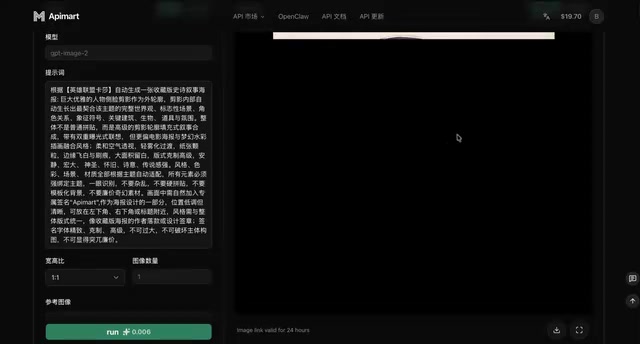
The platform also supports multi-language switching and provides a feedback channel for submitting issues or improvement suggestions.
Task Logs and Cost Tracking
The platform includes a built-in task log feature that records every API call in detail, including request time, model name used, and credits consumed. This feature is highly practical for controlling development costs and troubleshooting call anomalies.
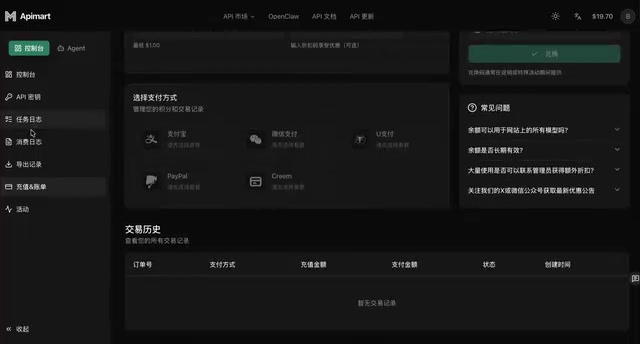
On the billing page, you can clearly see your current balance and historical spending details. With pricing approximately 20% lower than official rates, the cumulative savings for developers making heavy daily API calls can be substantial.
Real-World Experience Using It with Cursor
Cursor is an AI-native code editor built as a deep modification of VS Code. Unlike plugin-based solutions like GitHub Copilot, Cursor embeds AI capabilities deep into the editor's core: it can not only complete single lines of code but also understand the context structure of your entire codebase (by building vector indexes of project files), support multi-file coordinated editing, generate code snippets directly from natural language descriptions, and answer targeted questions by referencing specific functions or files in the chat window. Because these features require continuous, high-frequency requests to LLMs containing extensive context, Cursor is extremely sensitive to API stability and response latency — which is precisely why proxy platforms deliver exceptional value in this scenario. Cursor supports custom API Base URLs and API Keys, which is the technical foundation enabling seamless integration with proxy platforms — simply replace the official API address with the proxy platform's address, and all other call logic remains unchanged.
This seamless substitution is possible because proxy platforms strictly adhere to the OpenAI Compatible interface specification. This specification originated from the request/response data structures defined when OpenAI released its Chat Completions API, including the unified /v1/chat/completions endpoint path, the messages array format, the Server-Sent Events (SSE) streaming protocol, and more. As OpenAI established its dominant position in the industry, an increasing number of model providers (including Anthropic, Google, and domestic Chinese providers like iFlytek and Zhipu) began offering interfaces compatible with this specification. Open-source community tools like Ollama and LM Studio for local inference also fully support this standard. This means that every tool in the ecosystem supporting custom endpoints — whether Cursor, Continue, LobeChat, or custom-built applications — can freely switch between different model services by modifying a single configuration line, without changing any business code, dramatically reducing the engineering cost of model migration and multi-model usage.
Configuring the proxy platform's API Key in the Cursor editor yields several clear benefits in practice:
- More stable network: The proxy platform optimizes routes for domestic Chinese networks, significantly reducing timeouts and disconnections
- Easy model switching: A single key can be used to configure multiple models in Cursor, allowing flexible switching based on task complexity
- Transparent costs: A unified billing dashboard makes every expense crystal clear
- No additional network tools needed: Lower barrier to entry, ready to use out of the box
Things to Consider Before Using a Proxy Platform
While proxy platforms are convenient, here are a few things worth considering before integration:
- Data security: Your code and prompts are forwarded through third-party servers, so projects involving sensitive business data require careful evaluation. Data security risks manifest at two levels: first, the transmission layer — whether request content is logged or analyzed on the proxy server; second, the compliance layer — for regulated industries like finance and healthcare, routing data through overseas third-party servers may trigger cross-border data transfer compliance requirements. Pay close attention to the platform's privacy policy regarding log retention periods and whether they offer enterprise-grade data non-retention guarantees. For extremely sensitive business scenarios, locally deploying open-source models (such as Llama or Qwen) remains the safer choice.
- Service availability: Platform stability depends on its own operational capabilities — prioritize platforms with strong user reputation and longer track records
- Model version updates: Proxy platforms may support new models a few days to a week later than official releases
- Top-up strategy: Start with a small amount to test response speed and service quality before committing more
Overall, AI API proxy platforms offer a pragmatic solution for developers in China to access overseas LLMs. They're especially well-suited for users who want to integrate AI capabilities into programming tools like Cursor without spending too much effort dealing with network issues. Choosing the right platform can make your daily AI-assisted development experience significantly smoother.
Key Takeaways
- AI API proxy platforms aggregate multiple mainstream models — one key to access all services
- Pricing is approximately 20% cheaper than official rates, ideal for high-frequency developers
- Platforms provide comprehensive documentation, task logs, and cost tracking features
- Using them with Cursor solves network instability and payment difficulties faced in China
- Be mindful of data security and service reliability risks when using proxy platforms
Related articles
 Product Reviews
The Programmer's Desk Setup Guide: Building a Workspace That Feels Like Home
Discover how programmers build productive, comfortable workspaces. From multi-monitor setups to ergonomic design, explore the desk philosophy that drives focus and flow.
 Product Reviews
Qoder vs Cursor Real-World Comparison: Which $20/Month AI IDE Is Better?
Hands-on comparison of Qoder vs Cursor AI IDEs: Agent autonomy, human interaction count, and architecture decisions. Qoder needed only 2 interactions vs Cursor's 8.
 Product Reviews
Cursor Cloud Agent Demo: Eliminating Bottlenecks Across the Entire Software Development Lifecycle
Deep analysis of Cursor's Cloud Agent demo showing how cloud VMs, automated test artifacts, and a full-chain control plane systematically eliminate human bottlenecks across the software development lifecycle.