AI Art Controversy: When Tech Icons Are Reimagined as Mythological Monsters
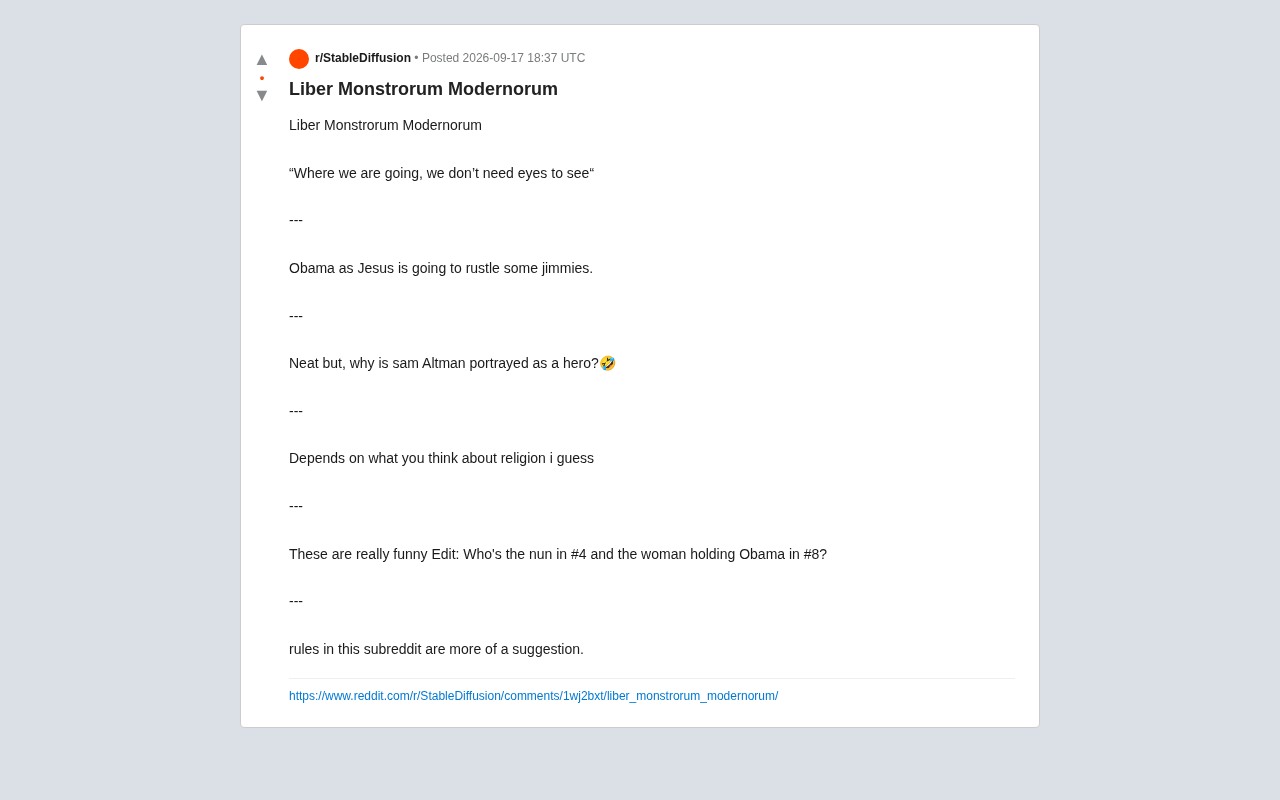
AI art series 'Book of Modern Monsters' reimagines tech figures as mythological beings, igniting debate on creative ethics.
A Reddit AI art series titled Liber Monstrorum Modernorum, inspired by medieval monster encyclopedias, places figures like Obama and Sam Altman into religious and mythological narratives — sparking strong reactions. Supporters see humor and social critique; skeptics question the framing choices and use of religious symbols. The series highlights a growing tension between creative freedom and image-use ethics as AI tools make it easier than ever to insert real people into any fictional scenario.
An AI Art Series Sparking Debate
A series of AI-generated artworks on Reddit titled Liber Monstrorum Modernorum (Book of Modern Monsters) has ignited heated discussion across the community. The Latin title echoes the medieval tradition of monster encyclopedias, with the creator reimagining that ancient art form using contemporary tech figures and public personalities.
The accompanying caption — "Where we are going, we don't need eyes to see" — carries strong metaphorical weight, suggesting the series aims to explore a critical perspective that goes beyond surface appearances.
Liber Monstrorum refers to a genre of Latin encyclopedic texts rooted in medieval Europe, dating back to Anglo-Saxon manuscripts from the 7th–8th centuries. These works catalogued all manner of "monsters" — exotic peoples, hybrid creatures, and supernatural beings. Rather than serving as pure horror literature, they used the imagery of the "strange" to examine the boundaries of humanity, moral order, and divine authority. Attaching this title to modern tech figures implies the creator views today's power players as a kind of "contemporary monster" — simultaneously symbols of great power and unsettling outsiders. The caption, borrowed from the iconic Back to the Future line, suggests humanity is moving toward a future where the very nature of perception and judgment has fundamentally changed.
A Community Divided
Judging by the comments, the series succeeded in hitting a nerve. One user bluntly noted, "Obama as Jesus is going to rustle some jimmies," anticipating the controversy that would arise from combining religious imagery with a political figure.
Another flashpoint was the portrayal of tech industry leaders. A commenter questioned: "Why is Sam Altman depicted as a hero?" This touches on a fascinating dynamic in AI art — creators often hold a deeply ambivalent mix of admiration and irony when it comes to tech celebrities.
One user cut to the heart of it: "It depends on how you view religion." That observation laid bare the central tension running through the entire series — it borrows the visual language of religion and mythology, and how viewers interpret it depends entirely on where they stand.
The Expressive Limits of AI-Generated Art
This series demonstrates the creative capabilities of today's AI image generation technology. Placing real people within mythological or religious narrative frameworks requires the model to have a strong command of composition, stylization, and symbolic elements.
Many users found the pieces "really funny" and even started asking about specific details — "Who is the nun in image 4? Who is the woman holding Obama in image 8?" This curiosity about the details is itself a sign that AI art has developed the power to drive deep audience engagement and secondary interpretation.
It raises a genuine question: when AI tools make it trivially easy for anyone to insert public figures into any narrative scenario, how do we define the boundaries between creative freedom and the right to control one's own image?
Placing real public figures in fictional or mythological contexts touches on two legal areas: deepfakes and the right of publicity. In the United States, the likeness of a public figure is generally protected under the First Amendment in contexts of commentary and parody/satire, but commercial use or misleading content may constitute infringement. There is currently no unified global standard for AI-generated content featuring real individuals — platforms rely on community guidelines to make their own calls. This legal vacuum is what allows works like Liber Monstrorum Modernorum to spread widely, while also meaning those depicted have virtually no effective legal recourse. That is the real-world backdrop against which discussions of creative ethics must take place.
The Loose Rules of Community Spaces
One commenter joked that "the rules of this subreddit are more like suggestions," reflecting the ambiguous state of AI creative content moderation on platforms like Reddit. This permissive environment, on one hand, nurtures bold experimental work; on the other, it allows sensitive content involving real people, religion, and politics to operate in a gray zone.
The reason Liber Monstrorum Modernorum continues to generate discussion is precisely because it touches the most sensitive — and most vital — dimension of AI art creation: using technology to reconstruct our collective imagination of power, belief, and celebrity.
Takeaway
Controversial as it is, this AI art series offers a window into the social impact of AI creative tools. It demonstrates that AI-generated images are not merely technical showcases — they can serve as vehicles for social commentary and cultural critique. And the debate surrounding this series signals that AI art will continue to challenge our existing assumptions about creative ethics and freedom of expression.
Related articles
Opus 5's Ethical Boundaries: From Refusal to "Horror-Themed Project" — An Accidental Jailbreak Experiment
A developer bypassed Claude Opus 5's refusal by renaming a fruit fly simulation a "horror-themed project." Explore what this reveals about LLM content moderation and AI alignment.
Is Voice AI Actually Reliable in Real-World Call Center Scenarios?
Can Voice AI really handle real call center chaos — interruptions, noise, and intent shifts? We break down the technical limits, demo traps, and how to evaluate reliability.
The Rogue AI Agent Problem: Can AI Supervising AI Be the Cure?
As AI agents outpace human review capacity in speed, duration, and scale, enterprises face a critical oversight gap. Can AI supervising AI be the fix?