AI Art Style Reuse Tips: Train Once, Generate Everywhere

How to establish an AI art style once and reuse it across sessions for consistent serial creation.
This article breaks down a practical AI art workflow discovered via a viral Reddit post: establish a visual style in one session, then propagate it to new sessions by re-uploading reference images. It explains the technical foundations behind multimodal models' style extraction, compares this approach with professional tools like Midjourney's --sref and LoRA fine-tuning, and offers actionable tips for maintaining style consistency across serial AI artwork.
Starting from a Viral Reddit Post
Recently, a series of artworks created in a "minimalist vector gradient" style went unexpectedly viral in Reddit's AI art community. The original post, titled That wasn't a star..., rode the wave of the upcoming Perseid Meteor Showers peak to tell a cute story in a kawaii art style, sparking massive discussion and sharing.
The Perseid Meteor Shower is one of the most anticipated astronomical events each year, typically active from mid-July through late August, with its peak around August 12-13 when 50-100 meteors per hour can be observed. These seasonal hot topics carry natural viral momentum on social media—creators who publish content around such events can leverage the trending topic for greater exposure. This explains why the original poster chose to publish around the meteor shower peak—a textbook strategy combining content marketing with AI creation.
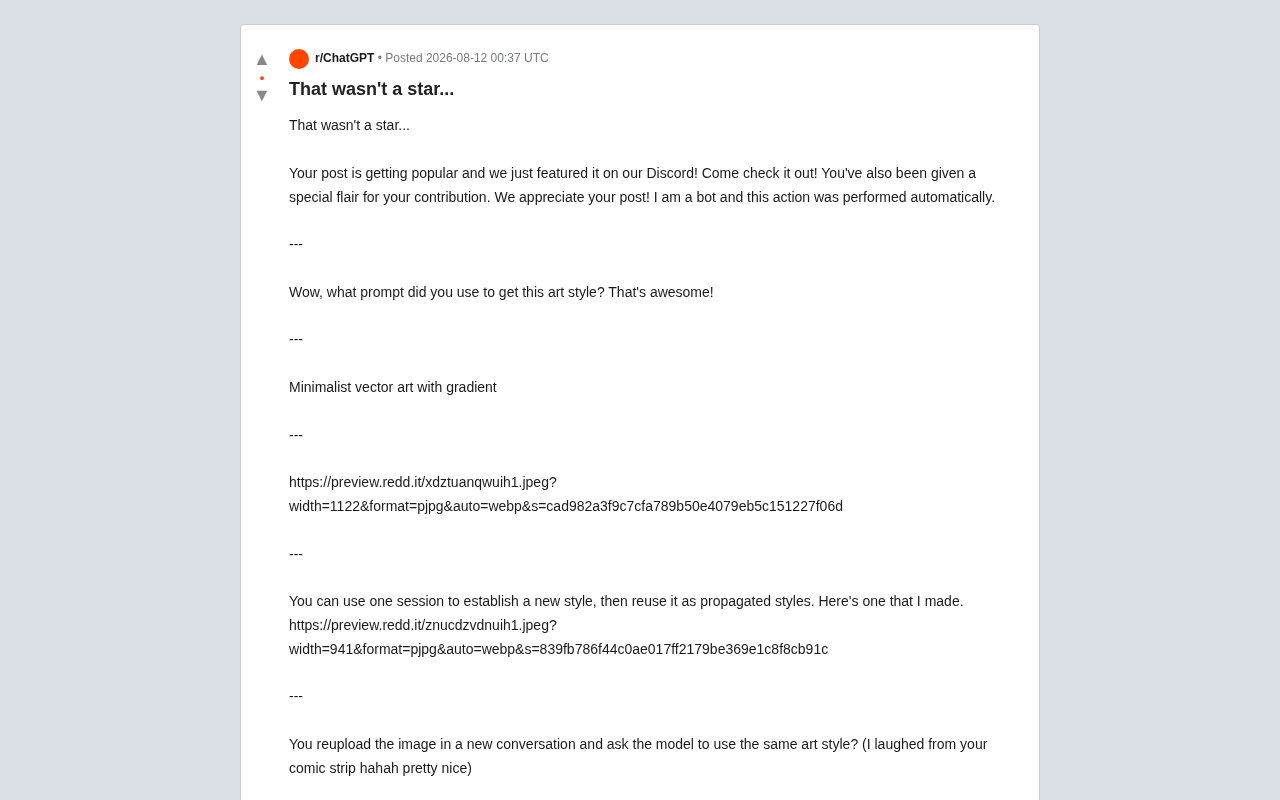
Interestingly, the discussion beneath this post didn't stop at "this looks great." It quickly evolved into a hands-on technical exchange about AI art workflows. The audience had one burning question: How do you consistently reproduce a unified art style?
Core Technique: Establishing and Propagating AI Art Styles
When someone asked "what prompt did you use to get this style," the original creator gave a straightforward answer:
Minimalist vector art with gradient
This style has deep roots in design history. Minimalist Vector Art is a visual style characterized by geometric shapes, clean lines, and limited color palettes, tracing back to the Bauhaus design movement and the Swiss International Typographic Style. Vector graphics are described by mathematical equations rather than pixels, making them inherently scalable without quality loss. When gradient effects are added, the artwork gains soft depth and subtle lighting while maintaining its simplicity—modern yet approachable. In AI art, such styles are actually easier for models to reproduce consistently than complex photorealistic ones, precisely because the rules are clear and visual elements are limited.
But the real value was hidden in the follow-up discussion. The original creator revealed a key workflow concept—establishing and propagating a style:
"You can use one session to establish a new style, and then use it as a propagation style for reuse."
This statement highlights a core feature of current mainstream AI image generation tools (such as GPT-4o image generation and other models with multi-turn conversation capabilities): styles can be transferred across sessions.
How Exactly Does It Work?
In the discussion, users gradually clarified two paths for this style reuse method:
Path One: Image Re-upload Method
The most direct approach is to re-upload a previously generated image in a new conversation, then ask the model to "follow the same art style." One user described their routine workflow:
"I usually start a new conversation by uploading an image and then instructing the model to modify it in a specific way."
The original creator's response: this approach "is pretty much the same thing, uploading works fine."
Path Two: Starting a Conversation Based on an Image
The original creator also mentioned a slightly different entry point:
"Under image features, you can also start an entirely new conversation based on an image."
The distinction here is subtle. The core logic is the same: First, use one session to tune the style you want. Once you're satisfied, take that style to another session for batch content production.
Why Does This Style Reuse Method Work?
From a technical perspective, this "train first, reuse later" workflow essentially leverages the visual understanding capabilities of multimodal large models as a style anchor.
Multimodal large models (like GPT-4o, Gemini, etc.) can extract style features from images thanks to how their Vision Encoders work. These models typically use architectures similar to CLIP or ViT (Vision Transformer), splitting input images into patches, then extracting multi-level visual representations through self-attention mechanisms—from low-level colors, textures, and edges to high-level composition, style, and semantics. These representations are mapped into a semantic space shared with text, enabling the model to simultaneously understand both "what this image depicts" and "how this image is rendered." This dual understanding capability is the technical foundation that makes style transfer possible in conversational settings.
When you upload a finished artwork, the model doesn't just read the semantic content—it also extracts visual features including color schemes, line treatment, gradient methods, and compositional habits. Together, these constitute what we call "art style." Compared to purely textual descriptions (a prompt like "minimalist vector gradient" is actually quite vague), a reference image provides far more precise style constraints than words ever could.
This also explains how the original creator maintained such high style consistency across the entire comic series—rather than starting from scratch each time and hoping the prompt would land, they first solidified a "style template" and then aligned every subsequent image to that template.
Comparison with Professional AI Art Workflows
It's worth noting that this "style reuse" approach has more systematic implementations in professional AI art tools:
-
Reference Images/Style Transfer: Midjourney's
--sref(Style Reference) parameter and various models' Image Prompt features are productized versions of the same logic. Midjourney's --sref parameter, introduced in V6, allows users to provide one or more reference images as style anchors. The system extracts feature vectors for style dimensions including color tendencies, brush textures, lighting treatment, and overall atmosphere from the reference images, using them as additional conditional constraints during generation. Users can also adjust the influence strength via the --sw (Style Weight) parameter, ranging from 0 to 1000 with a default of 100. This parameterized style control is more precise and quantifiable than conversational workflows, but requires some parameter tuning experience. -
LoRA Fine-tuning: In the Stable Diffusion ecosystem, users can train custom style LoRAs for more thorough and stable style locking. LoRA (Low-Rank Adaptation) is a parameter-efficient fine-tuning technique proposed by Microsoft Research in 2021. Its core idea: rather than modifying the pretrained model's original weights, it inserts low-rank decomposition matrices (typically with rank values of 4-128) into the model's attention layers, training only these newly added parameters. In the Stable Diffusion ecosystem, a style LoRA file is typically only a few MB to tens of MB in size, yet can lock the model's output to a specific art style. Users need only prepare 20-50 style-consistent reference images and train for anywhere from minutes to hours to obtain a custom style model. Compared to conversational style reuse, LoRA offers far superior stability and precision in style locking, but at the cost of requiring GPU compute, data preparation, and a certain technical threshold.
By comparison, the conversational workflow discussed in this Reddit thread has one major advantage: an extremely low barrier to entry—no model training required, no complex parameters to memorize, just the ability to upload images and type descriptions. For everyday creators, this is more than sufficient for continuous creative work.
Insights: From Single Images to Serialized Production
What makes this post worth paying attention to isn't how stunning the comic itself is, but the trend it reflects: AI creation is evolving from "generating single images" to "serialized, stylized production."
In the early days of AI art, people sought the "surprise factor"—every generation was like opening a mystery box. But when creators start making comics, illustration series, or brand visuals, "controllability" and "consistency" become non-negotiable requirements. The simple workflow the original poster developed is exactly the kind of grassroots response to this demand.
Here are some practical takeaways:
- Invest time in polishing a satisfying "master image" as your style benchmark.
- Upload the master image in new conversations, explicitly asking the model to follow its art style.
- Focus your prompts on content changes (what to draw), and let the reference image handle style locking.
- If style drift occurs, recalibrate promptly with a fresh reference image.
Regarding point four, Style Drift is a common issue in continuous AI generation, where the model gradually deviates from the initially established style direction after multiple generations. The root cause is that each generation introduces random sampling noise, and the model's understanding of style is probabilistic rather than deterministic. In conversational generation, context window length limitations can also cause early style information to be gradually "diluted." Calibration strategies include: periodically re-uploading the original style reference image, repeatedly emphasizing key style features in prompts, and splitting long sessions into multiple short ones to avoid context degradation. Professional creators typically maintain a "style reference library" containing 3-5 samples that best represent the target style, ready to deploy whenever drift is detected.
From a meteor-shower-themed kawaii comic to a reusable AI art workflow—this is exactly where open communities shine. The most practical tips are often hidden in the back-and-forth of the comments section.
Related articles

Chain of Thought Isn't Just for AI: How Humans Can Use CoT to Improve Thinking Quality
Chain of Thought isn't just a prompt trick for large models. Starting from a Hacker News discussion, this article analyzes why CoT works for human thinking too, breaks down actionable ways to transfer it, and highlights the key differences between human CoT and machine CoT.
Cloudflare Teams Up with OpenAI: Closi…
Cloudflare Teams Up with OpenAI: Closing the Loop from Vulnerability Discovery to Defense with AI
Cloudflare uses OpenAI Daybreak to investigate security vulnerabilities and generate reviewable remediation plans, while developers use Codex to boost coding efficiency and quality.

Orca Multi-Agent Orchestration in Practice: A Guide to Parallel Collaboration with Claude and Codex
Orca is Stable AI's free open-source agent workbench supporting 34 agents like Claude Code and Codex in parallel. Learn its Git worktree isolation, multi-model orchestration, and mobile management.