AI Assistants Enter the "Phone Call" Era: Instinct and Meta Muse Add Voice Task Execution
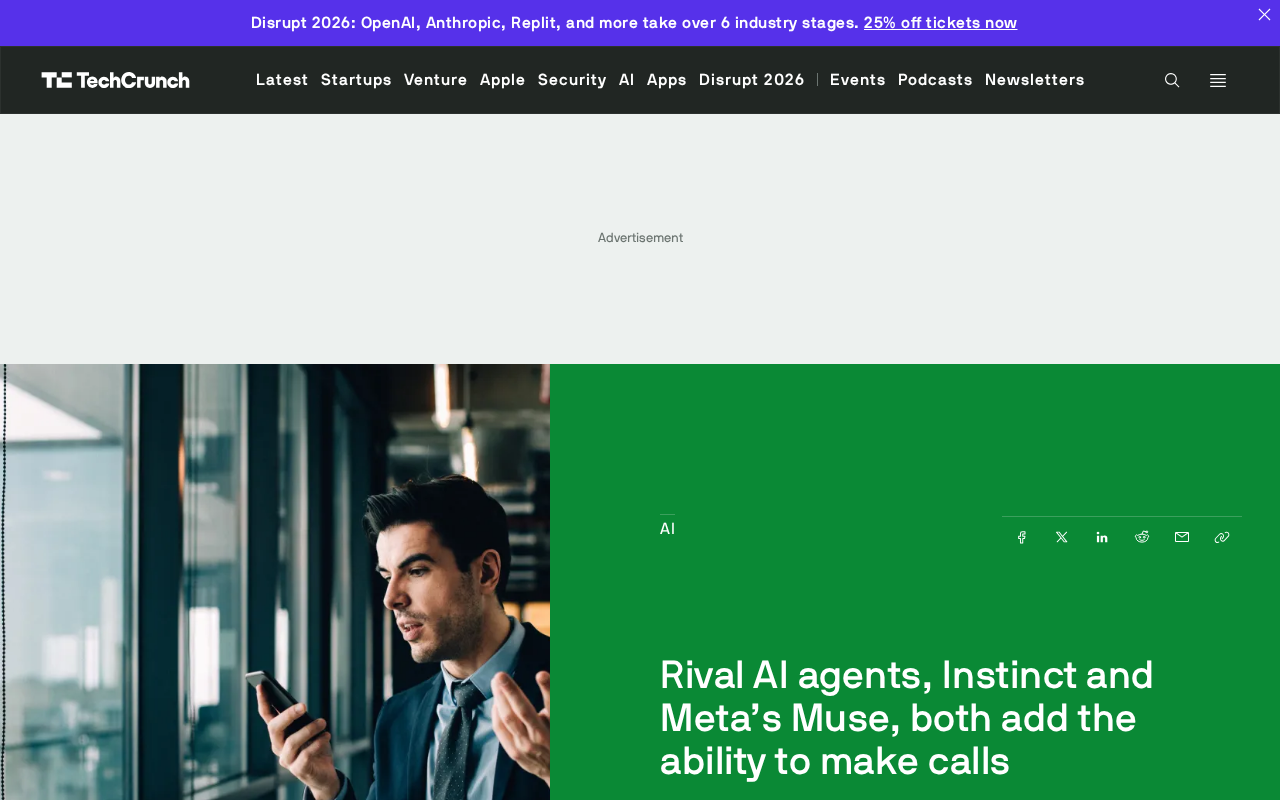
Instinct and Meta Muse launch phone-calling features, signaling AI's shift from chatbots to real-world task executors.
Two competing AI assistants — Instinct and Meta's Muse — have simultaneously launched the ability to make phone calls on users' behalf, handling tasks like restaurant reservations and subscription cancellations that require real voice communication. This marks a critical step from text-based AI tools toward agentic AI capable of closed-loop task execution in dynamic, real-world scenarios. Their synchronized launch signals the technology is approaching commercial viability, while challenges around voice accuracy, complex dialogue handling, and legal accountability will determine how broadly users come to trust and adopt these features.
Two competing AI agents — Instinct and Meta's Muse — have rolled out a major new capability in near-perfect sync: making phone calls on behalf of users. This marks a pivotal shift for AI assistants, moving from "helping you look things up and write content" toward "actually getting real-world tasks done for you."
AI Agents Start Taking Over Phone Tasks
According to initial reports, users can now rely on either assistant to handle everyday tasks like reserving a restaurant table or canceling a subscription service. What these tasks have in common is that they often require a real phone conversation — not just a few clicks on a webpage or filling out a form.
Restaurant reservations and subscription cancellations may seem trivial, but they're exactly the kind of tasks people tend to put off. Canceling a subscription is a particularly telling example: many service providers deliberately make the process cumbersome, requiring users to call customer support and endure long wait times and retention scripts. Having an AI handle this kind of task hits a genuine pain point.
From "Conversation" to "Action": A Fundamental Capability Leap
Over the past two years, mainstream AI assistants have focused primarily on text-based dialogue, content generation, and information retrieval. Making phone calls represents something fundamentally different: the AI must engage in real-time voice interaction, interpret the other party's responses on the fly, and complete a defined goal within a dynamic, unpredictable conversation.
The value of this kind of "agentic AI" lies in closed-loop execution. Rather than simply offering suggestions, it actually gets things done. The fact that both Instinct and Meta Muse are simultaneously pushing in this direction signals that the industry now views "can it complete real-world tasks?" as the defining battleground for the next generation of AI agents.
Agentic AI is one of the core frontiers in current AI research and productization. Unlike traditional conversational AI, Agentic AI can autonomously plan multi-step tasks, invoke external tools (such as phone calls, browsers, and APIs), and dynamically adjust its strategy based on real-time feedback during execution. The phone call scenario is particularly complex for Agentic AI: it demands a combination of speech synthesis and recognition, natural language understanding, intent tracking, and exception handling (e.g., when the other party asks an unexpected question or transfers to a human agent) — all performed in real time within an unpredictable live conversation. This is fundamentally different from clicking buttons or filling out forms in a structured interface, where the state space is finite and predefinable. A phone conversation, by contrast, is essentially open-ended. For this reason, "can it complete a real phone call?" is widely regarded as an important milestone in measuring the maturity of an agentic system.
Two Rivals Go Head-to-Head
Notably, Instinct and Meta's Muse are explicitly positioned as rivals, and they launched nearly identical capabilities at nearly the same time. This kind of synchronized timing often signals that a particular technical direction has matured to the point where commercial deployment is viable.
As a tech giant, Meta's Muse — if it successfully rolls out phone-calling features at scale — can rapidly reach a massive range of use cases by leveraging its enormous user base. Instinct, as the challenger, may seek differentiation through a more focused and specialized experience. Their head-to-head competition suggests that the AI voice task execution space is about to heat up significantly.
Real-World Considerations Behind the Convenience
Despite the promising outlook, AI-powered phone calls still face considerable practical challenges. Speech recognition accuracy, the ability to handle complex conversations, and the quality of interaction when the other party is a human agent will all directly affect task success rates. Additionally, allowing AI to conduct commercial transactions or execute cancellation requests on a user's behalf raises important questions around authorization, privacy, and accountability.
For everyday users, whether this feature truly saves hassle depends entirely on how reliably it performs in real-world scenarios. If an AI misunderstands something during a reservation or cancellation, it could end up creating more problems than it solves. The actual user experience and the trust it earns will be central to determining whether this capability sees widespread adoption.
Authorization and accountability represent a significant legal and ethical gray area for AI-powered phone calls. When an AI reaches a verbal agreement on a user's behalf (such as confirming a reservation) or takes an action (such as canceling a paid subscription), it remains unclear under existing regulatory frameworks whether such acts carry the same legal weight as the user's own expressed intent. Furthermore, some jurisdictions have disclosure requirements for undisclosed AI voice interactions — meaning the AI must proactively identify itself as a bot, or it may run afoul of consumer protection regulations (such as relevant rules from the U.S. Federal Trade Commission). Privacy is also a concern: during a call, the AI may be exposed to the user's account information and personal identity data, and the storage and use of call content must be governed by transparent privacy policies. These real-world constraints will directly affect how quickly and compliantly this type of feature can be deployed across different markets.
Conclusion
The addition of phone-calling capabilities to Instinct and Meta Muse is a snapshot of a broader evolution: AI assistants transitioning from "information tools" to "task executors." As AI begins to genuinely interact with the real world on our behalf, the balance between convenience and reliability will become the defining measure of success for these products. The race around agentic AI is only just getting started.
Related articles

Neovim Reportedly Has ~$800K in Bitcoin Donations Sitting Untouched
A Neovim user discovered ~$800K in Bitcoin sitting untouched in the project's donation wallet since 2023, sparking debate about open-source crypto fund governance.
TechCrunch Disrupt 2026 Volunteer Applications Closing Soon
TechCrunch Disrupt 2026 volunteer applications are closing soon. Apply now through official channels for a chance to access one of tech's most influential startup conferences.
REVERSAL-BENCH: A Reversibility Benchmark for Reset-Free Reinforcement Learning
REVERSAL-BENCH introduces a continuous reversibility parameter ρ and a reset oracle to benchmark reset-free RL across five physics engines and eight manipulation settings, exposing the reset-free RL cliff.