AI-Assisted Creative Production: Building an Interactive Odyssey Narrative Scroll with Astra
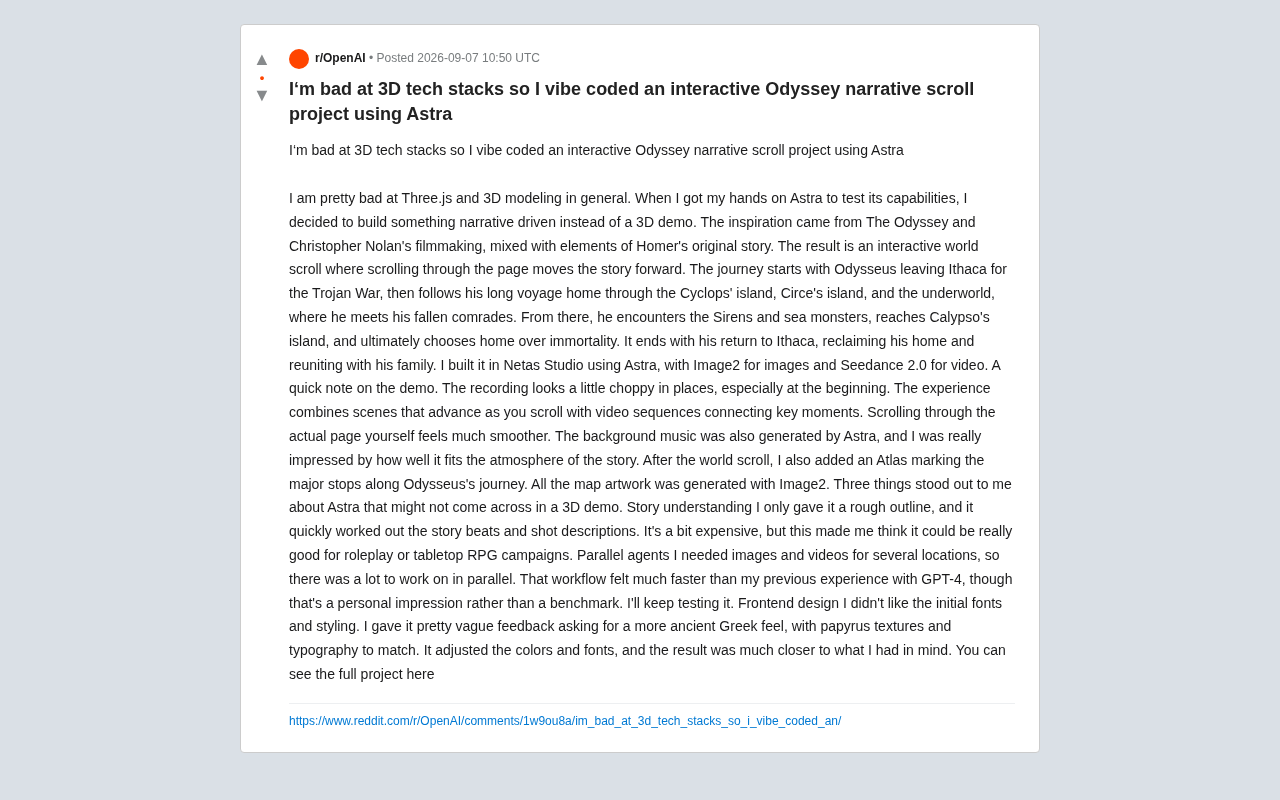
AI tools like Astra enable non-specialists to create complex interactive narratives by bridging technical gaps.
A developer lacking 3D expertise built an interactive Odyssey scroll using Astra AI within Netas Studio. The project combined Image2-generated scenes, Seedance videos, and AI-composed music through scroll-triggered interactions. Astra excelled at story comprehension, parallel task execution, and translating vague design feedback into polished results—demonstrating how AI lowers creative barriers.
From Technical Weakness to Creative Breakthrough
A developer who admits to being "weak in 3D tech stack" completed an interactive Odyssey narrative scroll project with the help of Astra, an AI tool. This case clearly demonstrates how AI helps non-specialists overcome technical barriers and rapidly transform creative ideas into interactive digital works.
The author openly acknowledges their lack of proficiency in Three.js and 3D modeling. Three.js is a WebGL-based JavaScript 3D graphics library created by Ricardo Cabello in 2010. It wraps the complex underlying WebGL API, allowing developers to create 3D scenes, models, and animations in browsers with more concise code. Three.js includes complete functional modules for scene management, camera controls, lighting systems, material rendering, and more, making it the de facto standard tool for web-based 3D visualization. However, its steep learning curve requires mastering 3D mathematics (matrix transformations, vector operations), rendering pipeline principles, and performance optimization techniques—presenting a significant barrier for developers without a graphics background.
But after gaining access to Astra's testing program, he chose a narrative-driven direction rather than a technical showcase. The project drew inspiration from Homer's epic The Odyssey and Christopher Nolan's cinematic storytelling style, ultimately manifesting as a "world scroll"—users scroll the page, and the story advances accordingly.
Technical Implementation and AI Tool Combination
The entire project was completed in the Netas Studio environment. Netas Studio is a next-generation AI-native development environment that integrates code editing, live preview, AI assistance, and multimodal resource management. Unlike traditional IDEs that require manual build toolchain configuration, Netas Studio provides an out-of-the-box web development environment supporting mainstream frameworks like React and Vue. Its core feature is deeply integrated AI capabilities: developers can describe requirements in natural language, and the AI assistant directly generates or modifies code; it supports AI generation and management of multimedia resources like images and videos; and provides intelligent debugging and performance analysis tools. This environment is particularly suited for rapid prototyping and creative experimentation scenarios.
The project employed multiple AI tools working in coordination:
- Astra: Core AI assistant, responsible for story comprehension, scene design, and code generation
- Image2: Generates static scene images, including all map illustrations
- Seedance 2.0: Creates video clips connecting key moments
The project uses scroll-triggered mechanisms to seamlessly combine static scenes with video sequences. Scroll-triggered interaction is a core technical pattern in modern web storytelling, dynamically changing visual elements by monitoring page scroll events. Technical implementation typically relies on the Intersection Observer API or scroll event listeners, calculating the position percentage of elements within the viewport and using this to control animation progress, opacity changes, or scene transitions. This mechanism is widely used in brand websites, data visualization reports, and interactive stories. Implementation challenges include performance optimization (avoiding frequent repaints), easing function design (ensuring smooth, natural animations), and multi-scene state management. Scroll narratives can transform linear reading into immersive exploration experiences, with users' physical actions directly mapping to story progression.
The story begins with Odysseus leaving Ithaca to join the Trojan War, traveling through the Cyclops' island, Circe's island, the underworld (encountering fallen comrades), the Sirens, sea monsters, Calypso's island (choosing home over immortality), and finally returning to Ithaca to reclaim his homeland.
Notably, the project's background music was also generated by Astra, which the author believes fits the story's atmosphere perfectly. Additionally, the project includes a map marking the main stops of Odysseus's journey.
Three Key Advantages of Astra
Through practice, the author identified three outstanding capabilities of Astra. These capabilities, often difficult to perceive in traditional 3D demonstrations, shine particularly bright in narrative creation scenarios.
Story Comprehension Ability
With just a rough outline, Astra can quickly organize story beats and shot descriptions. While usage costs are relatively high, the author believes this feature is especially suited for generating content for role-playing games or tabletop RPG campaigns.
Parallel Agent Workflow
The project required generating images and videos for multiple locations, involving numerous parallel tasks. AI agent parallel workflow refers to systems simultaneously dispatching multiple independent tasks to different AI instances for execution, rather than serially waiting for each task to complete. In this project, when generating visual assets for multiple locations in The Odyssey (Cyclops' island, Circe's island, the underworld, etc.), traditional workflows require submitting prompts one by one, waiting for generation, and downloading results. Parallel workflows launch multiple generation tasks simultaneously, with the system intelligently allocating computing resources and ultimately aggregating all results. This depends on backend task queue management, load balancing, and result aggregation mechanisms. For users, generating 10 scenes takes approximately the same time as a single scene, rather than accumulating linearly—crucial for projects requiring mass resource generation.
The author states this workflow felt much faster than previous experiences with GPT-4, though this is more a personal impression than strict benchmark results.
Frontend Design Iteration
When the initial fonts and styles didn't meet expectations, the author provided quite vague feedback—requesting "a more ancient Greek feel, with papyrus texture and matching fonts." Traditional UI design iteration requires designers to understand requirements, draw prototypes, developers to implement code, then modify based on feedback—a long cycle prone to comprehension gaps. AI-driven design iteration allows users to describe abstract requirements in natural language, with AI converting them into specific design parameters through semantic understanding: selecting serif fonts like Trajan or Cinzel, applying beige tones and paper textures, adjusting typographic spacing to simulate ancient manuscript styles. This capability stems from large language models learning associations between design principles and visual styles during training.
Astra adjusted colors and fonts accordingly, with results very close to expectations, demonstrating AI's ability to understand abstract aesthetic requirements. The key advantage is reduced design communication costs—non-specialists can obtain professional-grade visual effects through intuitive descriptions, accelerating the iteration cycle from concept to finished product.
Four Insights from AI-Assisted Creation
This project reveals new possibilities for AI tools in creative fields:
- Lowering Technical Barriers: Complex scroll-based interactive experiences can be achieved without mastering 3D tech stacks
- Transforming Vague Expression into Precise Implementation: AI can convert abstract aesthetic requirements into concrete visual designs
- Multimodal Collaborative Generation: Multimodal AI collaboration refers to different types of AI models (text generation, image synthesis, video production, audio creation) cooperating within a unified workflow to complete complex tasks. In traditional creative processes, these stages require switching between different tools and manual integration. Next-generation AI platforms enable models across modalities to generate content based on the same narrative thread by sharing context and semantic understanding. For example, Astra guides Image2 to generate scenes fitting the plot based on story outlines, then has Seedance create transition videos connecting these scenes, with background music also generated based on the same emotional tone. This collaboration avoids stylistic fragmentation and dramatically improves creative efficiency. Creating text, images, video, and music within a unified framework becomes possible.
- Rapid Prototype Validation: The cycle from concept to demonstrable prototype is dramatically shortened
The author specifically notes that screen recordings appear somewhat choppy in places (especially at the beginning), but the actual scrolling experience is much smoother. This experience gap reminds us that AI-generated interactive works need evaluation in real environments, not just based on demo videos.
Future Direction: From "Learn Tech First" to "Have Ideas First"
While the author will continue testing Astra's performance boundaries, this project has already proven a trend: when AI tools have sufficient "comprehension," creators can focus on narrative and experience design while delegating technical implementation to AI. This division of labor is reshaping the workflow of digital content creation—from "learn technology then do projects" to "have ideas first, learn as you go."
For developers hoping to try AI-assisted creation, this case offers three practical suggestions: choose narrative-driven project types, fully leverage AI's parallel processing capabilities, and iterate designs through natural language feedback. Technical shortcomings are no longer obstacles to creative realization—the key lies in how to collaborate effectively with AI tools.
Key Takeaways
Related articles
Prequel Review: Cinema-Quality Screen Recorder for Mac with Auto-Zoom and 4K Export
In-depth review of Prequel, a macOS screen recording tool with intelligent auto-zoom, 4K export, and background enhancement. Compare with Screen Studio and analyze its strengths.
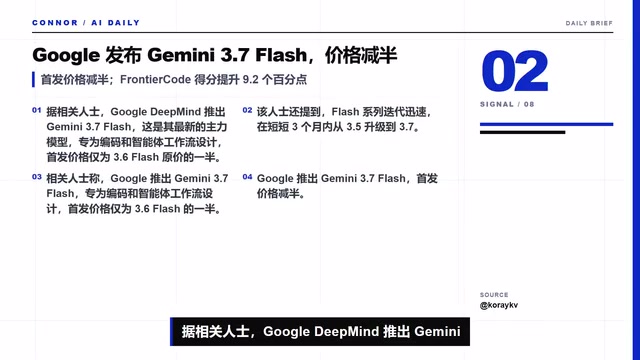
AI Daily: The Speed War and Cost War Are in Full Swing
OpenAI GPT 5.6 UltraFast mode delivers 14x faster inference, Gemini 3.7 Flash slashes prices while boosting performance, MOE architecture gains traction, HBF storage breakthrough—AI industry competition shifts from model capability to speed and cost efficiency dual-front battle.
Internet Archive Fundraising Crisis: Server Operations Challenge Behind 800 Billion Archived Web Pages
The Internet Archive faces server operations funding pressure with 800 billion archived pages. Analysis of Wayback Machine cost challenges, nonprofit digital preservation survival crisis, and sustainable development paths.