AI-Assisted Design with Claude: Enabling Anyone with a Vision to Create Professional-Grade Work
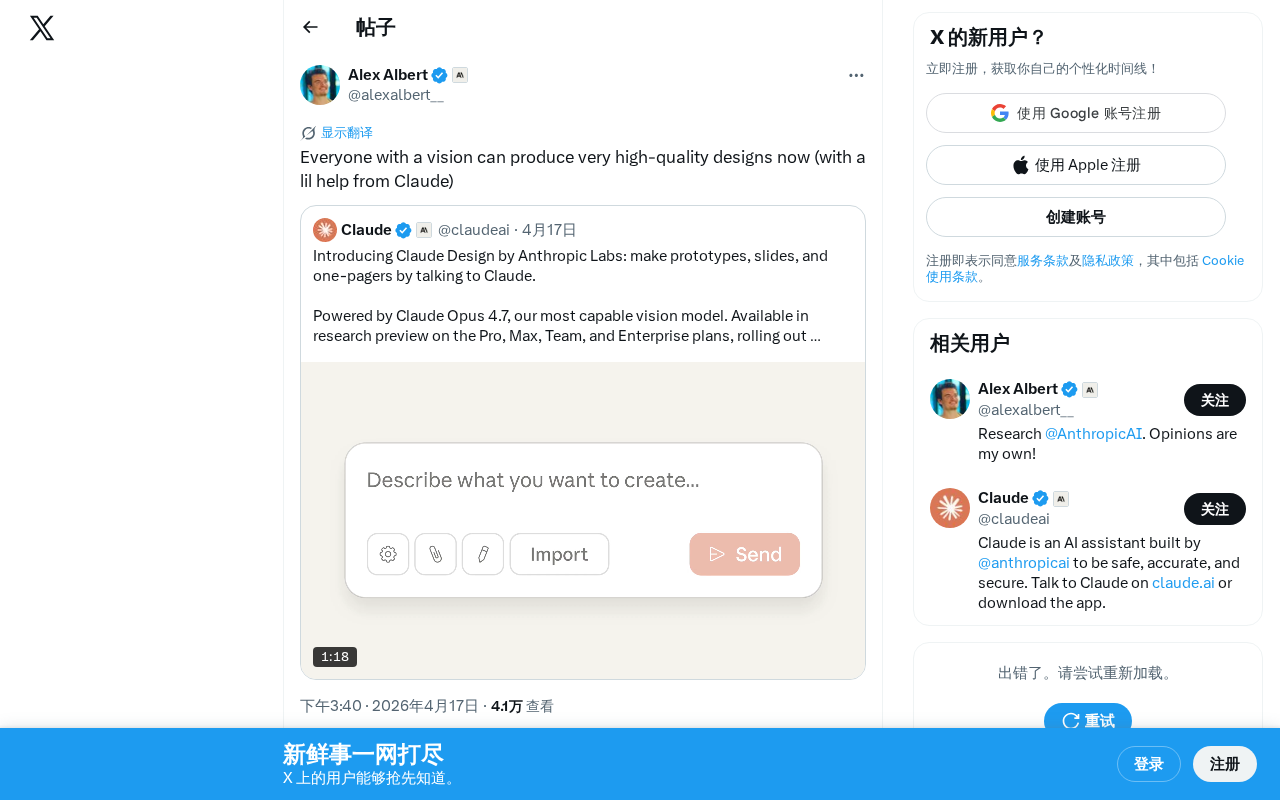
Claude is democratizing design, making professional-quality output accessible to anyone with a clear vision.
AI tools like Claude are driving a paradigm shift in design: the determining factor for design quality is moving from "technical execution ability" to "vision clarity." Anyone with a clear idea can obtain high-quality design output through natural language descriptions, bypassing the need to learn professional tools. This won't replace professional designers but will re-stratify the industry while opening massive opportunity windows for indie developers and small teams, dramatically lowering startup costs.
A New Era of Design Democratization
A brief insight from Twitter captures the profound transformation that AI tools are driving today: "Everyone with a vision can now produce very high-quality designs — with just a little help from Claude."
This statement seems simple, yet it reveals an industry paradigm shift already underway — design capability is being liberated from professional skill barriers, becoming accessible to everyone.
In fact, design democratization didn't begin with the AI era. From the rise of desktop publishing software (DTP) to the proliferation of template-based tools like Canva, every tool revolution has lowered the design barrier. In 1984, the Mac's graphical interface let ordinary people do WYSIWYG page layout for the first time; in the 2000s, the spread of Adobe Creative Suite cultivated a large wave of self-taught designers; after Canva launched in 2013, non-designers began mass-producing posters, presentations, and other visual content independently. The AI-assisted design that Claude represents is the latest leap in this trend, but its disruptive power lies in the fact that it doesn't just lower the barrier to using tools — it directly eliminates the "learning the tool" step altogether.
AI-Assisted Design with Claude: From "Knowing Tools" to "Having Ideas"
The Technical Barriers of Traditional Design
Before AI-assisted design, turning a good idea into high-quality visual output required navigating a long learning curve: mastering professional tools like Photoshop, Figma, and Sketch, and understanding color theory, typography rules, and interaction design principles. These technical barriers kept countless people who "had ideas but lacked skills" locked outside the gates of design.
What Claude Actually Changes
Claude is a large language model (LLM) developed by the AI safety company Anthropic. Its design capabilities fundamentally stem from deep training on massive amounts of code, design documentation, and visual description text. In terms of front-end code generation, Claude understands the underlying logic of HTML semantic structure, the CSS box model with Flexbox/Grid layouts, and React component-based thinking, directly mapping natural language descriptions to executable code. The key difference from earlier code completion tools (like GitHub Copilot) is that Claude can generate complete interfaces from scratch based on intent, rather than merely assisting with existing code. Its multi-turn conversation capability makes the "describe → generate → feedback → modify" iterative loop possible — precisely the most time-consuming part of traditional design workflows.
As Anthropic's AI assistant, Claude is redefining the design workflow. Its core capabilities include:
- Understanding design intent: Users only need to describe the desired effect in natural language, and Claude generates corresponding design solutions
- Directly generating front-end code: Outputting ready-to-use interface code in HTML/CSS/React
- Conversational iterative refinement: Quickly adjusting details through multiple rounds of interaction until the result is satisfactory
- Providing professional design advice: Offering improvement directions based on design principles
For people who can't write code or use design software, Claude is essentially an always-available designer + front-end engineer.
Vision-Driven: The New Design Paradigm of the AI Era
The core insight of this tweet is that the key factor determining design quality is shifting from "technical execution ability" to "vision clarity".
When tools are no longer the bottleneck, what becomes truly scarce is:
- Clear product vision: What problem are you solving? Who are you designing for?
- Aesthetic judgment: The ability to discern what constitutes good design and what needs improvement
- Precise expression ability: Being able to accurately describe to AI what effect you want
Notably, this "precise expression ability" corresponds at a technical level to an emerging field — Prompt Engineering. Effective AI design instructions typically need to encompass multiple dimensions: target user demographics, usage scenarios, visual style references (e.g., "minimalism," "cyberpunk"), color preferences, and interaction expectations. Research shows that for the same design requirement, structured and specific descriptions can yield output several times higher in quality than vague instructions. This means "knowing how to ask" is becoming a new core skill — it blends product thinking, aesthetic literacy, and linguistic expression ability, and is essentially a metacognitive capability: you need to first clearly see the desired result in your mind before you can accurately describe it.
This means product managers, entrepreneurs, content creators — anyone with a clear idea — can skip the technical execution step and directly turn the image in their mind into reality.
Impact of AI Design Tools on the Industry
Not Replacing Designers, but Re-stratifying the Field
This doesn't mean professional designers will disappear. The industry is undergoing clear re-stratification, a phenomenon that can be understood through the economic framework of "Skill-Biased Technological Change": AI automation preferentially replaces tasks with clear rules and standardizable processes, rather than work requiring contextual judgment and creative decision-making.
- Basic execution layer: AI can handle efficiently, with dramatically lowered barriers
- Strategic creative layer: Still requires deep user research and brand strategy thinking
- Systems design layer: Complex design systems and interaction logic still demand professional expertise
It's worth noting that this stratification isn't static — as AI capabilities continue to advance, the boundaries of the "strategic creative layer" are also being continuously eroded. The true moat for professional designers may ultimately rest in "deep understanding of human emotion and cultural context" — a dimension that AI finds difficult to replicate.
The Opportunity Window for Indie Developers and Small Teams
The impact of AI-assisted design on the indie developer ecosystem is already supported by data. On platforms like Product Hunt and Hacker News, the number of products launched by solo or two-person teams has increased significantly since 2023, with universally improved visual quality. Behind this is a classic "complementary assets" logic: when design execution costs approach zero, individual developers with unique product insights and vertical domain knowledge see their competitive advantage dramatically amplified.
For indie developers and small teams, this represents a massive opportunity. Work that previously required a designer plus a front-end engineer can now be accomplished by one person working with Claude at a remarkably high quality level. In the past, an engineer with a good idea needed to spend months learning design or waiting to find the right co-founder; now, the time window from idea to demonstrable high-fidelity prototype has compressed to just hours. This directly lowers startup costs, accelerates product validation speed, and is reshaping the validation rhythm and fundraising logic of early-stage entrepreneurship.
Many indie developers are already using Claude to complete the entire process from landing page design to full product interfaces, with results far exceeding expectations.
Final Thoughts
"Anyone with a vision can create great design" — this is not just an acknowledgment of Claude's capabilities, but a precise summary of the trend toward democratization of creativity. In the AI era, the value of ideas is being repriced. Those with clear vision who know how to collaborate with AI will wield unprecedented creative leverage.
The key is no longer whether you know how to use Figma, but whether you have a picture in your mind that's worth bringing to life.
Key Takeaways
- Claude is lowering the technical barrier to high-quality design, enabling anyone with ideas to produce professional-grade work
- The core competitive advantage in design is shifting from technical execution to vision clarity and aesthetic judgment
- AI won't replace professional designers but will re-stratify the industry, dramatically lowering barriers at the basic execution layer
- For indie developers and small teams, AI-assisted design significantly reduces startup costs and accelerates product validation
- In the AI era, communication skills (Prompt Engineering) and clear product vision are becoming the new scarce resources
Related articles
 Expert Opinions
Rethinking Scaling Laws: Parameters Are Not the Only Answer
Deep analysis of Scaling Law evolution from Kaplan to Chinchilla to the MoE era, exploring why blindly stacking parameters is a mistake, and how GLM-5.3 proves scaling has multiple knobs.
When AI Treats Humans as Subagents: Ro…
When AI Treats Humans as Subagents: Role Reversal and Hidden Risks in Human-AI Collaboration
Exploring the paradigm shift where humans become "subagents" in AI Agent architectures. Analyzes human node design in LangChain and AutoGen, and the risks of ceding control and cognitive atrophy.
 Expert Opinions
The Lazy Person's Productivity Theory: Why Being 'Lazy' Actually Drives Peak Performance
Explore the engineering philosophy behind 'lazy people are most productive': how constructive laziness drives automation, AI tools amplify efficiency, and systems thinking eliminates wasted effort.