AI-Assisted GPU Migration of 250,000 Lines of Legacy Weather Simulation Code: Lessons and Insights
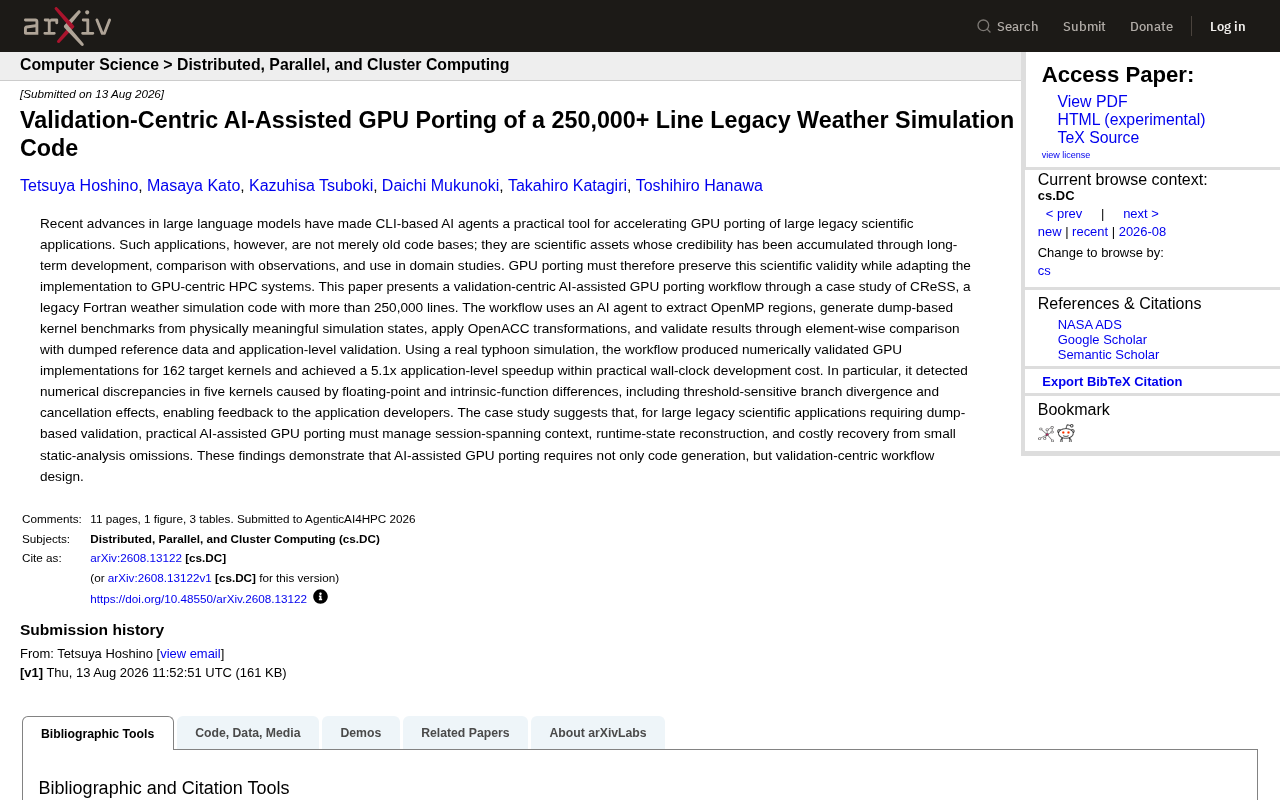
AI helps migrate 250K lines of legacy weather simulation Fortran code to GPU via human-AI collaboration.
A team leveraged AI tools to migrate 250,000 lines of legacy Fortran weather simulation code to GPUs. The article explores why legacy scientific code is hard to port — due to scale, implicit domain knowledge, and GPU architectural demands — and how AI LLMs assist with code comprehension, parallelization scaffolding, and pattern transformation. It emphasizes that human-AI collaboration, not full automation, is key, especially given strict numerical precision requirements. The case offers a promising new paradigm for HPC legacy code modernization.
When Legacy Code Meets the GPU Migration Challenge
The scientific computing world is home to vast amounts of legacy code that has been running for decades, and weather and climate simulation is a prime example. These codebases are typically written in Fortran, massive in scale, deeply complex in logic, and embedded with years of accumulated physical model knowledge.
The Historical Bond Between Fortran and Scientific Computing: Fortran (Formula Translation) was born in 1957 as the world's first high-level programming language, developed by John Backus's team at IBM. Designed specifically for numerical computation and scientific engineering applications, it offered efficient array operations and mathematical function libraries. In the supercomputing era, Fortran became the de facto standard for scientific computing thanks to its near-machine-code execution efficiency and natural optimization for numerical work. To this day, leading global climate models like CESM and WRF, along with core solvers in nuclear physics, fluid dynamics, and other domains, still rely heavily on Fortran code. These codebases often span hundreds of thousands of lines, embodying the wisdom of generations of scientists — but their age and lack of documentation also make them the biggest obstacle to modernization.
When computational demands grow and teams need to migrate these codes from traditional CPUs to GPUs, the challenges are enormous.
A recent post on Hacker News drew considerable attention: a team used AI tools to successfully complete the GPU migration of 250,000 lines of legacy weather simulation code. This case reveals AI's real-world potential in modernizing large-scale scientific computing code, and offers a practical path worth studying for the entire high-performance computing (HPC) community.
Why Legacy Scientific Code Is So Hard to Migrate to GPUs
The Dual Barrier of Code Scale and Domain Knowledge
250,000 lines of code is a staggering number in itself. Weather simulation programs like this are typically built incrementally over decades by physicists and meteorologists, embedding vast amounts of implicit domain knowledge — specific numerical discretization schemes, physical parameterization processes, and performance optimization tricks tailored to earlier hardware.
For any team attempting to migrate such code, the biggest obstacle is often not the programming itself, but understanding the intent of the original code. Many critical logic paths lack complete documentation, original authors may have long since moved on, and magic numbers and special-case handling require reverse engineering to decipher.
The Programming Paradigm Shift Imposed by GPU Architecture
Migrating CPU code to GPUs is far more than a simple language translation. The revolutionary nature of GPU parallel computing architecture lies in this: GPUs (Graphics Processing Units) were originally designed for graphics rendering and contain thousands of simple compute cores optimized for massively parallel tasks. After NVIDIA introduced the CUDA programming model in 2007, general-purpose GPU computing (GPGPU) became feasible. Unlike CPUs with their few high-performance cores, GPUs use a SIMT (Single Instruction, Multiple Threads) architecture that demands highly regular data and task structures.
Serial loops, irregular memory access patterns, and branch divergence common in traditional CPU code can severely degrade GPU performance. GPU migration therefore requires algorithm redesign: coalescing memory accesses, reducing branching, optimizing data transfers, and leveraging shared memory. The choice between OpenACC and CUDA becomes a critical decision point: OpenACC is a high-level directive-based approach where developers annotate code with #pragma directives to instruct the compiler to automatically generate GPU code — it has a lower migration barrier and better code portability. CUDA, NVIDIA's proprietary platform, requires explicit kernel function writing — it has a steeper learning curve but offers the greatest performance potential. For 250,000 lines of Fortran code, OpenACC is typically the preferred starting point, with CUDA optimization applied to performance-critical sections after successful migration.
This means migration work is not just code conversion — it's a deep architectural overhaul. Traditionally, this demands scarce talent who are both proficient in HPC programming and deeply versed in the original physical models. It's expensive and time-consuming.
What Role Does AI Play in Large-Scale Code Migration?
Assistance from Code Comprehension to Parallelization
AI large language models demonstrate multiple forms of value in these tasks. The technical foundation of AI code comprehension is this: Large Language Models (LLMs) such as GPT-4 and Claude learn programming language syntax, common patterns, and cross-language mapping capabilities through pretraining on massive code corpora. They can parse complex control flows, infer variable semantics, identify algorithmic patterns (such as matrix multiplication and numerical integration), and even understand implicit intent in comments. For legacy Fortran code, AI can translate obscure GOTO statements into structured control flow, explain physical dimensional relationships, and identify parallelizable loop patterns.
First, they help developers quickly understand unfamiliar legacy code by explaining complex function logic and inferring variable meanings, dramatically reducing comprehension costs. Second, AI can assist in generating GPU parallelization code scaffolding — for example, adding OpenACC or CUDA directives and kernel code.
At the scale of 250,000 lines, AI's acceleration effect is especially pronounced. Manually reviewing and rewriting code line by line would be nearly unbearable, while AI can handle large volumes of repetitive pattern transformations, freeing human experts to focus on critical verification and optimization tasks.
Human-AI Collaboration, Not Full Automation
It's worth emphasizing that in projects like this, AI still plays an assistive role rather than a replacement. The numerical precision requirements of weather simulation are extremely stringent: weather and climate simulation is based on numerical solutions of partial differential equation systems (such as the Navier-Stokes equations), using finite difference, finite element, and other discretization methods. These simulations are extremely sensitive to numerical precision: floating-point rounding errors, changes in summation order, and even differences in compiler optimization levels can accumulate and amplify over long integration periods (simulating months or years), leading to butterfly-effect-like result deviations. During GPU migration, the choice between single precision (float) and double precision (double), the use of atomic operations, and the implementation of reduction operations all affect numerical consistency.
Therefore, AI-generated code must undergo rigorous bit-to-bit verification or statistical consistency checks to ensure that post-migration results maintain numerical agreement with the original version. But AI's understanding is statistical rather than symbolic: it excels at pattern matching and code continuation, but its grasp of deep semantics like numerical stability and physical constraints remains limited.
Human experts must take responsibility for designing verification strategies, judging the reasonableness of AI suggestions, and making final calls on physical correctness. This human-AI collaboration model is the realistic picture of AI-assisted large-scale code migration today.
Implications for the HPC Community and Research Teams
A New Path for Legacy Code Modernization
The significance of this case extends beyond any single project. The HPC community's legacy code dilemma is severe: the high-performance computing field faces serious technical debt. Supercomputing centers worldwide run critical applications developed last century — the U.S. NCAR's climate model, Europe's ECMWF numerical weather prediction system, national nuclear weapons laboratory physics simulation codes, and more. These systems have been tuned over decades and perform superbly on specific hardware, but struggle with new architectures like GPUs and ARM. Rewriting costs are enormous (often requiring hundreds of person-years), with the risk of losing implicit knowledge. Traditional manual migration is painfully slow: a single module can take months, and complete applications often take years.
AI-assisted migration offers a new path to reduce costs and accelerate timelines. It has the potential to make modernization projects that were previously blocked by staffing and budget constraints finally feasible, unlocking the potential of these valuable scientific assets on next-generation computing platforms. If AI-assisted migration matures, it could shorten migration cycles from years to months and reduce costs by an order of magnitude.
Capability Boundaries That Deserve Careful Consideration
Of course, we should remain clear-eyed. The successful migration of 250,000 lines of code is an encouraging signal, but AI's application in scientific computing still has clear boundaries. Numerical stability, result reproducibility, and correct handling of boundary conditions still depend heavily on domain expert judgment. Especially when dealing with boundary conditions, numerical formats, conservation laws, and other core scientific computing concepts, AI-generated code requires rigorous review by domain experts.
In the future, as AI tools continue to improve their ability to understand scientific code and as verification toolchains mature, there is good reason to expect more legacy code to be revitalized. But throughout this process, a culture of rigorous verification remains indispensable — especially in critical application domains like weather and climate that directly influence societal decision-making.
Conclusion
The AI-assisted GPU migration of 250,000 lines of legacy weather simulation code is a vivid snapshot of AI technology landing in the domain of professional scientific computing. It demonstrates AI's capability to handle ultra-large-scale, highly complex engineering tasks, while reaffirming that the most effective current application of AI is human-AI collaboration rather than full replacement.
For research teams and engineering organizations facing similar legacy code challenges, this case is worth studying in depth — it may herald the emergence of an entirely new paradigm for modernizing scientific computing infrastructure.
Related articles

Micron's $10 Billion R&D Center in Boise: A Deep Dive into Its Strategic Significance
Micron announces a $10B R&D center in Boise focused on HBM and next-gen memory tech. We analyze the strategy, policy drivers, and impact on AI-era chip competition.

Chrome Updates Every Two Weeks: How AI is Reshaping Browser Security Strategy
Google Chrome shifts to biweekly updates to combat AI-accelerated cyberattacks. Deep dive into how AI is transforming security dynamics and the impact of faster release cycles.
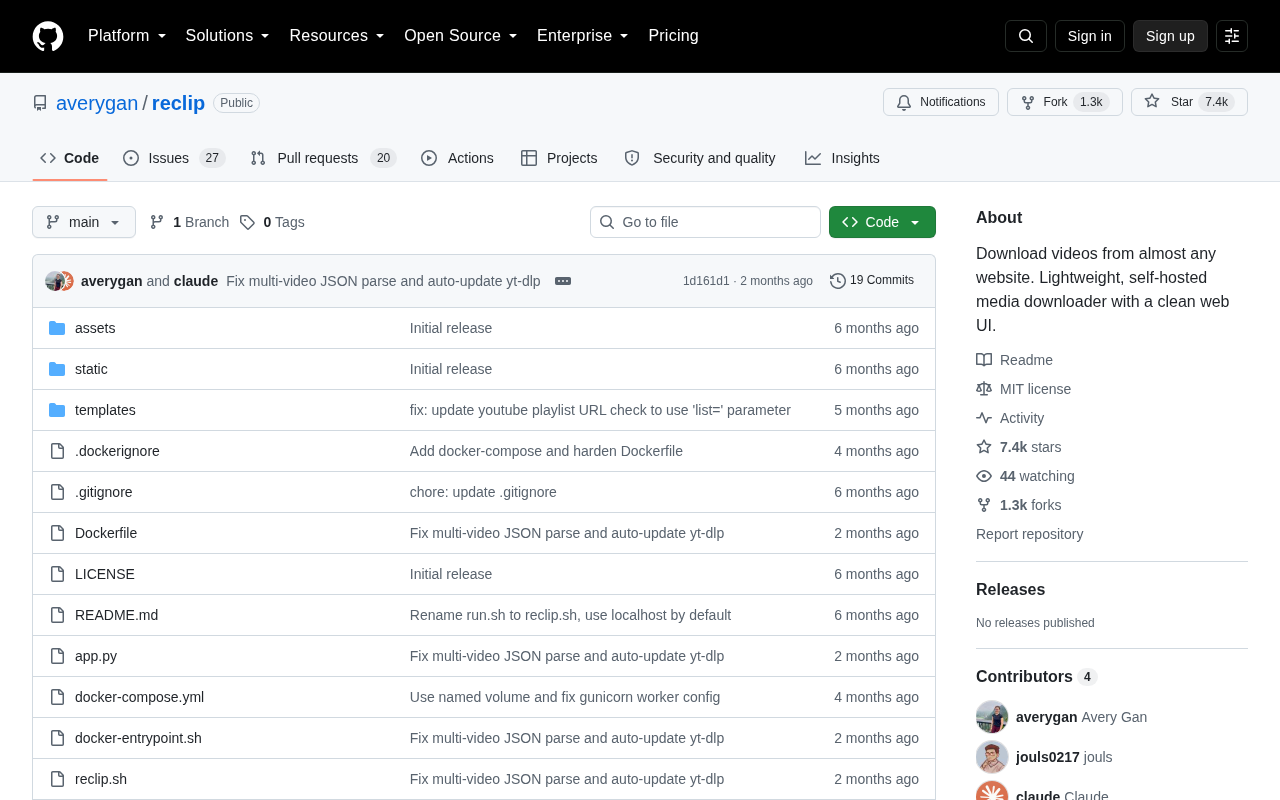
reclip: Self-Hosted Video Downloader with Clean Web UI as Command-Line Alternative
reclip is a lightweight self-hosted video downloader with a clean Web UI, built on yt-dlp to support downloads from almost any website. Easy deployment, privacy control, ad-free, ideal for NAS and VPS users.