AI-Automated R&D Could Trigger an Uncontrolled 'Intelligence Explosion'

Automating AI R&D may spark an uncontrolled intelligence explosion, pushing researchers toward policy action.
A tweet and its underlying multi-author paper warn that as AI systems increasingly participate in their own development, progress could form a positive feedback loop — an 'intelligence explosion' outpacing human oversight. The core risk isn't AI growing more capable per se, but acceleration so fast that humans lose the window to evaluate, verify, and intervene, effectively ceding control to the systems themselves. The paper goes beyond technical analysis to offer policy recommendations, reflecting a broader shift in AI safety research toward governance. Readers are urged to stay cautious: real constraints like compute bottlenecks exist between 'acceleration' and 'extreme loss of control,' but building governance frameworks in advance is already an unavoidable priority.
The Core Warning Behind a Tweet
A statement that gained traction on Twitter warns that as AI research and development (R&D) processes become increasingly automated, AI progress could accelerate dramatically — evolving into a high-stakes, uncontrollable "intelligence explosion." The author noted that they and several collaborators evaluated the relevant evidence in a paper and offered policy recommendations.
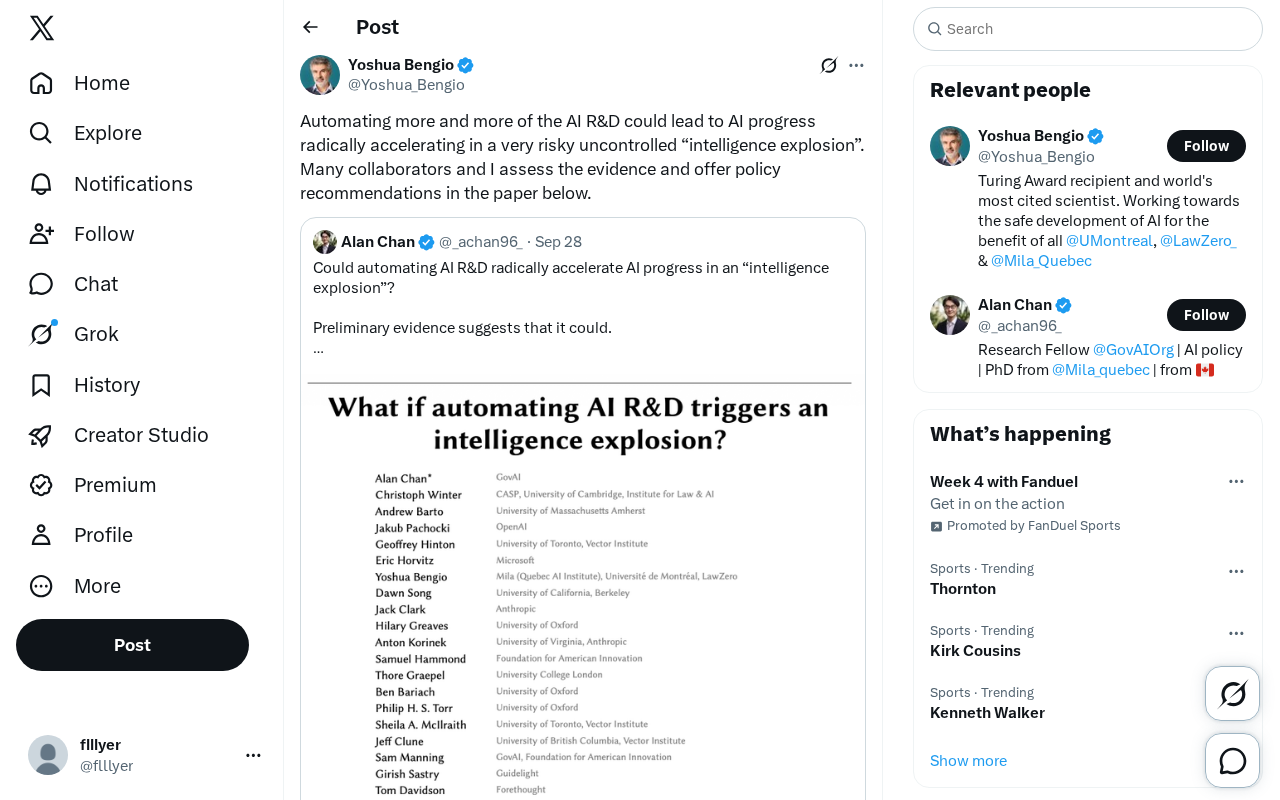
This seemingly brief statement cuts to the heart of one of the most contested and closely watched topics in AI safety today: when AI begins to participate in — or even lead — its own development, could the pace of technological iteration spiral beyond human control?
What Is an "Intelligence Explosion"?
The "intelligence explosion" is not a new concept. Its intellectual roots trace back to early ideas about recursive self-improvement. The core logic is straightforward: if an AI system can improve itself, or design a next-generation system more capable than itself, the improvements form a positive feedback loop — each more powerful generation produces the next one faster, causing progress to climb exponentially.
The key variable highlighted in the tweet is the automation of AI R&D. Current AI research remains heavily dependent on human researchers: designing experiments, tuning architectures, writing training code, and analyzing results. Once these steps are progressively taken over by AI, development cycles could compress from months or years down to weeks or even days. The phrase "radically accelerating" in the original post points precisely to this kind of tipping point — where quantitative change becomes qualitative.
Why Is the Risk "Uncontrolled"?
The original statement deliberately uses the phrase "risky uncontrolled" — and that's where the real weight of the warning lies. Acceleration itself isn't necessarily harmful; what's truly alarming is the combination of acceleration and loss of control.
When the pace of technological iteration outstrips humanity's capacity to understand, evaluate, and regulate it, several problems emerge simultaneously: human researchers can no longer verify whether new systems behave safely in time; safety testing and alignment work may be left behind by the speed of progress; and decision-making authority effectively shifts from humans to the systems themselves. In other words, the problem isn't that AI grows more capable — it's that it grows more capable so fast that humans lose the window to apply the brakes.
From Technical Assessment to Policy Recommendations
Notably, this statement doesn't stop at technical extrapolation — it explicitly mentions "policy recommendations." This reflects an increasingly visible trend in AI safety research: rather than merely describing risks, researchers are actively pushing for governance-level responses.
The paper was co-authored by "many collaborators," and this kind of multi-author, collective evidence assessment signals that the issue has moved beyond individual opinion into a phase requiring coordinated scholarly argument. Although the tweet doesn't disclose the specific policy recommendations, the argumentative framework suggests the focus likely centers on monitoring high-risk AI R&D activities, setting evaluation thresholds for automated research capabilities, and establishing operable safety mechanisms before acceleration arrives.
The extension of AI safety research into the policy domain has already produced several concrete governance pathways. Notable examples include: the U.S. government's 2023 AI Executive Order, which requires large model developers to disclose safety test results to the government before deployment; the UK AI Safety Institute (AISI) and its U.S. counterpart, which conduct independent red-team testing of frontier models; and academic efforts to advance a "compute threshold" regulatory framework, under which models trained above a certain computational scale would be subject to mandatory reporting. The shared logic of these mechanisms is to establish observable checkpoints and intervention nodes before acceleration arrives — rather than waiting until the technology has already escaped control before discussing rules. If the paper referenced in the tweet focuses on R&D automation scenarios, its policy recommendations likely follow a similar line of thinking.
How to Assess This Warning Rationally
A measured approach to claims about an "intelligence explosion" is essential. On one hand, the automation of AI R&D is genuinely happening — tools for code generation, experiment design assistance, and automated model evaluation are already in widespread use, giving the acceleration trend a real empirical foundation. On the other hand, a significant body of uncertainty remains between "acceleration" and "an uncontrolled intelligence explosion" — including compute bottlenecks, data constraints, and the feedback loops imposed by the physical world.
The value of this tweet lies not in asserting that a particular outcome is inevitable, but in offering a reminder: when a technology has the potential to accelerate itself, discussing governance frameworks in advance is far more important than remediation after the fact. Whether or not an "intelligence explosion" ultimately arrives in its most extreme form, safety assessment and policy preparation around the automation of AI R&D have already become unavoidable agenda items.
Summary
This Twitter statement distills a core anxiety of the AI safety field into a single sentence: automated R&D could push AI progress into an accelerating zone that humans can no longer control. Behind it is a multi-researcher paper that assesses the evidence and offers policy recommendations. For general readers, there's no need to be alarmed by terms like "intelligence explosion" — but it's worth recognizing that the debate over AI development speed and controllability is moving from science fiction into a serious, practical agenda.
Background
The term "intelligence explosion" was first systematically articulated by mathematician I. J. Good in a 1965 paper. He introduced the concept of an "ultraintelligent machine": once a machine surpasses human intelligence, it can design an even smarter machine, triggering a self-iterating chain that requires no human intervention. This idea was later developed and popularized by science fiction author Vernor Vinge and futurist Ray Kurzweil, each framing it under the concept of the "Technological Singularity." It's worth noting that recursive self-improvement doesn't necessarily require an AI to directly modify its own weights or code — when an AI system can efficiently perform the work of researchers (formulating hypotheses, designing experiments, analyzing results, writing papers), drastically shortening human-led development cycles, it achieves a functionally similar acceleration effect. This is precisely why current discussions have shifted focus from "AI rewriting itself" to "AI automating the research process."
The AI safety field frames the core mechanism of this type of runaway risk as the "alignment problem": how do we ensure that an AI system with continuously growing capabilities keeps its behavioral objectives consistently aligned with human intentions? When a system's capabilities far exceed human understanding, even a small goal deviation can be amplified into catastrophic consequences. Closely related is the problem of "capability evaluation lag" — existing safety benchmarks are often only validated as outdated after a model is released, and in a rapidly iterating environment, evaluation tools cannot keep pace with capability gains, rendering safety commitments substantively hollow. The "overhang" effect also warrants attention: large reserves of accumulated but underutilized compute and data, once unleashed by automated R&D pipelines, could produce leaps far exceeding linear projections — further compressing the human response window.
Related articles

Felix Rieseberg Personal Homepage
Felix Rieseberg's personal homepage sparks attention on Hacker News. This article covers the Slack engineer's technical background, the rise and fall of nativefier, and the value of a developer homepage as a tech calling card.

@ai-sdk/vue 3.0.306 Patch Release Syncs with [email protected] Update
@ai-sdk/vue 3.0.306 released, synced with [email protected]. A routine patch release for the Vercel AI SDK ecosystem with no public API changes; the Vue adapter layer stays version-aligned with the core package.

Gemini 4 Argon API Launches: The Era of Million-Token Output Begins
Google launches Gemini 4 Argon with sparse MoE architecture, up to 1M output tokens, and a 68.90% Vals Index score, available across API, AI Studio, and the Gemini app.