AI Automation Implementation Guide: How Enterprises Can Build Reliable AI Systems

The core of the next AI wave is enterprise-level AI automation, where execution and reliability are the dividing line.
The article notes that AI is shifting from personal chat tools to core enterprise business processes. The key to the next wave is enterprises owning their own AI assistants, automated workflows, customer communication systems, growth engines, and internal knowledge systems. Among these, internal knowledge assistants have the most mature technical path — RAG plus permission management covers most needs — but the difficulty lies in organizational issues like knowledge updates, answer accuracy, and employee trust; workflow and customer communication systems involve multi-system integration, where stability matters more than feature completeness. The author emphasizes that "execution is scarcer than ideas," and enterprises should start with high-frequency, low-risk scenarios, first achieving 80% accuracy plus human fallback, and measure value by business outcomes rather than model count.
From Personal Use to Enterprise Infrastructure: The New Battleground for AI Automation
While most people are still discussing the experience of using ChatGPT to write emails and generate weekly reports, a more fundamental shift is taking place: enterprises are no longer satisfied with "employees occasionally using AI tools" — they are beginning to embed AI into the core of their business processes.
A developer proposed this assessment in a blog post: The core of the next wave of AI is not individuals using ChatGPT, but enterprises owning their own AI assistants, automated workflows, customer communication systems, growth engines, and internal knowledge systems. These five directions seem disparate, but they point to the same underlying logic — AI is transforming from "an application in the toolbox" into "the enterprise's operating system."
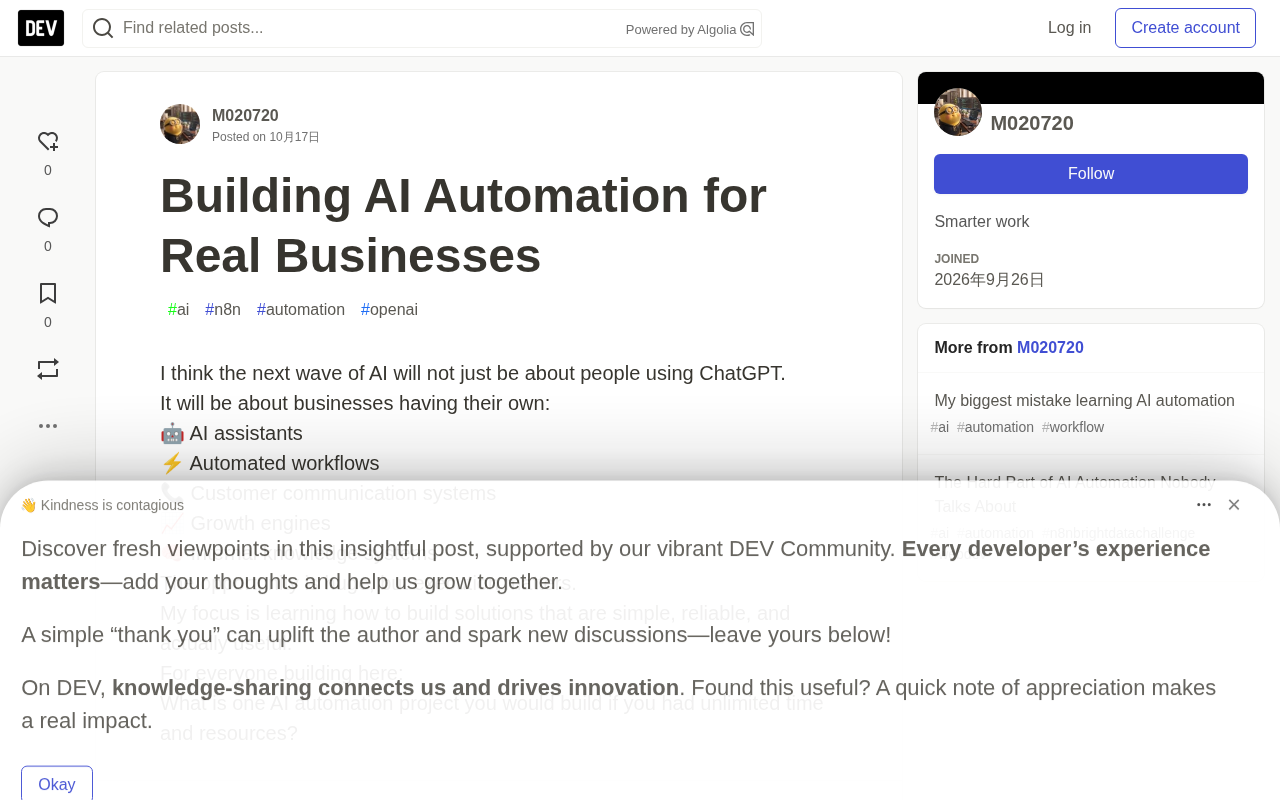
The value of this assessment lies not in predicting trends, but in pointing out an overlooked fact: the opportunity is enormous, but execution is the dividing line. The original author specifically emphasizes that his focus is "learning how to build simple, reliable, and actually useful solutions" — in this sentence, "simple" and "reliable" come before "useful," which is worth pondering carefully.
Five Real Implementation Points for Enterprise AI Automation
The five directions listed in the original article are not randomly assembled; they cover the most labor-intensive areas of enterprise operations. Breaking them down one by one reveals different technical barriers and implementation difficulties.
AI Assistants and Internal Knowledge Systems: The First Scenarios to Be Captured
Enterprise internal knowledge is scattered across documents, chat logs, emails, and employees' minds. Building an AI assistant that can accurately answer "What is our return policy" or "Who should I contact for this approval process" has a relatively mature technical path — retrieval-augmented generation (RAG) plus permission management can cover most needs.
But "simple and reliable" is precisely what's hardest here. The update frequency of the knowledge base, the accuracy boundaries of answers, and the establishment of employee trust are all organizational issues beyond engineering. An internal assistant that frequently gives wrong answers is worse than having no assistant at all.
RAG (Retrieval-Augmented Generation) is a technical architecture that combines information retrieval with the generative capabilities of large language models. Its basic process is: when a user asks a question, the system first retrieves the most relevant document fragments from the enterprise knowledge base, then feeds these fragments as context along with the question into the large model, which generates an answer based on these real materials. Compared to having the model answer directly from its training data, RAG's advantage is that answers are grounded and traceable, and knowledge can be updated without retraining the model — simply updating the knowledge base changes the answers.
In the enterprise internal assistant scenario, RAG also needs to work with permission management: employees in different roles can retrieve different ranges of documents, and the retrieval layer must filter results based on user identity, otherwise sensitive information could be leaked. This is also what makes enterprise-grade RAG more complex than general-purpose Q&A — the difficulty lies not in model invocation, but in retrieval quality, document chunking strategies, and the engineering implementation of permission boundaries.
Automated Workflows and Customer Communication Systems: The Deep End of Execution
Compared to internal assistants, workflow automation and customer communication systems involve more system integration and external interaction. For processes like order processing, customer service routing, and lead follow-up, AI needs to connect with CRM, ticketing systems, and messaging channels — any instability in any link will be amplified.
The original article doesn't elaborate on specific implementations, but from the wording "simple, reliable, and actually useful," it can be inferred that the author is skeptical of overly complex automation solutions currently on the market. Enterprise AI that actually works is often not the one with the most features, but the one that can be quickly discovered and taken over by humans when something goes wrong.
CRM (Customer Relationship Management) systems are the core database where enterprises store customer information, follow-up records, and sales leads, while ticketing systems are used to record and track the complete process of customer issues from submission to resolution. For enterprise AI automation to truly take hold, it often needs bidirectional integration with these existing systems: AI reads customer context from the CRM, writes processing results back to ticket status, and interacts with customers through email, instant messaging, and other channels.
The engineering challenge of such integration is that enterprise systems typically have non-standard interfaces, messy data formats, and any failed call can cause tickets to get stuck or customers to receive incorrect information. Therefore, mature solutions introduce human-in-the-loop mechanisms: AI handles routine processes, and automatically hands off to humans when encountering low-confidence or anomalous situations, ensuring business continuity when the system fails.
Why "Execution" Is Scarcer Than "Ideas"
The market discussion about enterprise AI never lacks grand narratives; what's missing is the engineering capability to make solutions simple and stable. The original author places "execution matters" after the opportunity assessment, effectively cooling down the hype.
A notable detail is that the original article ends with a question: "If you had unlimited time and resources, which AI automation project would you build?" This question itself exposes real constraints — most teams don't have unlimited resources, so prioritization and scope control are the real content of execution.
For builders, a more pragmatic way of thinking might be: start with the link that takes the longest manual processing time and has relatively clear rules, first achieve 80% accuracy plus human fallback, then gradually expand coverage. Simple and reliable systems earn trust, and trust brings the next round of investment.
Key Trade-offs in Enterprise AI Automation
Based on the original article's viewpoints, enterprises need to hold three lines when building AI automation:
- Keep scope narrow: Don't spread across all five directions at once; pick one high-frequency, low-risk scenario to close the loop first.
- Reliability over intelligence: A system that can stably handle 80% of routine cases and hand off to humans when anomalies occur is more valuable than a system that pursues full automation but frequently makes errors.
- Measure usability by business outcomes: Not by how many models are integrated, but by how many work hours are saved and how much response time is reduced.
The enterprise-level opportunity for AI automation does exist, but it belongs to teams willing to put effort into engineering details and organizational adaptation, not to those chasing concepts.
One-line Summary
The core of the next AI wave is enterprise-level AI automation, where execution and reliability are the dividing line.
Paragraph Summary
The article points out that AI is shifting from personal chat tools to core enterprise business processes, and the key to the next wave is enterprises owning their own AI assistants, automated workflows, customer communication systems, growth engines, and internal knowledge systems. Among these, internal knowledge assistants have the most mature technical path — RAG plus permission management can cover most needs — but the difficulty lies in organizational issues such as knowledge updates, answer accuracy, and employee trust; workflows and customer communication systems involve multi-system integration, where stability matters more than feature completeness. The author emphasizes that "execution is scarcer than ideas," and enterprises should start with high-frequency, low-risk scenarios, first achieving 80% accuracy plus human fallback, and measure value by business outcomes rather than the number of models.
Related articles

Chain of Thought Isn't Just for AI: How Humans Can Use CoT to Improve Thinking Quality
Chain of Thought isn't just a prompt trick for large models. Starting from a Hacker News discussion, this article analyzes why CoT works for human thinking too, breaks down actionable ways to transfer it, and highlights the key differences between human CoT and machine CoT.
Cloudflare Teams Up with OpenAI: Closi…
Cloudflare Teams Up with OpenAI: Closing the Loop from Vulnerability Discovery to Defense with AI
Cloudflare uses OpenAI Daybreak to investigate security vulnerabilities and generate reviewable remediation plans, while developers use Codex to boost coding efficiency and quality.

Orca Multi-Agent Orchestration in Practice: A Guide to Parallel Collaboration with Claude and Codex
Orca is Stable AI's free open-source agent workbench supporting 34 agents like Claude Code and Codex in parallel. Learn its Git worktree isolation, multi-model orchestration, and mobile management.