AI Autonomous Execution in Practice: How Codex Handles End-to-End Workflows from Analysis to Image Generation

Codex-style AI autonomously handles e-commerce workflows from image analysis to batch asset generation.
This article examines a real-world demo of Codex combined with the latest LLMs, covering three scenarios: auto-extracting image prompts from e-commerce product pages, batch-generating 9:16 detail page assets, and automatically localizing visuals for Western markets — all via plain-language instructions, no manual workflow setup required.
AI Is Evolving from a "Conversation Tool" to an "Execution Tool"
For most of its early history, using a large language model meant operating in a "question and answer" loop: you ask, it responds, and you still do the actual work. With OpenAI's latest model releases and the maturation of tool-calling solutions like Codex, AI's role is undergoing a fundamental shift — it no longer just offers suggestions, but can call tools on its own and complete an entire complex workflow from start to finish.
The technical foundation for this shift is the architectural evolution of large language models (LLMs) from pure text generation to tool-calling capabilities. Early models could only produce text, but the introduction of Function Calling allowed models to proactively trigger external APIs, operate on file systems, and invoke image generation interfaces. OpenAI's Codex originally distinguished itself through code generation, with its core capability being the translation of natural language intent into executable program instructions that drive a tool chain to complete complex tasks. This paradigm is known as "Agent" mode — the model is no longer a passive responder, but an active task agent that plans and executes step by step.
This article is based on a hands-on demonstration by a Bilibili creator testing the latest model combined with Codex, covering the real-world performance and practical value of this kind of "AI autonomous execution" workflow. It's worth noting that the features described here come from a single-source demo; readers are encouraged to independently verify specific model version names and the reliability of any third-party sites mentioned.

The standout highlight from the demo is no need to build complex workflows. Traditionally, getting AI to complete a chain like "analyze image → generate prompt → batch produce images → save files" required automation platforms such as n8n, Zapier, or Make — manually linking multiple API nodes and writing data format conversion logic. The barrier for non-technical users is extremely high, and a failure at any single step can break the entire pipeline. Now, users simply describe their needs in natural language, and the model automatically breaks the task down and executes each step in sequence — turning what once required an engineer's involvement into something any ordinary user can control with plain language instructions.
Test 1: Automatically Deconstructing E-commerce Product Pages into Image Prompts
In the first test scenario, the creator grabbed a few product detail page screenshots from an e-commerce platform, handed them directly to the model, and gave the instruction: "Extract the visual information from these images and give me corresponding image generation prompts."
Within about ten seconds, the model had fully broken down each image's composition, scene, atmosphere, and key selling points, converting them into reusable image generation prompts. The value here is that it compresses two steps that previously relied on human expertise — visual understanding and prompt engineering — into a single automated call.
Prompt Engineering refers to the technical practice of crafting carefully designed text instructions to guide an AI model toward desired outputs. In image generation, a high-quality prompt typically needs to describe subject, style, lighting, composition, color tone, mood, and more — all dimensions that take significant hands-on practice to master. Previously, this was a core competitive skill for professional designers and experienced AI users. When a model can automatically reverse-engineer and structure prompts from reference images, the barrier to this skill drops significantly.
For e-commerce practitioners, this means being able to quickly reverse-analyze the visual logic of competitor materials or reference assets, eliminating the time cost of manual analysis image by image.
Test 2: Batch-Generating Product Detail Pages from Prompts
With the prompts in hand, the creator sent the model their own product photos and asked it to "generate a set of 9:16 product detail pages based on the prompts from just now."

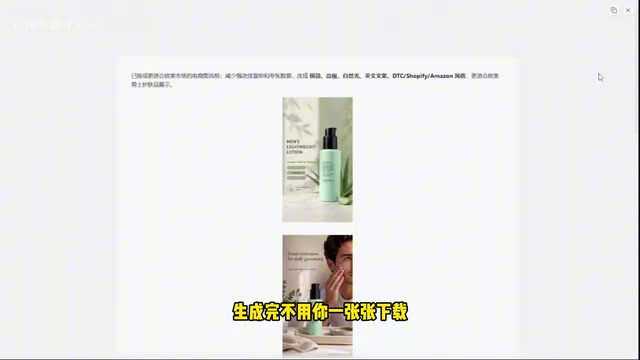
About three minutes later, the finished materials were ready. The generated detail pages demonstrated three key elements: clear presentation of product data, effective scene atmosphere, and concise communication of selling points. This is no longer a simple "AI draws a picture" — it's a complete set of commercially viable design assets with sound business logic.
The significance of this kind of AI batch image generation is that it partially automates "the execution work of a designer." For small sellers or individual entrepreneurs, detail page designs that once required outsourcing or significant time investment can now be turned into usable drafts with a single instruction.
Test 3: Automatic Localization for Cross-Border E-commerce
The third test best illustrates the model's depth of understanding. The creator simply said, "I'm selling to the US and European markets — generate detail pages suitable for Amazon," and the model not only automatically switched the copy to English, but also proactively adjusted to the minimalist, clean, natural-light aesthetic preferred by Western markets.

The creator specifically noted, "I never told it to adjust the style." There's a clear internal logic behind this: consumers in different markets have very different aesthetic preferences for product detail pages. Western markets (especially Amazon) tend to favor minimalism — generous white space, natural-light photography, unretouched real-world settings that emphasize the product's quality and functionality. Chinese e-commerce platforms, by contrast, favor high-saturation colors, dense promotional messaging, and multi-layered visual hierarchies. Because the model was trained on a sufficient volume of cross-platform e-commerce content, it has internalized these aesthetic differences and can automatically apply the corresponding visual language template when given a market-specific instruction. This is a prime example of the model's ability to make implicit knowledge explicit.
For cross-border e-commerce sellers, this directly addresses a real pain point: different markets require different visual languages and copy styles, and AI's automatic adaptation capability fills the gap left by manual localization — which is time-consuming and experience-dependent.
A Detail Worth Noting: Finished Assets Automatically Saved to a Materials Folder
Beyond the core generation capabilities, engineering-level details also improve practical usability. The demo noted that once the model finishes, users don't need to manually download each file — the outputs are automatically saved to a designated materials folder, ready to use immediately.
This "end-to-end closed loop" design is a direct expression of Codex's tool-calling capability — it doesn't just generate content, it can also operate on the file system and manage output results. The fundamental difference from traditional workflow automation tools is that users don't need to predefine data formats and handoff logic for every step; the model handles task decomposition, parameter passing, and error handling on its own. For users, this further reduces the friction of working with AI, moving it from "AI helps me think" to genuinely "AI helps me do."
The AI-as-Tool Era: Opportunities and a Rational Perspective
From this hands-on test, it's clear that the latest generation of models, combined with tool-calling capabilities, has dramatically expanded the range of applications. Beyond e-commerce detail pages, the creator also mentioned its applicability to scientific figures, product design drafts, and presentation slide decks for other batch content production scenarios.
This marks a meaningful transition for AI from "assisting with thinking" to "replacing execution." For content creators, e-commerce operators, designers, and similar roles, understanding and effectively using AI automation workflows will bring significant productivity gains.
That said, a measured perspective is warranted: the features described in this article come from a single-source demonstration, and actual results will vary depending on the specific task and material quality. For third-party sites claiming to offer "free unlimited usage," pay attention to data security and privacy risks, and avoid uploading sensitive business assets. The technology trend is worth following — but hands-on adoption still requires careful evaluation.
Key Takeaways
Related articles

The Truth Behind Codex 'Build a Website in 5 Minutes': AI Isn't Creating Sites—It's Helping You Copy Them
Exposing the truth behind viral Codex 5-minute website videos: creators aren't building original sites with AI—they're copying shared prompts or scraping others' work. Learn AI coding tools' real limits.

Getting Started with AI Agent Development: A Complete Guide from Concept to Practice
A comprehensive guide to AI Agent architecture and development, covering automated marketing, intelligent customer service, and investment analysis scenarios with single and multi-agent collaboration.

The Truth Behind Codex 'Build a Website in 5 Minutes': AI Isn't Creating Sites — It's Helping You Copy Them
Exposing the truth behind viral Codex 5-minute website videos: creators aren't building original sites with AI — they're copying shared prompts or scraping others' work.