AI Bills Keep Rising, But Intelligence Is Actually Getting 20x Cheaper: Breaking Down Three Pricing Dimensions

AI intelligence costs have actually fallen 20x — rising bills are driven by the Jevons Paradox, not higher prices.
A common misconception: rising top-model token prices mean AI is getting more expensive. The author argues that per-token price is the worst way to measure AI cost. By comparing models with equivalent intelligence benchmark scores over time — including DeepSeek V4 Flash vs. GPT-5 — the true cost of equivalent intelligence has dropped roughly 20x, far exceeding Altman's promised tenfold reduction. Rising bills are explained by the Jevons Paradox: as AI becomes cheaper and more capable, users deploy it for far more complex tasks, causing token consumption to explode. Spending growth and productivity growth are inseparable.
Sam Altman once promised that the cost of AI intelligence would drop tenfold every year, painting a picture of a future where intelligence becomes "too cheap to meter." But reality seems to tell a different story — one developer admitted that while they spent roughly $800 to $1,000 on AI for the entire previous year, they can now burn through $1,000+ in tokens on any given day. As models like Fable and Astra arrive — costing more per token and consuming far more tokens — enterprise AI bills seem to climb without end. Has Altman's promise failed?
The answer: the tenfold cost reduction is real. We've just been measuring it wrong.
Why Token Prices Seem to Be Skyrocketing
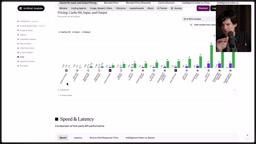
If you focus only on the per-token rates of top-tier models, the numbers are alarming. According to Artificial Analysis data, GPT-5 medium charges $10 per million output tokens and $1.25 per million input tokens. At the GPT-6 Astra tier, output prices jump to $50 per million and input to $10 — a 5x to 10x increase on both sides, seemingly the exact opposite of the promised cost reduction.
But per-token price is one of the worst ways to measure AI costs. What actually matters comes down to three dimensions: how many tokens a dollar buys, how many tokens a task consumes, and how much it costs to solve a problem at a given intelligence level. Fixating on the first dimension alone is like judging a car's running cost by gas price alone, ignoring fuel efficiency and range.
It's also worth noting that the budget end of the market is evolving rapidly. Models like GLM 5.3 Flash cost just $0.15 per million input tokens and $0.50 per million output tokens — often with a 50% discount. That's roughly 20 to 30 times cheaper than GPT-5, yet it outperforms GPT-5 on a wide range of real-world agentic tasks. The top end is getting wilder, but the bottom end has become remarkably capable. There's genuine progress on both ends.
Token Consumption Is the Real Driver of Your Bill
Cheaper per-token rates don't necessarily mean cheaper total costs — what matters is how many tokens a task burns through. Consider an illustrative example: Gemini 3.8 Flash is priced at $3.75 per million output tokens, which looks like less than half the price of GPT-5 and a tenth of Astra. But once you measure by "cost per intelligence benchmark task," the gap narrows dramatically — because 3.8 Flash consumes tokens extremely inefficiently, and what looked like a 10x+ price advantage shrinks to under 3x.
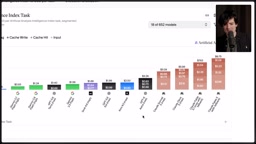
Even more striking is Sonnet 5: its token-burning rate is so aggressive that the actual total cost ends up higher than Astra's. This illustrates how task type completely changes the pricing logic. If your task involves reading 800,000 tokens and performing classification, input costs dominate and output is nearly negligible — in that case, pick the model with the cheapest input. If the work is agentic software development, caching and other optimizations offer much greater leverage.
Cost is never one-dimensional. You have to combine unit price with task-level token consumption to get close to your actual spend.
Flip the Perspective: The Cost of Equal Intelligence Is Collapsing
The most compelling analysis asks the question in reverse — not "how much intelligence does a dollar buy?" but "how much does a fixed level of intelligence cost over time?" The author conducted extensive research and found that locating models with comparable historical benchmark scores was harder than expected, since nearly every evaluation has had to be reworked as models blow past old ceilings.
Ultimately, DeepSeekAd V4 Flash was found to be roughly equivalent to GPT-5 codecs high on the intelligence index — and actually stronger on several benchmarks including Humanities Last Exam and hallucination rate tests. DeepSeek V4 Flash is 21x cheaper on input tokens and 55x cheaper on output. Even assuming it runs 3x less efficiently, the net result is still roughly a 20x improvement. In other words, if the target was "10x cheaper for equivalent intelligence," reality has already doubled that goal.
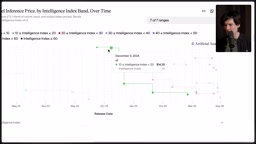
Artificial Analysis's long-term tracking makes this even clearer. For tasks with an intelligence index below 10, costs fell from $0.60 per task in November 2022 to $0.02 by July 2024. In the 10–20 range, O1 Preview initially cost $15 per task; within a few months, Grok 3 Mini achieved a higher score at roughly 1% of that price — a ~99% drop in four months. And each successive price drop comes faster than the last. At the high end — scores in the 40s and 50s — Opus 4.7 started at $3.85, then 5.6 Terra achieved a higher score at nearly half the price, GLM 5.3 exceeded it at under one-third the price, and GLM 5.3 Flash approached equivalent scores at roughly 1% of the original cost.
The "intelligence index" and benchmarks like Humanities Last Exam referenced in this article come from AI research institutions' attempts to quantify model capabilities. Artificial Analysis's intelligence index aggregates weighted scores across reasoning, coding, mathematics, and language understanding to enable cross-model comparison. Humanities Last Exam (HLE) is an extremely difficult academic benchmark covering expert-level questions in philosophy, history, literature, and other humanities disciplines — even top models typically score below 20%, making it a useful "ceiling test" for distinguishing leading models. It is precisely because such high-difficulty benchmarks are constantly being surpassed that older evaluations quickly lose their discriminative power, which is why the author found it so difficult to locate "historically comparable" models — the pace of model progress has outrun the benchmark update cycle.
The Jevons Paradox: The Cheaper It Gets, the More We Spend
If equivalent intelligence has genuinely gotten cheaper, why do bills keep rising? The fourth factor — which the author deliberately saved for last — is that how we use AI has fundamentally changed.
We used to ask models to autocomplete a function. Now we hand them a screenshot of a bug and ask them to trace it end-to-end, fix it, verify it, and merge it to the main branch. Models can do far more, run far longer, handle far larger tasks, and require far less human intervention. The explosion in token generation is itself a sign of success — precisely because models are cheaper, stronger, and more reliable, we're comfortable giving them heavier workloads.
This is the classic Jevons Paradox: when steam power got cheaper and coal became more accessible, humans actually spent more on both — because they finally became cheap and good enough to unlock applications that were previously out of reach. Rising AI bills aren't a sign that models are getting more expensive. They're a sign that we're doing more with powerful models.
The author also makes a pointed observation: GLM 5.3 Flash isn't just "equivalent capability at lower cost" — it's a better model than GPT-5 outright: stronger vision processing, better tool use, and especially superior performance in agentic workflows that run for hours at a stretch. GPT-5's only edge is broader knowledge without needing search, but give both models search tools and Flash tends to reverse the gap by orders of magnitude — because it's simply better at using tools. A well-tooled model can comprehensively outperform last year's most capable model.
The Jevons Paradox was proposed by 19th-century British economist William Stanley Jevons. In his 1865 work The Coal Question, he observed that as steam engine efficiency improved and the per-unit cost of coal use fell, Britain's total coal consumption actually rose sharply. The reason: efficiency lowered the barrier to adoption, making previously uneconomical applications viable and generating entirely new demand — with total consumption growth completely offsetting, and even exceeding, per-unit savings. In the AI context, this dynamic plays out as follows: once inference costs drop low enough to justify "letting a model run autonomously for hours on complex tasks," users start applying AI to scenarios they never would have considered before. Per-task token consumption grows by orders of magnitude, and bills end up higher than ever. This isn't waste — it's the inevitable result of unlocking latent demand.
Conclusion: The Promise Was Kept — It's Just Hiding Inside Productivity
The author candidly admits to having wrongly concluded two years ago that AI had "already hit its ceiling" — one of the worst calls he's ever made, and a lesson never to underestimate the pace of progress. Today's reality: AI has become stronger, faster, and cheaper than he imagined possible — cheap enough that people now use it extravagantly without a second thought.
"Intelligence too cheap to meter" may not have arrived in quite the way Altman implied, but the promise of "10x cheaper" has long since been blown past. The same tasks we were running on AI last year genuinely do cost that much less today. The only difference is that we're now using AI to tackle bigger, harder problems. Burning $1,500 in a single day sounds alarming — but the output that buys is something that simply couldn't have been accomplished in the GPT-5 era. LLM spending has always been, and remains, bound to the productivity it delivers.
Related articles

JobRunner MCP Server: AI Agents Can Now Fix Failed Java Jobs
JobRunner launches an open-source MCP server enabling AI agents to view cluster status, diagnose failures, and recover Java jobs—incident response from any cloud coding environment or existing agent.

MLAI Digital Launches 9 Security Agents: MCP Server Safeguards the Full Lifecycle of Agentic AI
MLAI Digital launches Security MCP Server with nine built-in specialized security agents covering vulnerability discovery, attack simulation, prompt injection detection, API and infrastructure assessment, and accelerated remediation—embedding security validation across the full Agentic AI lifecycle from development to production.

Running Isaac Lab on H100 GPUs: Exploring Better Approaches
Exploring optimization methods for running Isaac Lab on NVIDIA H100 GPUs, including MIG configuration, mixed precision, TensorRT acceleration, and community experience to improve robotics simulation and reinforcement learning efficiency.