AI Bots Are Polluting Your Survey Data? Here Are 5 Ways to Spot Them

AI agents defeat traditional bot detection; combine server-side checks, pattern analysis, and knowledge verification.
The article notes that AI agents can generate fluent open-ended responses and pass simple attention checks, making traditional bot detection ineffective. Drawing on B2B market research experience, the author proposes a multi-layered defense: client-side honeypot checks as only the first line of defense, with server-side validation of honeypot fields and submission speed; analyzing overall response patterns (consistent length and tone, polished but non-specific content, contradictory identity claims) as more reliable than single-point checks; designing knowledge-check questions for niche audiences; checking and cross-validating metadata; and combining multiple signals to avoid penalizing real users while logging removal reasons. Ultimately, no single detection method exists—stacking low-cost server-side checks, pattern analysis, and audience-specific questions is the pragmatic strategy.
If you've ever run a survey, lead form, or feedback widget, you've had entries in your database that didn't come from a real person. In the past, bots were easy to spot: garbled text, duplicate answers, forms completed in under 2 seconds. But AI agents have changed everything—they can write fluent open-ended responses and even pass simple attention checks.
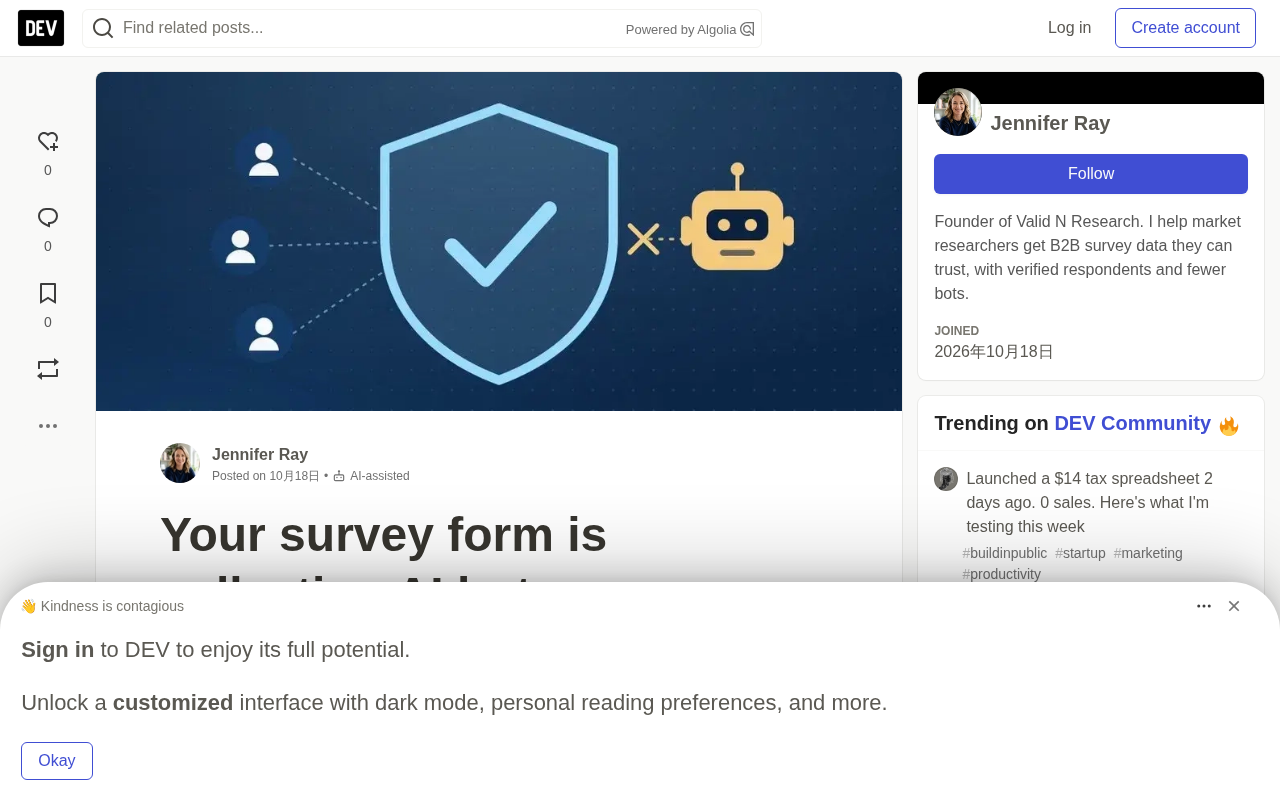
I work in B2B market research, where a single fake "IT decision-maker" is enough to distort an entire study's results, so we deal with this problem every day. Here are the methods that still work.
Client-side checks alone are far from enough
A hidden "honeypot" field is a good starting point: real users can't see it, but bots will fill it in. But if the check only happens in the browser, any bot that submits data directly to your endpoint can easily skip it. You also need server-side validation—reject submissions where the honeypot field has a value, or where the form is submitted so fast that no human could have completed it.
According to the original author, client-side checks should only serve as the first line of defense, while server-side validation is the key to intercepting automated submissions.
Honeypot Field is a common anti-bot technique: a field is inserted into a form that is invisible to real users (hidden via CSS), with the expectation that bots will automatically fill in every field. However, the effectiveness of this method depends entirely on whether the attacker knows the field exists. Modern AI agents or automated scripts can send HTTP requests directly to the form submission endpoint, completely bypassing browser rendering, and therefore never triggering any client-side checks.
Server-side validation performs checks when the server receives the data—for example, whether the honeypot field was filled, whether the submission timestamp is abnormally short, or whether the HTTP headers look suspicious. Because these checks run on the server side, attackers cannot bypass them by modifying front-end code. Therefore, treating client-side checks only as the first line of defense and relying on server-side validation as the core interception mechanism is the recommended architecture for combating automated submissions today.
Look at overall response patterns, not individual answers
AI-generated answers often look fine in isolation; the telltale signs show up in the patterns:
- Every answer has the same length and tone
- Open-ended responses are polished in wording but never specific
- Claimed identities contradict themselves—for example, a "CTO" at a 3-person company who manages a 200-person IT team
These pattern signals are more reliable than any single-point check. In B2B research, a single fake "IT decision-maker" is enough to distort the entire study's conclusions, so you must look for clues in the consistency of responses.
Pattern characteristics of AI-generated text stem from how large language models work: they tend to produce coherent, grammatically correct, and stylistically consistent text, lacking the colloquialisms, omissions, repetitions, or emotional fluctuations common in human responses. In survey contexts, AI answers often exhibit "over-perfection"—each answer is similar in length, formal in tone, and complete in structure, but lacks specific details or personal experience.
Identity consistency checks are another key dimension: AI may generate contradictory identity information across different questions (such as a job title that doesn't match the company size), because it has no persistent "memory" or real background. In B2B research, this contradiction is especially obvious, because real respondents' professional identities usually have internal logic. Therefore, analyzing response patterns and consistency reveals automated submissions better than checking individual answers.
Ask questions only real respondents can answer
For niche audiences, a short knowledge check is more effective than an attention check. Ask a question that members of that group can answer off the top of their heads but that is extremely hard to guess, and you can effectively distinguish real people from AI. For example, for practitioners in a specific industry, ask about technical terms or process details they would only encounter in their daily work.
The original article points out that this method is more resistant to AI's imitation capabilities than generic attention checks.
Knowledge-Based Verification is a verification method targeted at specific audiences. Its principle is to design a question that only members of that group can answer accurately, while AI—lacking domain-specific tacit knowledge or real-time experience—struggles to give the correct answer. For example, ask about abbreviations commonly used within an industry, the steps of a specific process, or recent industry events.
Compared with generic attention checks (such as "Please select the third option"), knowledge checks are harder for AI to imitate, because AI may learn the套路 of attention checks from training data but cannot grasp detailed knowledge in niche domains. In B2B market research, this method is especially effective because respondent groups usually have clear professional boundaries, and questions can be designed closely around their daily work scenarios.
Check the "boring" metadata
Repeated devices, impossible geographic locations, disposable email domains, and large numbers of submissions arriving in a short time window—none of these signals is decisive on its own, but together they are very strong indicators. The original article suggests using this metadata as supporting evidence, cross-validated with response content analysis.
Metadata in form submissions includes device fingerprints, IP addresses, submission timestamps, user agent strings, email domains, and more. This information may not look abnormal in isolation, but combined analysis can reveal patterns of automated behavior. For example, many submissions come from the same device fingerprint or the same IP range, geographic locations don't match claimed identities, disposable email domains are used, or submissions arrive densely within an extremely short time.
Cross-validation means combining metadata signals with response content analysis: if the metadata is suspicious and the response patterns also match AI characteristics, confidence increases substantially. Conversely, a single metadata anomaly may just be a coincidence (such as a user on a VPN) and should not be used as grounds for rejection on its own. This multi-signal combination strategy effectively reduces false positives.
Avoid penalizing real users
Every check will wrongly flag some honest users: fast readers, non-native speakers, mobile users. Don't reject a submission based on a single signal alone; instead, combine multiple signals and record the reason for each removal so you can review it later. The original author emphasizes that keeping a decision log is the foundation for continuously improving anti-fraud strategies.
Conclusion
There is no single bot detection method anymore. Stacking low-cost server-side checks, response pattern analysis, and audience-specific questions, then observing which submissions ultimately get filtered out, is the more pragmatic strategy.
The original author also provides a longer guide covering the checks they use and the questions they ask data vendors. See How to Prevent Survey Fraud and AI Bots. What have you found in your own forms? Share what works.
One-line Summary
AI agents have rendered traditional bot detection ineffective, requiring a combination of server-side checks, pattern analysis, and knowledge verification.
Paragraph Summary
The article points out that AI agents can generate fluent open-ended responses and pass simple attention checks, rendering traditional bot identification methods ineffective. Based on B2B market research experience, the author proposes a multi-layered defense strategy: client-side honeypot checks serve only as the first line of defense, and honeypot fields and submission speed must be validated server-side; analyzing overall response patterns (such as consistent answer length and tone, polished but non-specific content, and contradictory identity claims) is more reliable than single-point checks; design knowledge-check questions for niche audiences that only real members can answer; check metadata (device, geographic location, email domain, submission time) and cross-validate; combine multiple signals to avoid penalizing real users, and log removal reasons for continuous improvement. Ultimately, it emphasizes that there is no single detection method—stacking low-cost server-side checks, pattern analysis, and audience-specific questions is the pragmatic strategy.
Related articles

Chain of Thought Isn't Just for AI: How Humans Can Use CoT to Improve Thinking Quality
Chain of Thought isn't just a prompt trick for large models. Starting from a Hacker News discussion, this article analyzes why CoT works for human thinking too, breaks down actionable ways to transfer it, and highlights the key differences between human CoT and machine CoT.
Cloudflare Teams Up with OpenAI: Closi…
Cloudflare Teams Up with OpenAI: Closing the Loop from Vulnerability Discovery to Defense with AI
Cloudflare uses OpenAI Daybreak to investigate security vulnerabilities and generate reviewable remediation plans, while developers use Codex to boost coding efficiency and quality.

Orca Multi-Agent Orchestration in Practice: A Guide to Parallel Collaboration with Claude and Codex
Orca is Stable AI's free open-source agent workbench supporting 34 agents like Claude Code and Codex in parallel. Learn its Git worktree isolation, multi-model orchestration, and mobile management.