AI Can Write Code, But Who Verifies It? Developer Community Debates the Trust Crisis

AI lowers the code-writing barrier, but verification costs shift to review and testing, with responsibility still on human teams.
A Hacker News thread notes that AI coding tools drastically lower the code-generation barrier, but verification costs shift from writing to review and testing. The community agrees AI code looks plausible, making review harder, and output speed far outpaces human verification, shifting the bottleneck from writing to reviewing. They split on whether testing can backstop this: one camp trusts high coverage, another warns of AI testing AI and AI favoring passing tests over correctness. Accountability still rests with human teams. The takeaway: build verification infrastructure first, then pursue AI efficiency.
When AI Becomes the Code Author, the Verifier Is Missing
A discussion thread on Hacker News titled "AI Can Write the Code. Who Verifies It?" quickly accumulated 17 upvotes and 33 comments. The post itself is short, but the question it raises hits the most vulnerable link in today's AI coding tools: once the barrier to code generation is drastically lowered, who should bear the responsibility for review and verification?
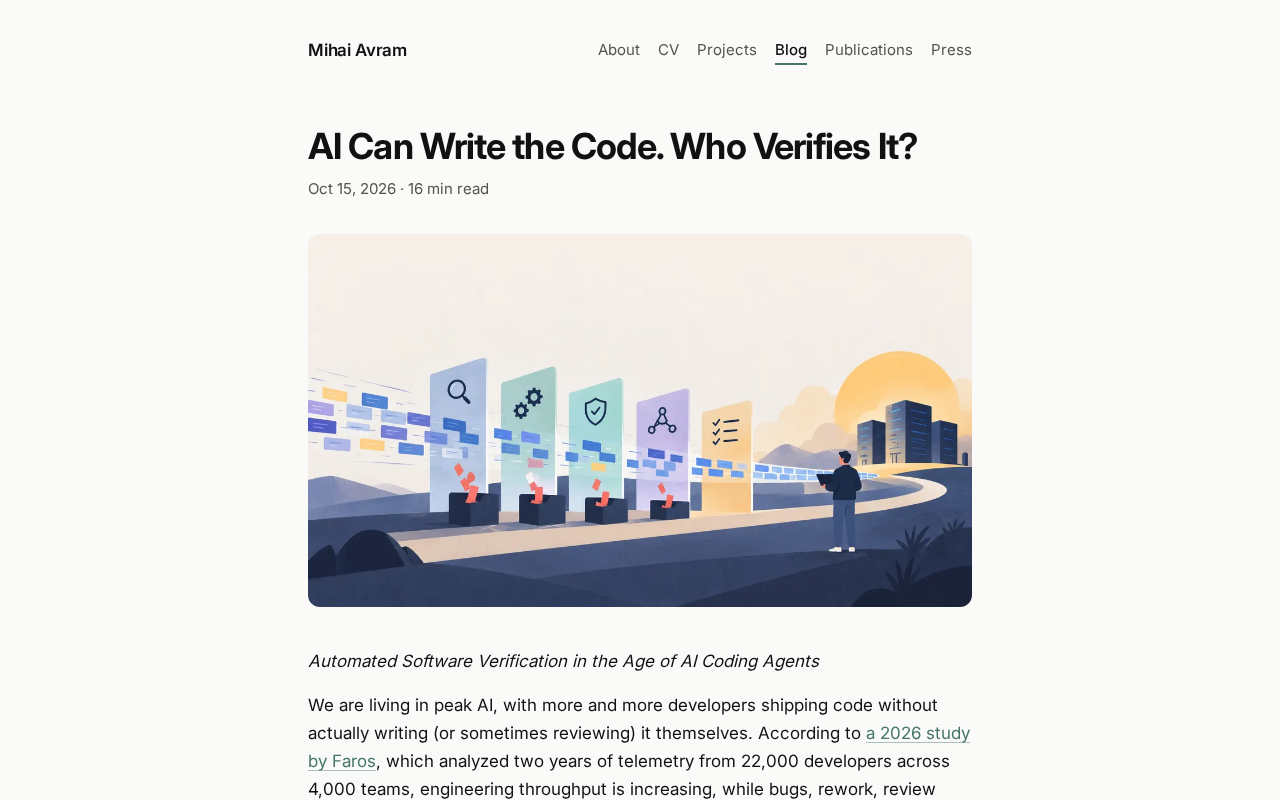
The comment section did not linger on the superficial debate of "is AI code good or not," but quickly shifted to a more practical level—when AI-generated code enters production environments, are the existing code review processes, testing systems, and accountability mechanisms still sufficient.
Consensus: Verification Costs Are Shifting, Not Disappearing
Multiple commenters reached a basic consensus: what AI coding saves is "time at the keyboard," but verification costs do not vanish into thin air—they simply shift from the writing phase to the review and testing phase. One commenter stated bluntly that AI-generated code often "looks very reasonable," and this surface-level plausibility actually increases review difficulty—human reviewers easily fall into the cognitive trap of "it looks about right" and skip line-by-line scrutiny.
This leads to a structural contradiction: AI raises code output speed by an order of magnitude, but the speed at which humans verify code has barely changed. If the verification step doesn't scale accordingly, the bottleneck in the entire software delivery chain will shift from "writing" to "reviewing"—and the latter is precisely harder to automate.
Disagreement: Can Testing Be the Gatekeeper for AI Code?
The comment section showed a clear split on the question of "can testing backstop this."
One camp argues that as long as test coverage is high enough and test cases are strict enough, AI code and human code are essentially no different—the CI pipeline will block problematic commits. This logic holds in theory, but another camp points out the circular dependency: AI can also generate tests, and if the tests are written by AI too, then "using AI to test AI" becomes self-referential. The quality of the tests themselves needs to be verified, and that verification loops back to human judgment.
Other comments mention a more insidious problem: AI tends to generate code that "passes the tests" rather than code that is "correct." When test cases have coverage blind spots, AI-generated code may happen to bypass those blind spots and appear perfectly normal—until edge conditions are triggered in production.
CI pipeline (continuous integration) refers to the automated process where, after each commit, the system automatically triggers a build, runs tests, and reports results. Its core value lies in converting verification from manual operation to machine execution, thereby intercepting obvious defects before code is merged. But CI's effectiveness depends entirely on the quality and coverage of test cases—if the tests themselves have blind spots or weak assertions, the pipeline only provides a false sense of security. When AI-generated code and tests enter the repository together, CI still runs normally, but cannot distinguish whether "tests pass" because the code is correct or because the tests are too loose. This is precisely the engineering-level manifestation of the circular dependency that the comment section worries about.
Accountability: Who Is Responsible for AI-Written Code
Among the 33 comments, many discussions revolved around accountability. The consensus is that no matter who generates the code, the person who merges it and the team that approves its release still bear ultimate responsibility. AI is not an accountable entity; it is just a tool.
But the problem is: when an engineer reviews 50 AI-generated PRs in a day, how much energy does he have left to truly understand every line of code? Some in the comment section suggest that code review culture itself needs adjustment—shifting from "quick glance" to "sampled deep review," marking the source of AI-generated portions, and requiring authors to attach verification notes. Others believe teams should clearly define which modules allow AI generation and which must be written manually—for example, security-sensitive code paths or those involving financial transactions.
Code review is a quality control step in software engineering, typically involving other engineers checking logic, style, and potential risks line by line before code is merged. Traditional review relies on the reviewer's understanding of the author's intent and their own domain experience, whereas AI-generated code lacks traceable design intent—reviewers can only infer logic from the result. More critically, review is attention-intensive work with extremely high cognitive load. When AI multiplies the number of PRs, reviewer attention becomes a scarce resource, and quick-glance shallow review becomes the default behavior—which is precisely the main channel for defect escape. Therefore, the source marking and verification notes proposed in the comment section are essentially an attempt to rebuild the missing information of "author intent" in the review process.
Practical Impact on Development Workflows
The value of this discussion is not in providing a standard answer, but in highlighting a shift that is already happening: the proliferation of AI coding tools is pushing the center of gravity of software engineering from "writing" to "verifying." This means teams need to reallocate their energy—investing more in test design, code review standards, and observability infrastructure, rather than simply pursuing the proportion of AI-generated code.
For teams introducing AI coding assistants, the implicit advice from the comment section is: build the verification infrastructure first, then talk about efficiency gains. Otherwise, the speed advantage brought by AI will ultimately be offset by production incidents and rework.
One-line Summary
AI lowers the barrier to writing code, but verification costs shift to review and testing, with responsibility still resting with human teams.
Paragraph Summary
A Hacker News discussion thread points out that AI coding tools have drastically lowered the barrier to code generation, but verification costs have not disappeared—they have shifted from the writing phase to the review and testing phase. The comment section reached a consensus: AI code looks plausible on the surface, which actually increases review difficulty, and its output speed far exceeds human verification speed, so the delivery bottleneck will shift from writing to reviewing. The disagreement is over whether testing can backstop this—one camp believes high coverage can intercept problems, while another points out that AI can also generate tests, creating a circular dependency of using AI to verify AI, and that AI tends to generate code that passes tests rather than code that is correct. On accountability, the team that merges code and approves releases bears ultimate responsibility; AI is just a tool. The discussion suggests teams should build verification infrastructure first before pursuing AI efficiency gains.
Related articles

Chain of Thought Isn't Just for AI: How Humans Can Use CoT to Improve Thinking Quality
Chain of Thought isn't just a prompt trick for large models. Starting from a Hacker News discussion, this article analyzes why CoT works for human thinking too, breaks down actionable ways to transfer it, and highlights the key differences between human CoT and machine CoT.
Cloudflare Teams Up with OpenAI: Closi…
Cloudflare Teams Up with OpenAI: Closing the Loop from Vulnerability Discovery to Defense with AI
Cloudflare uses OpenAI Daybreak to investigate security vulnerabilities and generate reviewable remediation plans, while developers use Codex to boost coding efficiency and quality.

Orca Multi-Agent Orchestration in Practice: A Guide to Parallel Collaboration with Claude and Codex
Orca is Stable AI's free open-source agent workbench supporting 34 agents like Claude Code and Codex in parallel. Learn its Git worktree isolation, multi-model orchestration, and mobile management.