AI Capabilities Are Soaring, But Reliability Is Stalling: The Real Problem Nobody's Talking About

AI capability curves are steep; reliability curves are flat — a gap that becomes critical as agents move into execution.
This article distinguishes between AI "capability" (peak single-run performance) and "reliability" (consistent reproduction of correct results), two concepts that are often conflated. Princeton's HAL research shows task accuracy keeps climbing while consistency barely improves. Current evaluation methods compound this by rewarding confident answers over honest uncertainty, effectively training overconfident systems. As AI shifts from conversational advice to autonomous execution, the blast radius of errors grows by orders of magnitude — SQL mistakes, financial errors, and deployment failures can't simply be brushed aside. The article calls on the industry to incorporate consistency, appropriate refusal behavior, and failure severity into core evaluation metrics, framing reliability as the defining competitive moat of the agent era.
Capability and Reliability Are Not the Same Thing
When discussing AI progress, people tend to treat "capability" and "reliability" as interchangeable — but they're fundamentally different. A model can perform brilliantly on a challenging task in a single attempt and still be something you'd never trust in production.
Princeton's HAL (Holistic Agent Leaderboard) research has quantified this gap: task accuracy keeps climbing, but reliability improvements lag far behind. The same agent can solve a problem yet fail to reproduce that result when the identical task is run again. The headline numbers go up; consistency barely moves.
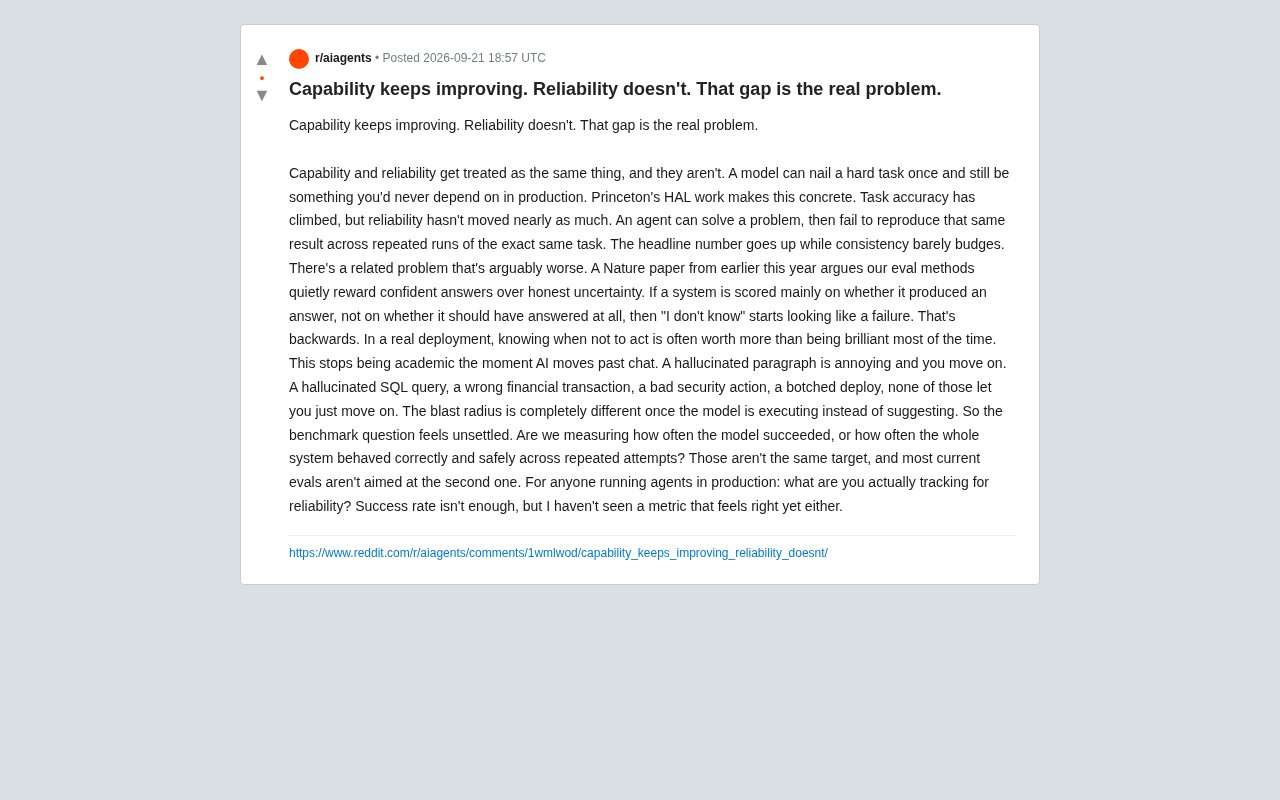
This is a critical blind spot in today's AI evaluation landscape. We fixate on peak performance while ignoring the metric that actually determines whether a system can be depended upon: the ability to reproduce correct results consistently.
Princeton's HAL (Holistic Agent Leaderboard) is a benchmark framework specifically designed to evaluate the holistic performance of AI agents. Unlike traditional benchmarks that focus on single-task pass/fail outcomes, HAL examines the overall behavioral quality of agents across multi-step, multi-turn interaction scenarios. It was built precisely to fill the gap between "peak capability" and "stable performance" — by running identical tasks under identical conditions multiple times and directly measuring output consistency. This approach reveals an uncomfortable truth: most frontier models exhibit enormous variance, with the same task potentially yielding completely different results across runs — a kind of instability that traditional one-shot evaluations simply cannot detect.
Evaluation Methods Are Quietly Rewarding "Confident Errors"
There's a related problem that may be even worse. The original post cited a paper published earlier this year in Nature, whose central argument is that current evaluation methods implicitly reward confident answers while penalizing honest uncertainty.
If a system is primarily scored on whether it gave an answer rather than whether it should have answered at all, then "I don't know" gets counted as a failure. That logic is backwards.
In real-world deployment, knowing when not to act is often more valuable than being smart most of the time. A system that stays silent and refuses to execute under uncertainty is far more trustworthy than one that exudes confidence yet occasionally makes catastrophic mistakes. Yet current evaluation incentives train AI to be exactly the latter.
This problem maps directly to the technical concept of model "calibration": a well-calibrated model's expressed confidence should closely match its actual accuracy — when it says "I'm 90% sure," it should be correct roughly 90% of the time. However, mainstream LLM training objectives (such as human preference feedback in RLHF) tend to reward responses that sound fluent and definitive, because human evaluators perceive them as "more helpful." This effectively trains models into overconfident systems: they continue giving affirmative answers in areas of genuine uncertainty rather than acknowledging the limits of their knowledge. For high-stakes, execution-capable agents, calibration matters as much as raw accuracy — a system that knows what it doesn't know can trigger human review at critical junctures instead of acting recklessly.
When AI Shifts from "Advising" to "Acting," the Risk Profile Changes Entirely
As long as AI stays within a chat interface, these issues feel academic. A hallucinated sentence is annoying, but you move on.
Once AI steps outside the chat box, everything changes:
- A hallucinated SQL query
- An erroneous financial transaction
- A botched security operation
- A failed code deployment
These mistakes don't let you just "move on." When a model transitions from advising to executing, the blast radius of an error is on a completely different order of magnitude. This is precisely why, as agents scale into production, reliability has moved from a peripheral concern to an existential one.
"Blast radius" is a term borrowed from cybersecurity and cloud architecture, originally referring to the maximum scope of impact from a security breach or system failure. In the context of AI agents, it describes the extent of cascading damage a single wrong decision can cause. When AI functions purely as an advisory tool, humans remain the final executor — and human judgment naturally caps the blast radius. But when an agent is granted direct permissions to call APIs, execute database writes, or trigger automated workflows, a single error can propagate to multiple downstream systems within milliseconds, often in ways that are difficult or impossible to roll back. This is why "least privilege" principles and human-in-the-loop review checkpoints are repeatedly emphasized in agent system design — they are, at their core, deliberate strategies to compress the blast radius.
What Are We Actually Measuring?
This leaves a fundamental question about benchmarking unresolved: are we measuring how many times a model succeeded, or how often the entire system behaved correctly and safely across repeated attempts?
These are two completely different objectives, and the vast majority of current evaluations are aimed at the former.
Raw success rate is clearly insufficient — it can't capture consistency, it doesn't reflect how well a system performs at refusing incorrect actions, and it doesn't measure the severity of failures when they occur. Yet as of now, the field still doesn't seem to have a reliability metric that truly feels right.
The original post posed an open question to every practitioner running agents in production: What metrics are you actually using to track reliability?
Final Thoughts: Reliability Is the Real Moat of the Agent Era
This conversation surfaces a truth obscured by capability narratives: models getting smarter doesn't mean they're getting more trustworthy. The steep climb of the capability curve makes it easy to believe AI is ready to take over critical tasks — but the flat reliability curve is the actual ceiling that determines whether it can truly be deployed.
For teams pushing agents into production, the challenge may be to redesign evaluations: make "consistency across repetitions," "refusal when refusal is warranted," and "severity of failure consequences" core metrics, rather than continuing to chase single-run peak performance numbers. Whoever solves reliability first will hold the real competitive moat of the agent era.
Related articles

JobRunner MCP Server: AI Agents Can Now Fix Failed Java Jobs
JobRunner launches an open-source MCP server enabling AI agents to view cluster status, diagnose failures, and recover Java jobs—incident response from any cloud coding environment or existing agent.

MLAI Digital Launches 9 Security Agents: MCP Server Safeguards the Full Lifecycle of Agentic AI
MLAI Digital launches Security MCP Server with nine built-in specialized security agents covering vulnerability discovery, attack simulation, prompt injection detection, API and infrastructure assessment, and accelerated remediation—embedding security validation across the full Agentic AI lifecycle from development to production.

Running Isaac Lab on H100 GPUs: Exploring Better Approaches
Exploring optimization methods for running Isaac Lab on NVIDIA H100 GPUs, including MIG configuration, mixed precision, TensorRT acceleration, and community experience to improve robotics simulation and reinforcement learning efficiency.