AI Chain-of-Thought Is Not Human Reasoning: Research Reveals the Truth About LLM Reasoning Tokens

Research shows LLM reasoning tokens are computational aids, not human-like logical thinking.
A new OpenReview study challenges the assumption that LLM reasoning tokens represent human-like logic. Key findings reveal that correct answers don't correlate with valid reasoning traces, models trained on corrupted traces perform equally well or better, and trace length is unrelated to problem difficulty. The research urges developers to stop anthropomorphizing AI thinking and instead view reasoning tokens as computational resource allocation mechanisms.
Introduction: Intermediate Tokens Are Not "Thinking"
When we see large language models (LLMs) generate lengthy "thinking processes" (thinking/reasoning tokens) before answering a question, it's easy to fall into an illusion — that AI is reasoning step by step, just like a human. This anthropomorphic interpretation has become almost an industry consensus: the more the model "thinks," the more reliable its answer; if the reasoning process is lengthy, we say it's "overthinking."
But a study published on OpenReview (paper link) raises fundamental questions about this narrative. The study's core argument is blunt and sharp: these so-called "reasoning tokens" have essentially nothing to do with human reasoning.
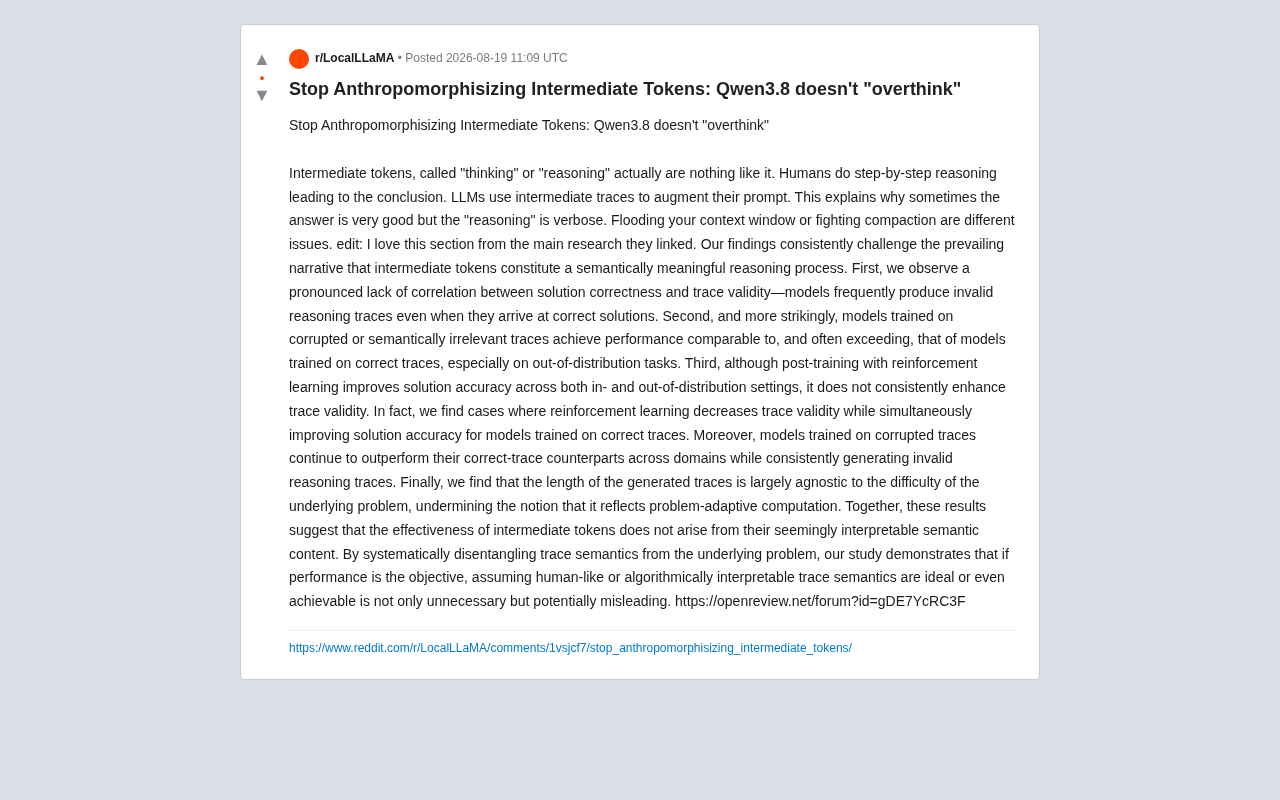
Human step-by-step reasoning is a logical ladder leading to a conclusion, where each step carries semantic meaning. The intermediate traces generated by LLMs, however, are more like expanding their own prompt context — they serve as a computational aid, not an interpretable thought process. This explains why models sometimes produce excellent answers while their "reasoning process" is verbose, chaotic, or even self-contradictory.
Five Core Findings from the Research
By systematically decoupling "trace semantics" from "underlying problems," this study arrived at a series of counterintuitive conclusions. Here are the five most impactful findings.
Finding 1: Correct Answers Are Unrelated to Valid Reasoning
The researchers observed a clear lack of correlation between answer correctness and reasoning trace validity. Models frequently arrived at correct answers even when their reasoning traces were completely invalid.
This means that the seemingly logically rigorous "chain of thought" may be nothing more than window dressing. Whether the answer is correct or not does not depend on whether these intermediate tokens make semantic sense.
Finding 2: Training on "Wrong Traces" Actually Produces Stronger Models
This is the most shocking conclusion of the entire paper. The study found that models trained on corrupted or semantically irrelevant reasoning traces performed on par with — or even better than — models trained on correct traces, especially on out-of-distribution tasks.
In other words, if you deliberately train a model on a bunch of nonsensical reasoning processes, it doesn't become dumber — it might actually perform better on unfamiliar tasks. This directly undermines the assumption that "high-quality reasoning data leads to high-quality reasoning ability."
Finding 3: Reinforcement Learning Improves Accuracy but Doesn't Necessarily Improve Reasoning Validity
Reinforcement learning (RL) during post-training does improve answer accuracy on both in-distribution and out-of-distribution tasks, but it does not consistently improve the validity of reasoning traces.
The study even found cases where, for models trained on correct traces, reinforcement learning improved answer accuracy while simultaneously reducing the validity of reasoning traces. Accuracy goes up, but the reasoning becomes more "absurd" — the two are completely decoupled.
Finding 4: Corrupted-Trace Models Dominate Across the Board
Extending the logic of Finding 2, models trained on corrupted traces consistently outperformed their correctly-trained counterparts on cross-domain tasks, while the reasoning traces they generated were consistently invalid.
This further demonstrates that the validity of reasoning tokens is not the source of model performance. The model's capabilities come from other mechanisms, not from what we understand as "logical deduction."
Finding 5: Trace Length Is Unrelated to Problem Difficulty
Finally, the study found that the length of generated traces is largely unrelated to the difficulty of the underlying problem.
This point is particularly important. It directly refutes the popular claim that "models adaptively adjust their computation based on problem difficulty" (problem-adaptive computation). So-called "thinking more" or "thinking less" does not truly correspond to the complexity of the problem. When we say a model is "overthinking," the anthropomorphic description itself is misleading.
Why This Matters
The Danger of Anthropomorphic Narratives
The researchers' summary is emphatic:
"Our findings suggest that assuming reasoning traces have human-like or algorithmically interpretable semantics is ideal, or even achievable, is not only unnecessary but potentially misleading if performance is the goal."
This statement highlights a cognitive trap in the current AI industry. We habitually use human frameworks to understand model behavior — calling intermediate tokens "thinking," labeling lengthy outputs as "overthinking," and describing brief responses as "being lazy." But these anthropomorphic labels may cause us to misjudge how models actually work.
Context Flooding Is a Separate Problem Entirely
You may not have noticed, but context window flooding caused by intermediate tokens, or conflicts with compaction mechanisms, is an entirely different class of problem.
The insight that "reasoning tokens aren't real reasoning" and the engineering problem that "reasoning tokens consume a large token budget" need to be discussed separately. The former concerns how we understand models; the latter concerns cost and efficiency in actual deployment.
Practical Implications for AI Developers
For engineers building AI applications, this research offers several key perspectives:
- Don't over-trust the readability of reasoning traces. A seemingly reasonable "chain of thought" doesn't mean the answer is more reliable, and vice versa.
- Reasoning tokens should be viewed as a computational resource allocation mechanism, not as decision-making evidence for human review.
- When evaluating models, focus on the correctness of the final answer, not on how "elegant" the reasoning process looks.
Conclusion: Returning to an Honest Understanding of AI Mechanisms
This research does not deny the value of reasoning models — their performance improvements are real. What it denies is the way we explain those improvements.
Intermediate tokens are indeed useful, but their effectiveness does not come from their seemingly interpretable semantic content. When we stop anthropomorphizing these tokens as "thinking" and "reasoning" and instead understand them as a mechanism for enhancing prompts and expanding computation, we can more accurately design, evaluate, and optimize the next generation of AI systems.
As a widely cited saying goes: understanding models as if they were humans is often the easiest — and most dangerous — shortcut.
Related articles

Kimi K3.1 Hands-On Test: Open-Source Model Nears Opus, Video Generation Steals the Show
Kimi K3.1 completed motion graphics, 3D rendering, mini-games, and video generation in a live test. Analysis of its 2.8T MoE architecture, gap vs Opus/GPT, and hidden video generation.

Sam Altman: Why Life's Biggest Advice Should Still Come from Humans
OpenAI CEO Sam Altman on the limits of AI advice: AI can talk you out of an impulsive email, but life's biggest advice should still come from humans.

"Black October": Did AI Uncover 3% of All Critical Vulnerabilities Ever?
A Reddit post claims 3% of all critical software vulnerabilities ever were found in the past month, dubbed 'Black October.' We break down the statistical issues, how AI-assisted code auditing accelerates discovery, and how developers should respond.