AI Chat Tools Quietly Remove Delete Feature, Disrupting User Workflows

AI chat tools silently remove delete feature, breaking power users' multi-session workflows.
A Reddit user discovered their AI chat tool's "delete last query" option vanished without warning, disrupting their multi-session workflow. This article examines why this feature matters for error correction, context management, and cost control, explores possible reasons for its removal including A/B testing and regression bugs, and outlines best practices for responsible product changes including changelogs, transition periods, and transparent communication.
A Feature That Suddenly Vanished
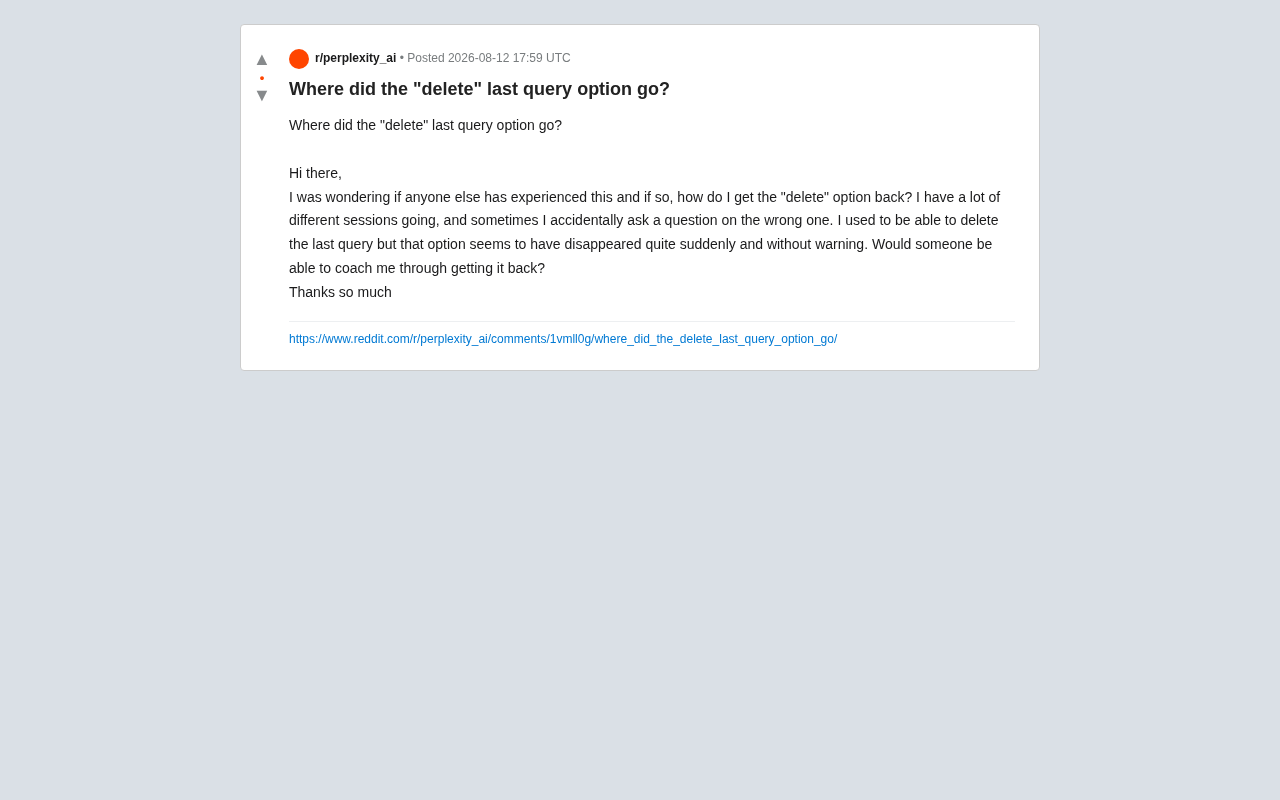
Recently, a user posted a plea for help on Reddit titled "Where did the 'delete' last query option go?" This seemingly minor question actually touches on a widespread yet often overlooked pain point in AI conversational products during their iteration cycles: the disruption to user workflows caused by the silent removal of features.
The poster described their predicament: they maintain multiple conversation sessions simultaneously and sometimes accidentally ask a question in the wrong session. Previously, they could quickly correct this mistake using the "delete last query" function, but this option "disappeared quite suddenly and without any warning." In the post, they somewhat helplessly asked community members to help them find this feature.
Why the "Delete Last Query" Feature Matters So Much
For power users of AI chat tools, "delete last query" is far from a dispensable edge-case feature. It serves several critical functions:
Error Correction and Fault Tolerance
As the poster described, in multi-session parallel workflows, users can easily type a question into the wrong conversation window. Multi-session workflow is a common usage pattern among heavy AI users — a user might simultaneously maintain one session for code debugging, another for copywriting, and yet another for data analysis. Each session has its own independent context window, and the model relies on the conversation history within that window to understand user intent. This workflow is similar to a programmer having multiple terminal windows open for different projects — once a command is executed in the wrong window, the consequences can be costly to fix. A convenient delete function allows users to recover from an operational mistake within seconds, rather than having to rebuild the entire session context.
Context Management
The quality of AI conversations is highly dependent on context. An irrelevant or incorrect query can "pollute" subsequent conversations, causing model outputs to deviate from expectations. To understand this, you need to grasp the Context Window mechanism of Large Language Models (LLMs) — it refers to the length of conversation history the model can "see" when generating a response, typically measured in token count. Current mainstream models have context windows ranging from a few thousand to hundreds of thousands of tokens. Because the attention mechanism in Transformer architecture performs weighted calculations across all tokens in the context, an erroneous query can cause the model to be persistently influenced by that incorrect information in subsequent conversations, producing off-topic responses or introducing irrelevant assumptions. Therefore, the delete function is actually an important tool for users to actively manage context quality.
Cost and Efficiency Control
In scenarios with per-token billing or usage quotas, promptly deleting invalid queries also helps control costs and keep sessions clean. A token is the basic unit by which LLMs process text, roughly equivalent to 3/4 of an English word or one Chinese character. AI service providers like OpenAI and Anthropic typically charge based on the total number of input and output tokens — for example, GPT-4's API fees are priced per thousand tokens. For enterprise users or developers integrating AI capabilities via APIs, every query sent to the model directly incurs costs. Even subscription-based consumer products often have daily or monthly usage quota limits. Therefore, promptly deleting accidentally sent queries isn't just an experience optimization — it's a tangible cost savings.
Common Reasons Why AI Tools Remove Features
Although the original post didn't specify which product was involved, AI tools typically remove similar features for several possible reasons:
- UI Redesign: Product teams may move the feature to a deeper menu level or temporarily take it offline during interface overhauls.
- Technical Architecture Changes: Certain backend logic changes (such as introducing a new session storage mechanism) may make the original delete operation difficult to maintain compatibility.
- A/B Testing: Some users may be assigned to an experimental group that doesn't include the feature. A/B testing is a core methodology in internet product development, where users are randomly divided into two or more groups, each shown different versions of features or interfaces, and behavioral data is compared across groups to determine which approach is superior. In AI products, everything from model response format adjustments and button position changes to the addition or removal of entire feature modules can be placed into experiments. This means different users of the same product may see completely different interfaces at the same time — which also explains why in community discussions, different users may give completely contradictory descriptions of whether a feature exists.
- Unintentional Regression Bug: In rapid iteration, features may be accidentally broken without being caught by test coverage. A Regression Bug is a common issue in software engineering, referring to previously working features behaving abnormally after new code is committed. This typically occurs when implicit dependencies exist between code modules — modifying Module A might accidentally break Module B that depends on A. In the fast-iteration environment of AI products, the automated test coverage rate of CI/CD (Continuous Integration/Continuous Deployment) pipelines directly determines how quickly regression bugs are discovered. If "delete last query" isn't included in the automated regression test suite, it could be silently broken in an update, unnoticed until a user discovers and reports it.
The "Silent Change" Trap in Product Iteration
This user's cry for help reflects a typical contradiction in the era of rapid AI product iteration. AI tools are in a period of high-speed evolution, with product teams pushing updates almost weekly or even daily. While this agility brings rapid capability improvements, it also produces side effects — features that users depend on may change or disappear without any notice.
The user repeatedly emphasized "suddenly" and "without any warning" in their post, and this is the crux of the problem. The removal of a feature itself may have its justifications, but lacking a transparent communication mechanism seriously damages user trust. When users discover their familiar workflows have been disrupted with no explanation anywhere, their frustration is amplified.
What Responsible Product Feature Changes Should Look Like
Compared to industry best practices, responsible feature changes typically include the following elements:
- Changelog: Clearly documenting which features are added or removed with each update. A changelog is a standard document for recording version update content in software projects. Projects following Semantic Versioning conventions typically clearly mark categories such as "Added," "Changed," "Deprecated," "Removed," and "Fixed." In the open-source community, initiatives like Keep a Changelog have promoted changelog standardization. However, many commercial AI products' changelogs tend to emphasize only new features and performance improvements while saying little about feature removal or degradation — this is one of the root causes of users feeling "suddenly backstabbed."
- Transition Period and Notifications: Providing advance warning before removing features, or offering guidance on alternative solutions.
- Feedback Channels: Making it easy for users to express their opinions about changes.
- Reversibility: For highly controversial changes, preserving the ability to roll back or letting users choose for themselves.
User Communities Become First Responders for Product Issues
You may not have noticed, but this user ultimately chose to seek help in the Reddit community rather than through official support channels. This detail itself is quite revealing: active user communities often provide solutions faster than official customer service.
In many cases, other users can provide answers faster than official channels — whether it's finding the new location where a feature has been hidden, or confirming that it's a known bug. For product teams, closely monitoring community discussions is an important way to discover user pain points and contain damage quickly. These seemingly trivial help-seeking posts are actually valuable user feedback signals. In the field of product research, this type of feedback from natural settings is called "unsolicited feedback." Compared to data actively collected through surveys, it often more authentically reflects users' actual pain points and priorities, because users only take the initiative to post when a problem is sufficiently bothersome.
Conclusion
The disappearance of the "delete last query" feature is a small incision that illuminates a universal challenge in AI product development. While pursuing feature innovation and iteration speed, product teams should not neglect those "infrastructure-level" features that support daily workflows. For users, every familiar button may be a link in their efficiency system; for products, respecting user habits and communicating changes transparently is the key to earning long-term trust.
Truly mature products need to know not only how to add features, but also how to subtract them with care.
Related articles

Chain of Thought Isn't Just for AI: How Humans Can Use CoT to Improve Thinking Quality
Chain of Thought isn't just a prompt trick for large models. Starting from a Hacker News discussion, this article analyzes why CoT works for human thinking too, breaks down actionable ways to transfer it, and highlights the key differences between human CoT and machine CoT.
Cloudflare Teams Up with OpenAI: Closi…
Cloudflare Teams Up with OpenAI: Closing the Loop from Vulnerability Discovery to Defense with AI
Cloudflare uses OpenAI Daybreak to investigate security vulnerabilities and generate reviewable remediation plans, while developers use Codex to boost coding efficiency and quality.

Orca Multi-Agent Orchestration in Practice: A Guide to Parallel Collaboration with Claude and Codex
Orca is Stable AI's free open-source agent workbench supporting 34 agents like Claude Code and Codex in parallel. Learn its Git worktree isolation, multi-model orchestration, and mobile management.