AI Citation Testing: Why These Old-School SEO Tactics Completely Fail with AI Agents

Real-world tests show classic SEO tactics fail for AI citations — structure and body content matter far more than meta descriptions.
A B2B AI visibility practitioner shared weeks of experimental findings on Reddit, with results that contradict traditional SEO intuitions. Optimized meta descriptions had almost no effect on AI citations; attempts to manufacture brand mentions on Reddit via automated services were quickly flagged as spam; and restructuring a "top 10 tools" list into an explanatory "how to evaluate tools" format significantly increased AI citation frequency. Together, these findings point to a fundamental reframe: AI SEO should be understood as a multi-stage chain — query → retrieval → source selection → answer generation → citation — not a simple extension of traditional ranking optimization.
When Traditional SEO Meets AI Retrieval: A Multi-Week Experiment
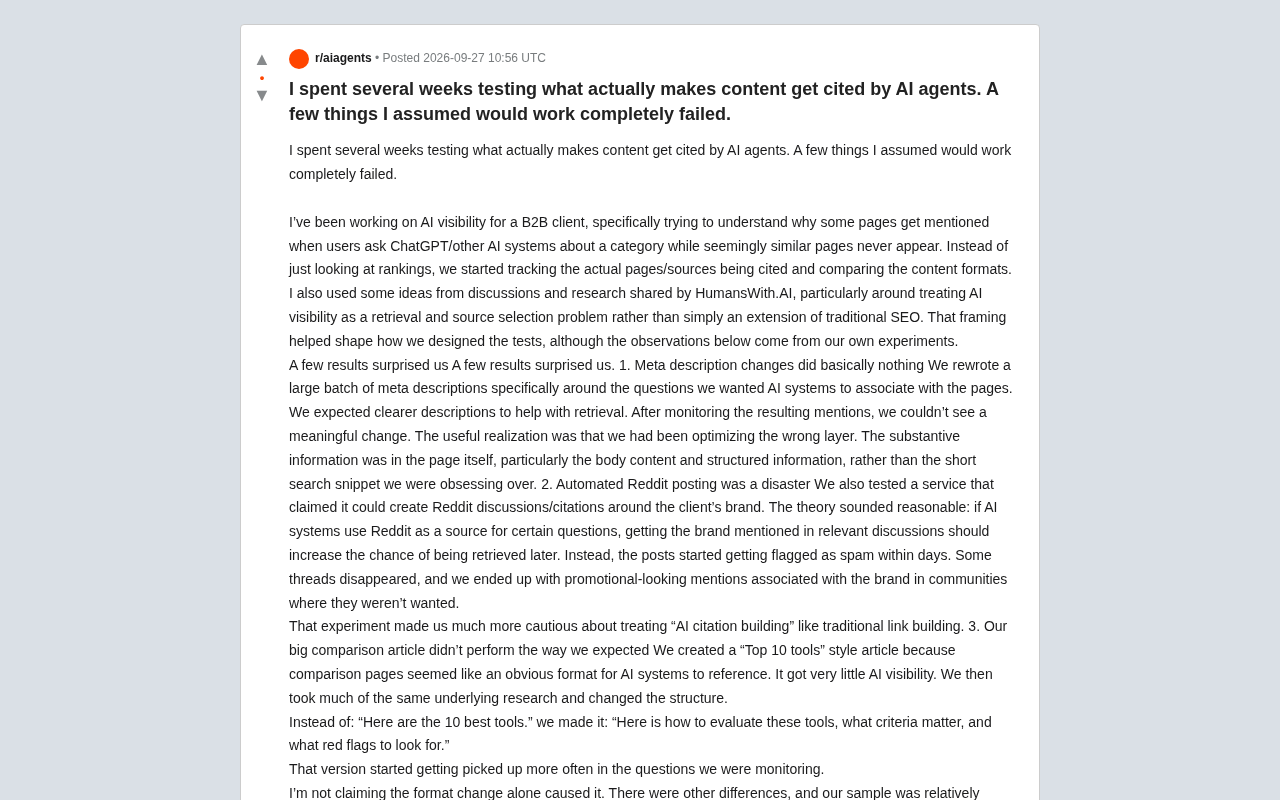
A practitioner working on AI visibility optimization for B2B clients shared their findings from weeks of hands-on testing on Reddit. The core question was straightforward: when users ask ChatGPT or similar AI systems about a product category, why do some pages get cited while seemingly similar pages never appear?
Rather than obsessing over rankings like traditional SEO, the team shifted to tracking which pages and sources AI systems actually cited, and comparing the format differences across those pieces of content. They drew on a key framework from discussions at HumansWith.AI — treating AI visibility as a retrieval and source selection problem, not simply an extension of traditional SEO. This perspective fundamentally shaped how the entire experiment was designed.
Several results came out directly opposite to their initial assumptions.
Three Hypotheses That Were Disproved
Meta Description Optimization: Almost Completely Useless
The team's initial intuition was that rewriting meta descriptions to better match the questions users were asking should help AI systems more easily associate those pages with relevant queries. They rewrote a large batch of meta descriptions in bulk, carefully crafting them around target questions.
After monitoring citation changes, the results were disappointing — no meaningful improvement was visible.
The real insight was that they had been optimizing at the wrong layer. The substantive information lives in the body text and structured content of a page, not in the search snippet they had been painstakingly refining. For AI retrieval, a short snippet matters far less than the actual content of the page. For practitioners accustomed to traditional SEO, this required a significant mental adjustment.
Automated Reddit Citations: A Disaster
The second experiment carries a stronger warning. The team tested a service that claimed to "manufacture" Reddit discussions and citations around a client's brand. The logic sounded reasonable: since AI systems cite Reddit content when answering certain questions, getting the brand mentioned in relevant discussions should increase the chances of being retrieved later.
Reality was harsh. The posts were flagged as spam within days, some threads disappeared entirely, and what remained was a collection of brand mentions that looked like ads, sitting in communities that clearly didn't want them.
This failure made the team extremely wary of the entire concept of "AI citation building" — it absolutely cannot be approached like traditional link building. Artificial-looking activity gets quickly identified and punished within community ecosystems, ultimately damaging brand reputation.
Comparison List Articles: Underperformed Expectations
The third finding may be the most instructive. The team produced a "top 10 tools" comparison article, because listicle-format comparison pages seemed like exactly the kind of content AI systems would naturally want to cite. But its AI visibility was very low.
They then took roughly the same underlying research and changed only the structure — from "here are the ten best tools" to "how to evaluate these tools, which criteria matter, and what red flags to watch for."
The restructured piece began appearing in citations far more frequently across the queries they were monitoring. The author was honest that this wasn't a rigorous controlled experiment: there were other differences beyond format, and the sample size was small. But the gap was significant enough that the team now tests content structure much more deliberately. This hints at a direction: AI systems may favor content that explains the reasoning behind judgments rather than simply listing conclusions.
Rethinking "AI SEO": From Rankings to the Retrieval Chain
These experiments led the author to a more fundamental question: have we been thinking about "AI SEO" wrong from the very beginning?
In traditional search, optimizing around ranking factors makes sense. But for AI systems, the author argues a more useful mental model is this chain:
Query → Retrieval → Source Selection → Answer Generation → Citation
The value of this framework is that it breaks down the single-point question of "how do I rank higher" into multiple distinct stages. The author is currently trying to figure out which parts of this chain publishers can actually control.
The failure of meta descriptions, the backfire of Reddit manipulation, and the unexpected success of content structure each map onto different stages in this chain with different weightings. Together they point to a single conclusion: the levers that influence AI citation don't overlap neatly with those of traditional SEO.
Behind this retrieval chain lies the RAG (Retrieval-Augmented Generation) architecture used by most mainstream AI Q&A systems today. RAG works roughly like this: when a user asks a question, the system first uses vector retrieval to pull a set of relevant document chunks from an external knowledge base, then feeds those chunks as context to a large language model to generate a response, with sources noted. This means a page being cited involves at least two independent thresholds: first, whether the content has been indexed by the system's retrieval index and whether its semantic similarity to the target query in vector space is high enough (the "retrieval" stage); second, whether after being retrieved, the model judges it as a high-quality, trustworthy source (the "source selection" stage). Traditional SEO primarily influences how search engines crawl and rank content, whereas each stage of a RAG pipeline has its own independent scoring logic — which is exactly why meta description optimization is nearly useless for AI citations. It can influence click-through rate presentation in traditional search results, but it barely participates in the semantic vector computation process.
The Core Question That Remains Unanswered
The author closed the post with a question worth the entire industry's consideration, directed especially at those building AI agents or working on retrieval systems:
In real-world systems, what are the relative weights of source authority/reputation versus the semantic quality and structure of retrieved content?
He specifically wanted to hear from people who had tested this with their own datasets — not SEO theory — not speculation by analogy to traditional SEO. The question itself reflects a genuine dilemma in the current "AI visibility optimization" space: most advice is stuck at the speculation stage or relies on analogies to traditional SEO, while empirical evidence grounded in the internal mechanics of retrieval systems remains extremely scarce.
For content creators and marketers paying attention to this space, this experiment at minimum offers a few practical takeaways: shift effort from snippets to the substantive body content, abandon opportunistic attempts to manufacture citations artificially, and organize content around explanatory structure rather than pure listicles. As for the relative weight of source authority versus content quality, the answer will likely require more frontline data to verify.
The mechanism by which "source authority" influences AI citation currently has two plausible pathways: one is implicit weighting at the training data level — if a domain appears extensively in pre-training data and is frequently cited, the model may assign it higher credibility at the parameter level; the other is explicit filtering at the retrieval system level — some RAG systems introduce signals similar to PageRank or domain whitelists during the retrieval stage, directly affecting which content is eligible to enter the candidate pool. The optimization implications of these two pathways are completely different: the former means authority is the result of long-term brand accumulation that is difficult to influence in the short term; the latter suggests there may be certain structured signals (such as Schema markup, author information, HTTPS, citation counts) that can be recognized by the retrieval layer. Very few AI products have publicly disclosed the internal mechanics of their retrieval systems — which is exactly why the author specifically sought input from AI agent and retrieval system practitioners at the end of the post.
Related articles

Chain of Thought Isn't Just for AI: How Humans Can Use CoT to Improve Thinking Quality
Chain of Thought isn't just a prompt trick for large models. Starting from a Hacker News discussion, this article analyzes why CoT works for human thinking too, breaks down actionable ways to transfer it, and highlights the key differences between human CoT and machine CoT.
Cloudflare Teams Up with OpenAI: Closi…
Cloudflare Teams Up with OpenAI: Closing the Loop from Vulnerability Discovery to Defense with AI
Cloudflare uses OpenAI Daybreak to investigate security vulnerabilities and generate reviewable remediation plans, while developers use Codex to boost coding efficiency and quality.

Orca Multi-Agent Orchestration in Practice: A Guide to Parallel Collaboration with Claude and Codex
Orca is Stable AI's free open-source agent workbench supporting 34 agents like Claude Code and Codex in parallel. Learn its Git worktree isolation, multi-model orchestration, and mobile management.