AI Clears Flare-On Reverse Engineering Challenge in Two Hours — Security Experts Fear for Their Careers

A top reverse engineer cleared Flare-On CTF in 2 hours using Claude, solving the hardest stage in just 20 minutes.
A top European reverse engineering expert completed this year's Flare-On CTF — a competition that normally takes 10–12 days — in just 2 hours using Claude. The final and hardest challenge was solved in roughly 20 minutes after uploading the binary with a single instruction, compared to the 5–6 days it historically takes human experts. Long considered a domain requiring irreplaceable human intuition, this performance suggests AI's autonomous reasoning and tool-use capabilities have crossed a critical threshold. The incident is a single-source anecdote and model details remain unverified, but the broader trend — AI capability ceilings rising faster than expected — carries serious implications for how security professionals define their value going forward.
A CTF Reverse Engineering Challenge That Sent Shockwaves Through the Industry
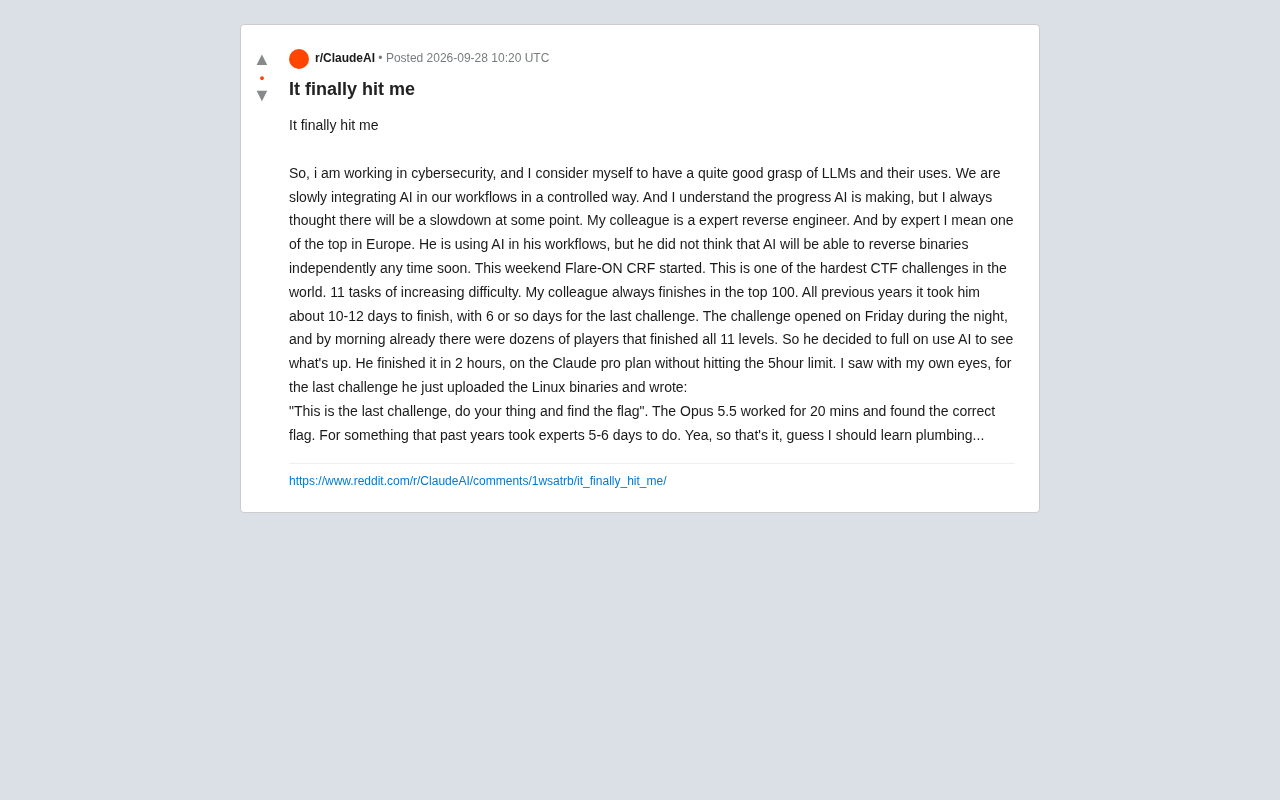
A Reddit user working in cybersecurity shared a firsthand experience from their weekend — one written with barely-concealed disbelief. They considered themselves well-versed in large language models (LLMs) and their applications, and their team had been carefully integrating AI into their workflows in a controlled manner. They had always believed AI progress would plateau at some point — until this past weekend shattered that belief entirely.
The central figure in this story is their colleague, described as a "top-tier European-level" reverse engineering expert. Despite using AI in their own work, this expert had consistently maintained that AI could not, in the near term, independently perform binary reverse analysis — a task that demands deep experience and intuition.
Flare-On: One of the World's Most Grueling Reverse Engineering CTFs
Flare-On is widely regarded as one of the hardest Capture the Flag (CTF) competitions in the industry. It consists of 11 progressively difficult reverse engineering challenges that test not just tool proficiency, but deep understanding of binary structures, obfuscation techniques, and cryptographic algorithms — requiring competitors to peel back layer after layer over extended periods of time.
This expert had consistently ranked in the global top 100 in previous years. Even so, completing all 11 challenges typically took them around 10 to 12 days — with the final, hardest challenge alone consuming roughly 6 days. Those numbers paint a vivid picture of what this competition demands even from elite human experts.
Background: CTF (Capture the Flag) is a competitive format in cybersecurity where participants break programs, analyze network traffic, and compromise systems to retrieve hidden strings called "flags" as proof of completion. Reverse engineering CTFs are especially complex: competitors receive compiled binary executables with no source code, and must use tools like IDA Pro or Ghidra to decompile machine code into readable logic, infer program intent, and uncover hidden flag-generation algorithms. Flare-On is organized by the Mandiant (now part of Google) security team and is known for its heavy use of anti-debugging techniques, code obfuscation, custom encryption, and VM-based protections — making it one of the industry's premier benchmarks for elite reverse engineering skill. Very few competitors finish each year, and consistently placing in the top 100 signals mastery across multiple platforms including x86, ARM, .NET, and scripting languages.
From 6 Days to 20 Minutes: AI's Overwhelming Performance
This year's challenge opened late on a Friday night. By the following morning, dozens of competitors had already completed all 11 stages — a pace that was itself highly unusual. The expert decided to go all-in with AI and see what was really going on.
The result was jaw-dropping: they completed every challenge in under 2 hours using a Claude Pro subscription, without even approaching the 5-hour usage limit. The original poster claims to have witnessed the final challenge being solved firsthand — their colleague simply uploaded the Linux binary and typed a single line:
"This is the last challenge, do your thing and find the flag."
According to the post, the model (referred to by the author as "Opus 5.5") worked for about 20 minutes and produced the correct flag. That same challenge had historically taken expert humans 5 to 6 days.
It's worth noting that the model version mentioned in the post cannot be verified from public information, and this is a single-source anecdote from a personal share — the specific details should be taken with appropriate caution. But even discounted, the trend it reflects is worth taking seriously.
Why This Matters
Reverse engineering has long been considered a "fortress" domain — one where AI was thought to be largely irreplaceable. It demands multi-level reasoning: reconstructing high-level logic from assembly instructions, identifying encryption and obfuscation schemes, and making experience-backed judgments across a vast search space. These are precisely the kinds of tasks once considered to require "irreplaceable human intuition."
If AI can truly complete the hardest challenges in a top-tier CTF with minimal human intervention — in a near-automated fashion — it suggests that models' autonomous reasoning and tool-use capabilities have crossed a critical threshold. No longer just a "co-pilot" assisting humans, AI is beginning to act as the "pilot" capable of handling complex technical tasks end-to-end.
How it works: AI's ability to perform these tasks stems from combining large language models with tool use. Models trained on massive corpora of code, security research papers, and CTF writeups accumulate implicit knowledge of common encryption algorithms, obfuscation patterns, and binary structures. Tool-use capabilities then allow the model to behave like a human expert — actively invoking disassemblers, debuggers, Python interpreters, and other external programs, executing code, and iterating based on outputs. This "perceive-think-act" loop is what enables end-to-end completion of complex tasks. Unlike pure text-based reasoning, an AI agent with tool access can dynamically run deobfuscation scripts, enumerate possible key spaces, and validate intermediate results — automating what previously required repeated human trial and error. This capability leap is what transforms AI from a "hint-giving assistant" into an "autonomous operator" — and it's precisely why the expert in this story was so stunned.
Practical Implications for Security Professionals
The original poster half-jokingly ended with "Guess I'll go learn plumbing" — a self-deprecating quip masking real professional anxiety. But perhaps the more grounded interpretation is:
- Capability boundaries are being redrawn. The value of security experts may shift from "performing the reverse engineering" to "defining the problem, validating results, and managing risk" — taking on a judgment and oversight role within human-AI collaboration.
- A double-edged sword for both sides. AI that can efficiently reverse binaries is a productivity tool for defenders — but it also means attackers can analyze malware samples and discover vulnerabilities faster. The tempo of the entire attack-defense cycle will accelerate.
- Controlled integration remains essential. The author's team approach of "integrating AI in a controlled manner" remains sound. The more powerful the tool, the more critical it becomes to establish guardrails around data security and output reliability.
Closing Thoughts
This Reddit post cannot serve as rigorous benchmark evidence — the model version and task details carry significant uncertainty. But the signal it reflects is fairly clear: in domains requiring deep reasoning, AI's capability ceiling is rising faster than many experts expected. For the security industry and every technical field, rather than anxiously asking "will AI replace me?", the more productive question may be: "How do I collaborate effectively with an increasingly capable AI?"
Related articles

Chain of Thought Isn't Just for AI: How Humans Can Use CoT to Improve Thinking Quality
Chain of Thought isn't just a prompt trick for large models. Starting from a Hacker News discussion, this article analyzes why CoT works for human thinking too, breaks down actionable ways to transfer it, and highlights the key differences between human CoT and machine CoT.
Cloudflare Teams Up with OpenAI: Closi…
Cloudflare Teams Up with OpenAI: Closing the Loop from Vulnerability Discovery to Defense with AI
Cloudflare uses OpenAI Daybreak to investigate security vulnerabilities and generate reviewable remediation plans, while developers use Codex to boost coding efficiency and quality.

Orca Multi-Agent Orchestration in Practice: A Guide to Parallel Collaboration with Claude and Codex
Orca is Stable AI's free open-source agent workbench supporting 34 agents like Claude Code and Codex in parallel. Learn its Git worktree isolation, multi-model orchestration, and mobile management.