AI Co-Created Battle City v1.6: Maxed-Out Firepower & Armor at Level 5, Eagle Base Auto-Fire

AI co-created Battle City v1.6 adds level-5 upgrades, Eagle auto-fire, and overflow reward mechanics.
Battle City v1.6, developed through AI co-creation, introduces major upgrades including firepower and armor expansion from 3 to 5 levels, an Eagle base auto-fire feature, and a clever overflow reward mechanism that converts excess items into base defenses. The update also adds QR scan-to-play, controller support, and numerous quality-of-life improvements, demonstrating AI-assisted game development's rapid iteration capabilities.
Continuous Iteration of AI Co-Created Games
The classic Battle City is being revitalized with the help of AI tools. Bilibili content creator "大海的科技宝箱" (Ocean's Tech Treasure Box) has been continuously co-creating games with AI, and their Battle City project has received the highly anticipated version 1.6 update. Compared to previous versions, this update brings significant improvements in gameplay depth, system support, and user experience, showcasing the unique advantages of AI-assisted game development in rapid iteration.
AI co-created game development is a new creative paradigm that has emerged over the past two years. Creators leverage large language models (such as GPT-4, Claude, etc.) and AI code generation tools (such as Cursor, GitHub Copilot, etc.), describing requirements through natural language while AI generates game code, numerical logic, and even level designs. The core advantage of this approach is dramatically lowering the programming barrier — creators don't need to master game engines or programming languages; they only need clear design thinking and basic debugging skills to complete the entire workflow from prototype to finished product. Platforms like Bilibili have seen a surge of such creators, who typically use classic games as blueprints for derivative works, reducing design complexity while leveraging players' nostalgia to gain attention.
For AI application enthusiasts, the value of such projects lies not only in the games' entertainment factor but also in validating that ordinary creators can continuously maintain and expand a small game with a complete numerical system using AI tools. Growth curves from level 3 to level 5, item drop logic, and New Game Plus inheritance mechanisms — content that previously required professional developers to carefully refine — can now be rapidly implemented through AI co-creation.
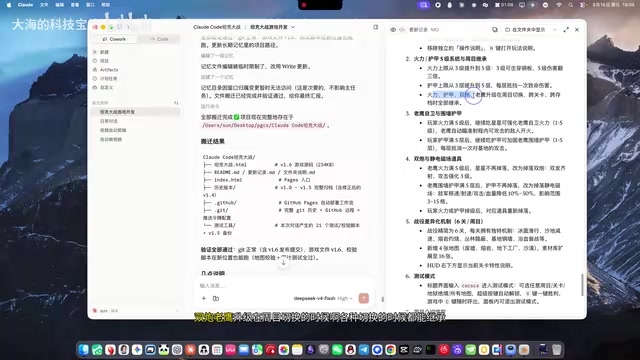
Core Gameplay Upgrade: Firepower and Armor Fully Doubled
Deep Enhancement of the Numerical System
The most significant change in version 1.6 centers on the character progression system. According to the creator, this update expands firepower levels from three to five — level three can already penetrate steel plates, while level five triples damage output. The armor system has likewise been upgraded from three to five levels, with each layer of armor absorbing one fatal hit, dramatically improving the player tank's survivability.
The game's numerical system (also known as game balance or numerical design) is one of the most critical technical modules in game design. In traditional game development teams, numerical designers need extensive mathematical modeling, Monte Carlo simulations, and player behavior data analysis to determine character growth curves, damage formulas, and resource distribution pacing. For example, expanding firepower from three to five levels seems simple, but behind it lies a series of questions: whether damage scaling is linear or exponential, how enemy HP should be adjusted accordingly, and whether the perceived difference between levels is sufficiently distinct. The value of AI tools in this area is that creators can quickly generate code implementations of numerical schemes and rapidly adjust parameters through repeated testing, compressing what might take a traditional team weeks of numerical iteration into just hours.
This "dual doubling" design philosophy creates clear strategic layering in the mid-to-late game. Players must weigh pursuing firepower output against accumulating armor, rather than relying purely on mechanical skill to win.
Overflow Reward Mechanism After Reaching Max Level
Even more noteworthy is the item handling logic after reaching max level. Once firepower hits level five, continuing to collect stars no longer simply increases levels — instead, it strengthens the "Eagle" (the player's base) self-defense firepower. After armor reaches five layers, continuing to collect armor reinforces the Eagle's wall defenses, with each layer absorbing one attack.
This overflow conversion mechanism is known in game design as "resource recycling" or "Overflow Reward," a relatively mature design pattern. Its design philosophy stems from the "positive reinforcement" principle in behavioral psychology — ensuring that every player action yields positive feedback, avoiding the frustration of feeling like efforts were wasted. A classic example is the Legend of Zelda series, where hearts picked up at full health convert to other rewards. This design in Battle City v1.6 essentially creates a multi-tier Reward Cascade, allowing resources to flow between different systems, greatly extending the game's strategic depth and replayability.
Once the Eagle's firepower reaches level five, stars will instead drop enhancement items like "Dual Cannon Double Shot"; once armor reaches five layers, it drops "Electrostatic Field," which reduces enemy movement speed, fire rate, attack, and HP within a range of three to fifteen tiles. This complete overflow conversion chain effectively eliminates the traditional problem of "wasted items after max level," making every pickup meaningful.
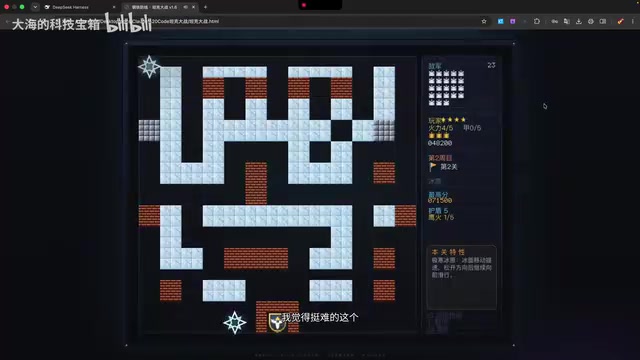
Eagle Auto-Fire: The Biggest Highlight and Bugs to Fix
The most eye-catching feature in this update is undoubtedly "Eagle auto-attacking enemies." The upgraded Eagle base automatically aims at enemies within range and fires, transforming from a purely protected object into a combat unit with counterattack capabilities. This design conceptually enriches the layers of defensive gameplay enormously.
From a technical perspective, the auto-fire feature involves target detection and auto-aiming system design in game AI. In professional game development, such functionality typically requires implementing range detection (through colliders or distance calculations), target priority sorting (closest distance, lowest HP, or greatest threat), firing angle calculation, and ballistic prediction — multiple subsystems working together. The current bug where the Eagle can only fire forward is likely because the vector calculation logic for shooting direction fails to dynamically update based on target position, or the sprite's facing rotation isn't correctly bound to the shooting direction. This type of issue is also very common in professional development and typically requires unit testing and edge case debugging to progressively fix.
However, the creator honestly pointed out the current limitations during live gameplay: the Eagle's shooting has an obvious bug — it can currently only fire forward and cannot truly achieve omnidirectional aiming, making it look "a bit dumb." In his words, this counterattack capability is currently "better than nothing" and needs continued fixes in subsequent versions. This honest presentation of imperfections precisely reflects the inevitable debugging phase characteristic of AI co-creation projects during rapid iteration — AI-generated code tends to have oversights in complex interaction logic, requiring creators to possess debugging judgment capabilities to locate and resolve issues.
Experience Optimization: Scan-to-Play and Cross-Device Support
QR Code Scanning Feature to Lower the Entry Barrier
Beyond core gameplay, version 1.6 puts considerable effort into usability. The new "scan to play" feature allows players to enter the game directly by scanning a QR code, without cumbersome downloads or installations. It also provides a copy-link sharing function, making it easy for users to recommend the game to friends.
The technical foundation of this feature is Web game (HTML5 game) architecture. Unlike traditional native applications, web games run in browsers without requiring any client installation. The core technology stack typically includes HTML5 Canvas or WebGL for graphics rendering, JavaScript for game logic, and WebSocket for multi-device communication. A QR code is essentially a graphical encoding of a URL — scanning it causes the browser to directly load the game page. This lightweight distribution method is particularly suitable for independent developers and AI co-creation projects because it bypasses the tedious app store review process, enabling instant publishing and instant updates.
This design is especially suited for cross-device scenarios: when playing on a computer, scanning the QR code on screen allows a phone or tablet to join the game, achieving a lightweight multi-device experience. For developers, this also requires handling responsive layouts, touch-screen and keyboard input adaptation, and other cross-platform compatibility issues.
Controller Support and System Feature Improvements
This update also improved game controller support — whether on tablet or PC, players can connect a controller for enhanced control feel. Additionally, the creator added a series of system features including cycle completion congratulations, challenge timers, super button indicators, local saves, gameplay instructions, and test mode, along with numerous bug fixes.
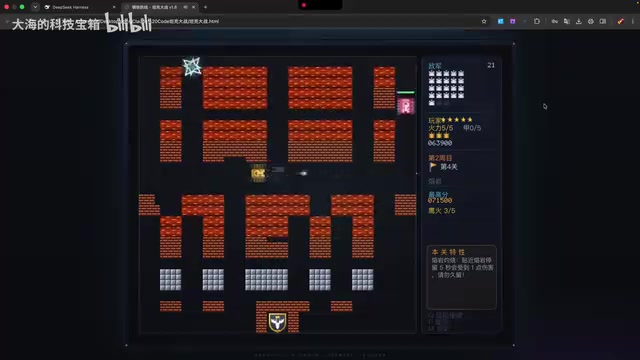
Practical Strategy: Hold Your Ground, Don't Get Greedy
During live gameplay demonstrations, the creator shared valuable strategic insights. He repeatedly emphasized that the core of this game lies in "don't get greedy" — holding advantageous strategic terrain often ensures steady stage completion. Most failure scenarios stem from players leaving safe positions to collect items, resulting in the Eagle base being overrun.
He also mentioned an interesting observation: the Eagle base in the game is actually more fragile than the player's tank — once enemies break through, it becomes their first priority target. Therefore, protecting home base and wisely utilizing armor items become the keys to clearing stages. This steady "wait-and-ambush" playstyle is especially important in New Game Plus cycles and higher difficulties.
It's worth noting that the game's New Game Plus (NG+) cycle inheritance mechanism is a classic replay design, traceable back to Chrono Trigger in 1995. Under this mechanism, players can carry over partial attributes or equipment into a new round after completion, while enemy difficulty scales up accordingly. The cycle system in Battle City v1.6 combines NG+ with Roguelike elements — players retain partial progression during cycle transitions but face stronger enemy configurations. The creator's emphasis on "hold your ground, don't get greedy" is precisely because the margin for error in higher cycles is extremely low — one risky move could lose everything.
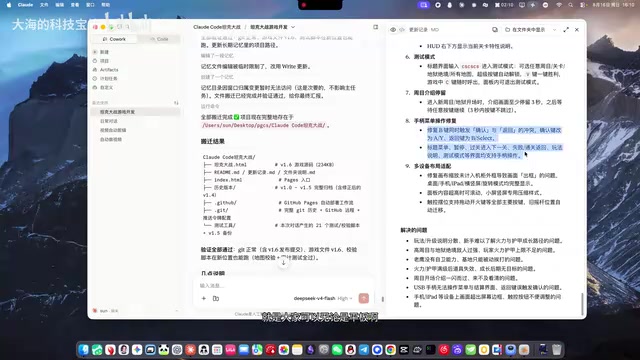
Conclusion: Ongoing Exploration of AI Co-Created Game Development
The version 1.6 update of Battle City demonstrates the comprehensive capabilities of AI-assisted game development in numerical design, feature expansion, and experience optimization. While new features like Eagle auto-fire still have bugs to fix, the overall iteration speed and content richness are impressive.
The creator has stated they will continue co-creating this project and will share more interesting AI usage tips and news. For viewers following AI application deployment, this type of authentic, transparent co-creation record holds more reference value than mere finished product showcases — it shows us how AI tools truly integrate into ordinary creators' ongoing creative workflows. As AI code generation capabilities continue to evolve and web game technology matures, we have reason to expect that an increasing number of non-professional developers will be able to leverage AI tools to turn the game ideas in their minds into reality, driving true democratization of game creation.
Related articles

Felix Rieseberg Personal Homepage
Felix Rieseberg's personal homepage sparks attention on Hacker News. This article covers the Slack engineer's technical background, the rise and fall of nativefier, and the value of a developer homepage as a tech calling card.

@ai-sdk/vue 3.0.306 Patch Release Syncs with [email protected] Update
@ai-sdk/vue 3.0.306 released, synced with [email protected]. A routine patch release for the Vercel AI SDK ecosystem with no public API changes; the Vue adapter layer stays version-aligned with the core package.

Gemini 4 Argon API Launches: The Era of Million-Token Output Begins
Google launches Gemini 4 Argon with sparse MoE architecture, up to 1M output tokens, and a 68.90% Vals Index score, available across API, AI Studio, and the Gemini app.