AI Coding Agent Benchmark: Comprehensive Ranking and Selection Guide for 80+ Tools
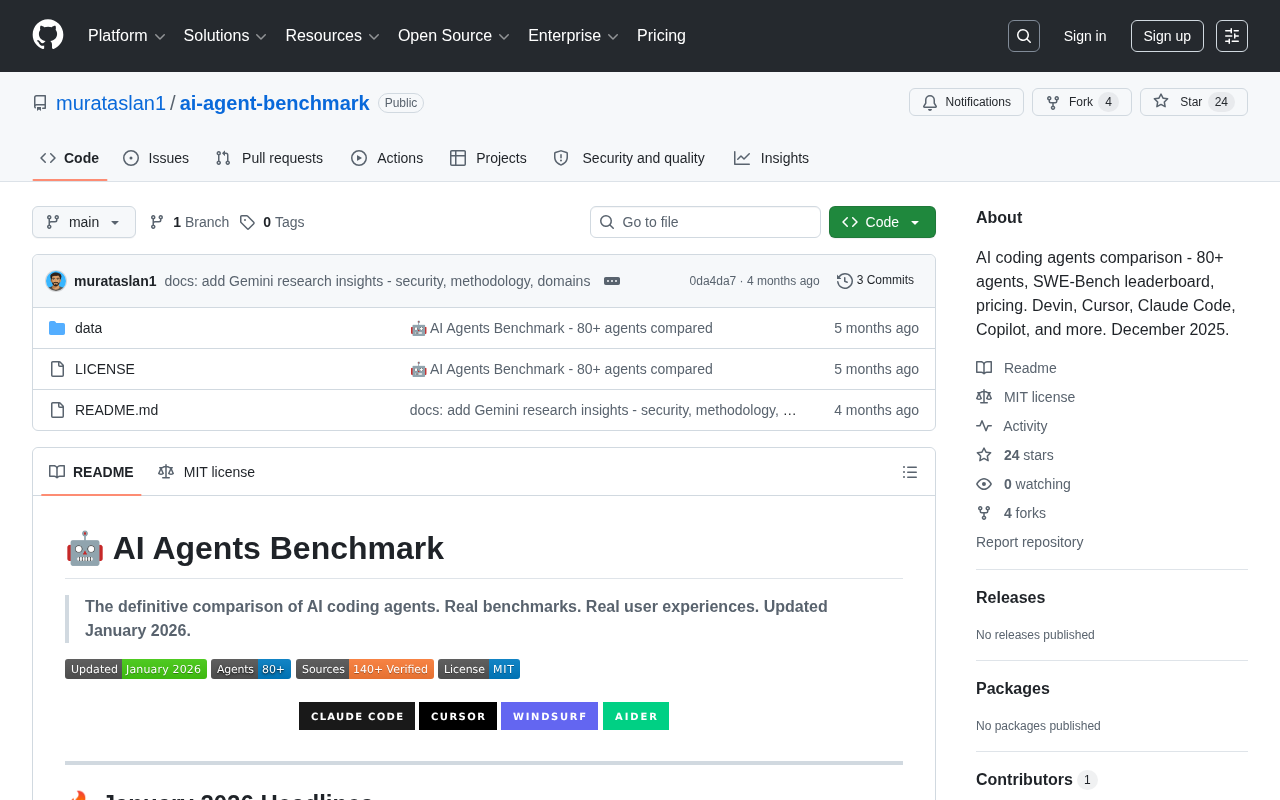
Benchmark project comparing 80+ AI coding agents with SWE-Bench rankings and selection guidance.
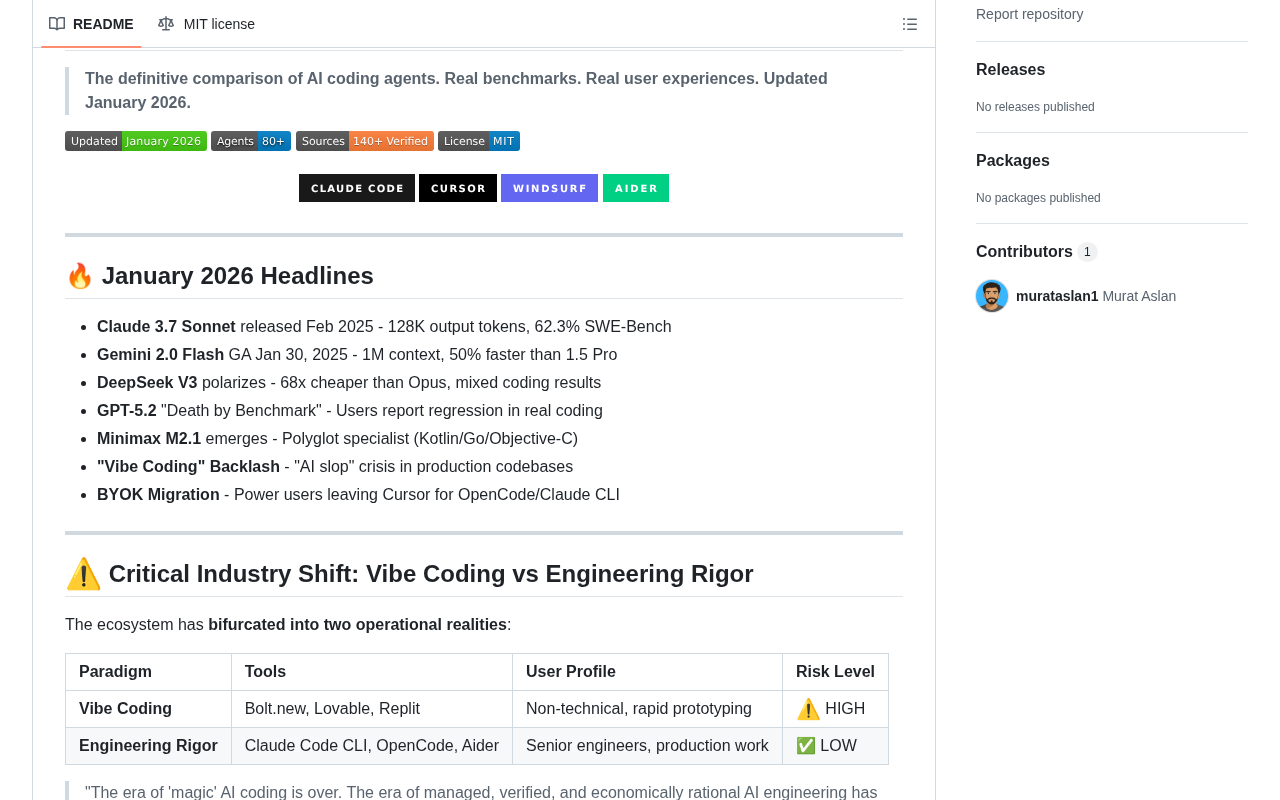
The ai-agent-benchmark project by GitHub user murataslan1 systematically compares over 80 AI coding agent tools — including Devin, Cursor, Claude Code, and GitHub Copilot — using SWE-Bench benchmarks for performance ranking and integrating pricing data to give developers a comprehensive selection reference from performance to cost-effectiveness. The project reveals the 2025 trend of AI coding evolving from code assistance to autonomous programming.
Overview
The AI coding assistant market is experiencing explosive growth, leaving developers facing an unprecedented selection dilemma. From Devin and Cursor to Claude Code and GitHub Copilot, over 80 AI coding agent tools have emerged on the market, each with different feature positioning and pricing strategies.
GitHub user murataslan1 created the ai-agent-benchmark project, which provides developers with a comprehensive, data-rich selection guide through systematic benchmarking and side-by-side comparisons.
What AI Coding Agent Tools Does the Project Cover?
The project catalogs over 80 AI coding agent tools, covering virtually every major product and noteworthy newcomer on the market today. Among them are several of the most widely discussed tools among developers:
-
Devin: A fully autonomous AI software engineer from Cognition Labs, capable of independently completing the entire workflow from understanding requirements to submitting code. Devin was first publicly demonstrated in March 2024 and was dubbed "the world's first AI software engineer." Its core technical architecture is based on an Agent framework powered by large language models, equipped with its own code editor, browser, and terminal environment. It can autonomously complete the full software development workflow — from reading requirement documents, researching technical solutions, writing code, running and debugging, to submitting Pull Requests — all within a sandboxed development environment. This "end-to-end autonomous development" paradigm is fundamentally different from traditional code completion tools. The latter merely provides snippet suggestions during the developer's coding process, while Devin attempts to replace the developer in completing the entire task chain.
-
Cursor: A deeply customized AI-enhanced editor built on VS Code, known for its smooth interactive experience. Developed by Anysphere, Cursor's technical approach involves a deep fork and modification of VS Code's open-source codebase, rather than simply developing a VS Code extension. This architectural choice enables Cursor to deeply integrate AI capabilities at the editor's foundational level, including AI-enhanced cursor movement, file navigation, terminal operations, and other core interactions. Cursor's key capabilities include Tab smart completion (which predicts the next multiple locations a developer will edit), inline editing (Cmd+K to describe modification intent directly in code), and Chat mode (which is aware of the entire project's codebase context). In 2024, Cursor's user base experienced explosive growth, making it the flagship product in the new category of AI-native IDEs.
-
Claude Code: A command-line coding assistant from Anthropic that excels at handling complex multi-file editing tasks. Claude Code adopts an interaction paradigm that is distinctly different from IDE plugins — developers converse with AI in natural language through the terminal, and Claude Code directly reads, creates, and modifies code files on the local file system. This command-line-native design philosophy stems from an observation: many senior developers' workflows are already terminal-centric (using tools like Vim/Neovim, tmux, etc.), and a command-line tool can integrate more naturally into such workflows. Claude Code's technical advantage lies in the inherent capabilities of Anthropic's Claude model in long-context understanding and complex reasoning, making it particularly strong at complex refactoring tasks that require correlated modifications across multiple files.
-
GitHub Copilot: An AI coding companion jointly built by Microsoft and GitHub, boasting the largest user base. Copilot was first released as a technical preview in June 2021 and was one of the earliest AI coding assistants to enter the market. Its greatest competitive advantage lies in ecosystem integration: as a native product of the GitHub platform, Copilot seamlessly integrates into the GitHub workflow used by over 100 million developers worldwide, including code repositories, Pull Request reviews, GitHub Actions CI/CD, and more. Copilot has evolved through three stages — from pure code completion, to conversational programming (Copilot Chat), to autonomous coding agent (Copilot Coding Agent) — and by 2025 has officially entered the autonomous coding agent competition.
Beyond these, dozens of other tools with varying positioning together form one of the most comprehensive AI coding agent comparison databases available today.
Understanding the SWE-Bench Benchmark Leaderboard
The project uses the industry-recognized SWE-Bench as its core evaluation standard. SWE-Bench is a software engineering benchmark built from real GitHub Issues that requires AI agents to understand problem descriptions and generate correct code fixes.
SWE-Bench was released in October 2023 by a research team at Princeton University. Its dataset was extracted from 12 popular Python open-source projects (including Django, Flask, scikit-learn, sympy, etc.), comprising 2,294 real GitHub Issues and their corresponding Pull Request fixes. Each test case requires the AI agent to generate a correct code patch on a specific historical version of the given code repository, based solely on the Issue description, and to pass the project's existing unit tests for verification. The research team later released SWE-Bench Verified (a human-verified subset of 500 high-quality problems) and SWE-Bench Lite (a subset of 300 simpler problems) to provide evaluation at different difficulty levels.
Why SWE-Bench Is a Reliable Evaluation Standard
- Driven by Real Tasks: Test cases come from real bug fixes and feature requests in open-source projects, not artificially constructed programming puzzles. This stands in stark contrast to previously widely used benchmarks like HumanEval and MBPP, which only evaluate standalone function-level code generation. SWE-Bench requires AI to understand an entire project's code structure, dependencies, and contextual semantics, which much more closely approximates the complexity of real-world software engineering.
- Multi-language, Multi-scenario Coverage: Covers multiple programming languages including Python and JavaScript, as well as different types of projects.
- End-to-End Capability Assessment: Evaluates the complete problem-solving ability from understanding the issue to generating code, not just snippet completion.
With a unified evaluation standard, developers can more objectively compare the actual coding capabilities of different AI programming tools and avoid being misled by marketing claims.
Pricing Comparison and Cost-Effectiveness Analysis
Beyond performance rankings, the project also consolidates pricing information for each tool. This is equally critical for individual developers and enterprise teams — in the selection of AI coding tools, cost-effectiveness is often the decisive factor.
Pricing models for AI coding tools on the market today vary significantly:
- Monthly Subscription: Such as Cursor Pro (~$20/month) and GitHub Copilot (Individual at $10/month, Business at $19/month), suitable for daily high-frequency use. The advantage of this model is predictable costs, allowing developers to use the tool's core features without restrictions.
- Usage-Based Pricing: Such as some API-driven tools, suitable for teams with fluctuating usage. These models typically charge by token consumption or API call count, offering lower costs at low usage but potentially generating higher expenses in high-frequency usage scenarios.
- Freemium: Some tools offer a basic free tier, with advanced features requiring paid upgrades. For example, GitHub Copilot introduced a free version to expand its user base, but with limitations on model selection and usage quotas.
A unified price comparison enables developers to find the optimal balance between performance and cost.
2025 AI Coding Agent Market Trends
The data covering 80+ tools reveals several important trends in the AI coding space:
Market Competitive Landscape
The 80+ tool count indicates that the market is still in a highly competitive early stage. A large number of startups and tech giants are entering simultaneously, with extremely fast product iteration — new tools or major updates appear almost every week. This competitive dynamic is similar to the app explosion during the early days of mobile internet. The market will most likely undergo consolidation and attrition, but it is currently still in a "let a hundred flowers bloom" phase.
Capability Convergence and Scenario Differentiation
The gap in basic code generation capability among leading AI coding tools is narrowing, but clear differentiation is emerging in specific scenarios. For instance, performance varies significantly across tools in areas such as contextual understanding of large codebases, cross-file refactoring, and test case generation. Behind this differentiation are the different choices each tool makes in Agent architecture design — some focus on efficient utilization of context windows, some emphasize tool-calling chain orchestration, and others have deeply optimized for specific programming languages or frameworks.
From Code Assistance to Autonomous Programming
Tool paradigms are rapidly evolving from early "code completion" to "autonomously completing development tasks." The technical architecture of current AI coding tools is rapidly progressing from "single-pass inference" to "multi-step Agent." Early code completion tools used a single-pass inference model: feed the current code context into the model, and the model outputs completion suggestions in one shot. The new generation of AI coding agents uses an Agent architecture, whose core is an "observe-think-act" loop: the AI first observes the current code state and task requirements, then formulates an execution plan, then invokes tools (such as file read/write, terminal command execution, web search, etc.) to perform specific operations, and then adjusts the next action based on execution results. Products like Devin represent this direction — AI no longer just provides suggestions but can independently plan and execute programming tasks. The ReAct (Reasoning and Acting) framework and Tool Use mechanism are the key technical foundations supporting this architectural evolution.
How Should Developers Choose the Right AI Coding Tool?
Facing 80+ tools, developers can filter based on four key dimensions:
- Task Complexity: If the primary need is code completion and simple generation, lightweight tools will suffice. If the work involves complete feature development or bug fixing, you'll need products with strong contextual understanding capabilities. SWE-Bench test results are highly valuable in this dimension, as they directly measure AI's ability to handle real complex tasks.
- Integration Method: IDE plugins (like Copilot), standalone editors (like Cursor), command-line tools (like Claude Code), or independent web platforms (like Devin) — the choice depends on your workflow preferences. It's worth noting that different integration methods also affect how well AI capabilities can be leveraged. Tools deeply integrated into editors can access richer contextual information (such as cursor position, open files, recent edit history), while command-line tools offer greater flexibility in automation scripts and CI/CD integration.
- Team Size: Individual developers prioritize ease of use and price, while team collaboration requires considerations such as permission management, code review integration, and other enterprise-grade features.
- Budget Constraints: Free plans typically have limitations on model capabilities and usage quotas, and the capability differences between paid plans are also worth careful comparison.
Project Value and Usage Recommendations
Although the project currently doesn't have a large number of stars, its systematic comparison approach fills a gap in the market for unified evaluation references.
However, there are several points to keep in mind when using it: AI coding tools iterate extremely fast, and benchmark results can change significantly within weeks; while SWE-Bench is authoritative, it cannot fully replicate the real-world experience of daily development — for example, it currently covers mainly Python projects, has limited evaluation capability for other programming languages, and cannot measure AI's performance in soft skills like interactive dialogue and requirement clarification. The final selection recommendation is to combine benchmark data with hands-on trials to find the tool that best fits your specific work scenarios.
Conclusion
In 2025, as AI coding agents flourish, systematic comparison projects like this one provide developers with invaluable decision-making references. Whether you want to understand ranking differences across tools on SWE-Bench or compare pricing plans across products, this project is worth bookmarking and following. As community contributors grow and data continues to be updated, it has the potential to become an essential reference resource in the AI coding tool selection space.
Related articles
 Product Reviews
The Programmer's Desk Setup Guide: Building a Workspace That Feels Like Home
Discover how programmers build productive, comfortable workspaces. From multi-monitor setups to ergonomic design, explore the desk philosophy that drives focus and flow.
 Product Reviews
Qoder vs Cursor Real-World Comparison: Which $20/Month AI IDE Is Better?
Hands-on comparison of Qoder vs Cursor AI IDEs: Agent autonomy, human interaction count, and architecture decisions. Qoder needed only 2 interactions vs Cursor's 8.
 Product Reviews
Cursor Cloud Agent Demo: Eliminating Bottlenecks Across the Entire Software Development Lifecycle
Deep analysis of Cursor's Cloud Agent demo showing how cloud VMs, automated test artifacts, and a full-chain control plane systematically eliminate human bottlenecks across the software development lifecycle.