AI Coding Agent Showdown: Claude Code vs. Codex vs. Devin — Who Comes Out on Top?

Claude Code tops the intelligence rankings but costs the most — mixing agents is the smartest strategy.
AI coding agents have evolved from interactive assistants into autonomous cloud workers. Claude Code leads Artificial Analysis's Coding Agent Index with 66 points but costs ~$13 per task — over 4x Codex (Sol). ChatGPT and Gemini dominate on user scale, while Claude Code generates ~$2.5B in annualized revenue from professional developers. The benchmark recommends matching tools to scenarios: Claude Code for complex codebases, Codex for low cost, Devin for full delegation, Gemini for free tiers. The optimal strategy is combining agents — one writes, another cross-validates.
AI coding assistants have evolved far beyond simple chat tools — they're now full-blown agents capable of completing tasks independently. This new generation doesn't just offer suggestions; it writes code, fixes bugs, and runs tests on your behalf. Some can even keep working in isolated cloud environments while you sleep. This article breaks down a head-to-head comparison of the leading AI coding agents across three dimensions: intelligence, cost, and user scale.
The Cloud Agent Wave: Getting Work Done While You Rest
The most significant shift right now is the emergence of a new class of cloud-based agents. Rather than living inside your local IDE, these tools run in independent cloud computing environments and can keep pushing tasks forward while you're offline.
According to the benchmark review, this wave of cloud agents has arrived in rapid succession: xAI launched Grokbot, Meta followed with Muse, and OpenAI embedded an agent called DOTS directly inside ChatGPT.
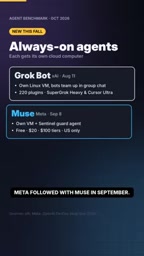
This "run in the background" model represents a major directional shift for AI coding tools: from interactive assistant to autonomous digital worker. You hand it a task, it plans and executes on its own, then reports back when it's done.
The fundamental difference between cloud agents and traditional IDE plugins (like early GitHub Copilot) lies in execution environment independence. Traditional coding assistants are tethered to the developer's local editor and require manual triggering for every interaction. Cloud agents, by contrast, have their own sandboxed compute environments — they can autonomously invoke terminal commands, run tests, read and write files, and even browse documentation. This architecture enables agents to handle tasks spanning several hours, unaffected by local network fluctuations or machine sleep. Technically, most cloud agents are built on "tool use" capabilities — instead of just outputting text, the large language model outputs structured action instructions, which an external execution engine carries out. Results are fed back to the model for the next decision step, forming a complete perceive-plan-execute loop.
Intelligence Rankings: Claude Code Takes the Crown
The most direct measure of a coding agent's capability is whether it can genuinely solve complex coding problems. According to the Coding Agent Index published by Artificial Analysis, here's how the products rank:
- Claude Code (running Opus 5.5): 66 points — top of the leaderboard
- Codex (GPT-6 Astra) and Devin: 62 points — close behind
- Codex (Sol): 57 points
- Grok Build: 56 points
These numbers show Claude Code maintaining a clear lead in coding tasks, with Codex and Devin forming a solid second tier. Notably, the same Codex product scores 5 points differently depending on which underlying model it uses (Astra vs. Sol), underscoring how much model selection impacts real-world performance.
Artificial Analysis's Coding Agent Index is one of the more credible third-party benchmarks in the industry, primarily based on standardized task sets like SWE-bench. SWE-bench draws from real GitHub open-source projects with verified bug fixes, requiring agents to independently identify and patch issues without access to the reference solution. The strength of this benchmark is that it mirrors real engineering scenarios rather than synthetic problems. Its limitation, however, is that it focuses on "fixing isolated bugs" and offers less coverage of scenarios like "building new features from scratch" or "navigating a massive codebase." Treat leaderboard scores as a capability reference, not a perfect proxy for how an agent will perform on your specific project.
The Cost Equation: Intelligence Doesn't Come Cheap
Capability doesn't automatically mean value. The benchmark also compared the average cost and time per task for each agent — data that's especially relevant for real-world adoption decisions.
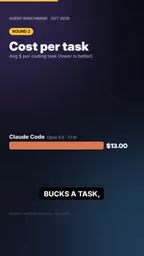
- Claude Code: ~$13 per task, ~1 hour to complete
- Codex (Astra): $7.47 per task, under 30 minutes
- Codex (Sol): just $2.99 per task
There's a clear value divergence here. Claude Code may be the smartest, but its per-task cost is more than four times that of Codex (Sol), and it's slower. For teams prioritizing efficiency and budget control, Codex's speed and price advantages are hard to ignore.
On the subscription side, Anti-gravity, OpenClawAd, and Meta's Muse all offer free tiers. Most paid plans cluster around $20/month, while heavy-duty agents like Grokbot or DOTS can run up to $100 per operation. The cost range is enormous, so total cost of ownership must be factored into any selection decision based on actual task volume.
User Scale: Who's Actually Being Used
Beyond technical metrics, user adoption reflects a product's real-world market acceptance.

- ChatGPT: 900 million weekly active users
- Gemini App: 900 million monthly active users
- Muse: Reached #2 on the US App Store
- OpenClaw: 3.2 million active users
- Codex: Over 2 million weekly users
- Claude Code: ~$2.5 billion annualized revenue at time of review
These numbers tell an interesting story. General-purpose entry points like ChatGPT and Gemini still dominate in raw user volume, while coding-focused agents have a smaller base but remarkable monetization power. Claude Code's ~$2.5 billion annualized revenue confirms that professional developers are willing to pay for high-quality specialized tooling.
How to Choose: Match the Tool to the Task
No single agent wins in every scenario. The benchmark offers practical, scenario-based guidance:

- Large, messy codebases → Claude Code — most reliable for complex engineering
- Speed and low cost → Codex
- Full task delegation → Devin
- Maximum output per dollar → Grok Build
- Free option → Gemini
- Run on your own machine → OpenClaw
- Background async assistant → Muse, DOTS, or Grokbot
The Smartest Approach: Mix and Match
One of the core insights from the benchmark is that the optimal solution is often not picking one tool, but combining them. Have one agent handle planning and code generation, then have another agent review and verify its work. This "cross-validation" workflow lets you leverage cost-efficient tools for execution while using high-intelligence tools for quality control.
For developers, this means the future workflow may not be about "choosing a tool" but about managing a team — assigning different agents to the roles they're best suited for.
Devin, developed by Cognition AI, is a fully managed coding agent built on the philosophy of letting users describe requirements in natural language while the agent takes over all subsequent technical decisions — including tech stack selection, architecture design, implementation, and test validation. Where other agents primarily position themselves as "developer assistants," Devin aims closer to replacing a junior engineer for complete units of work. OpenClaw, by contrast, focuses on local deployment, giving agents direct access to files and tools on the user's own machine — ideal for enterprises with strict data privacy or network requirements. Understanding these positioning differences helps assign the right agent to the right task type in a mixed workflow, rather than relying solely on leaderboard scores.
Conclusion
Competition in AI coding agents has reached a fever pitch, with each player emphasizing different strengths across intelligence, cost, and ecosystem. Claude Code represents the capability ceiling; Codex leads on value; Devin emphasizes full-task delegation; Grok Build optimizes for per-dollar efficiency; and cloud agents are redefining what "assistant" even means. Rather than agonizing over which one is "the best," the most pragmatic answer is to make a composite choice based on your codebase size, budget, and workflow preferences — and increasingly, that means building a team of agents rather than betting on a single one.
Related articles

How Big Can Stars Really Get? The Physical Limits of the Largest Stars
Red supergiants are the largest stars by volume, with radii up to 2,000 times the Sun, engulfing the inner solar system. But there is no precise upper limit on stellar size—models predict up to 15,000 solar radii. The most massive blue stars are far smaller than red supergiants—biggest and heaviest are two different things.

Apple HomeView Smart Display Full Feature Breakdown: Wall-Mount or Desktop, $299
Apple launches HomeView, a $299 smart display with wall-mount and desktop options, 12MP camera for facial recognition, smart home control, music playback, and recipe step-by-step cooking. Full breakdown of watch faces, apps, privacy, and cooking integration.

Where Did the Promised New Studio Go? Craft Computing Answers After Five Years
Craft Computing's host responds to viewer questions: the new studio promised five years ago was shelved as construction costs soared from $30,000 to $75,000, and was replaced by a 168-square-foot garage conversion.