AI Coding Agents Explosion: CodeWell Goes Open Source, Kimi K3 Launches, Claude Gets Browser Access

CodeWell, Kimi K3, MiniMax Code 2.0, and Claude browser integration mark AI's shift from generation to action.
A wave of AI developer tool updates signals a clear paradigm shift: from generative AI to agentic AI. CodeWell open-sources a unified terminal coding agent, Kimi K3 launches with ultra-long context and coding optimizations, MiniMax Code 2.0 rebuilds its Agent architecture with MCP and financial data integration, and Anthropic gives Claude browser-level permissions to act on users' behalf.
Recent weeks have seen a flurry of activity across AI tools and open-source projects — from terminal-based coding agents to flagship model updates and full desktop Agent architecture overhauls. The capability boundaries of AI-assisted development are expanding rapidly. This article rounds up the most noteworthy product developments and analyzes the technical trends driving them.
CodeWell: Bringing Multi-Model Coding to the Terminal
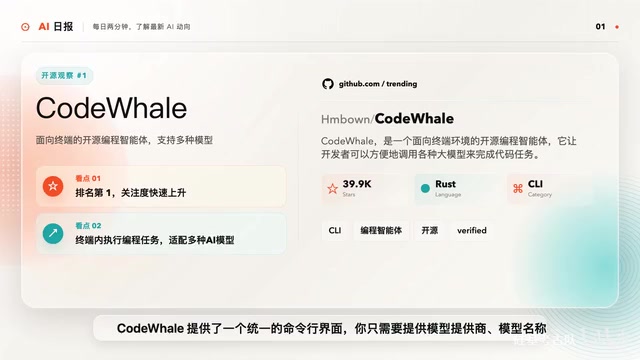
CodeWell is an open-source coding agent built for terminal environments. Its core value proposition is lowering the barrier for developers to invoke large language models directly from the command line.
For developers who live in the terminal, integrating LLM capabilities into everyday workflows has always been painful: every model provider has its own API, and the cost of configuring and switching between them is high. CodeWell provides a unified command-line interface — developers simply specify a model provider, model name, and task description, and the tool automatically reads code, edits files, and executes commands.
The Real Value of a Unified Interface
This design philosophy goes beyond mere convenience. When model capability becomes a pluggable resource, developers can quickly compare the real-world performance of different AI coding assistants within the same workflow — whether that's response speed, code quality, or task-specific fit. "Choosing a model" shifts from a one-time architectural decision to a runtime parameter you can tune at will, dramatically improving the speed of experimentation and deployment.
The model-agnostic positioning is backed by a technical approach that abstracts away the API differences between providers — similar in spirit to the database driver model (JDBC/ODBC), where the application layer doesn't need to care about the underlying implementation. The industry has already seen several standardization attempts: the OpenAI-compatible API has de facto become the integration standard for many open-source models, and open-source projects like LiteLLM specifically address the problem of unified multi-model invocation. CodeWell essentially embeds "LLM routing" capability into the terminal workflow, enabling developers to run A/B tests or cost-optimized model switches without changing their workflow at all. This positioning also makes it easier for the open-source community to build an ecosystem around it.
Kimi K3 Launches: Flagship Model Focused on Coding and Ultra-Long Context
According to IT之家, Kimi has officially launched its flagship model K3. K3 supports an ultra-long context window and delivers strong performance on coding, gaming, 3D, and knowledge-intensive tasks.
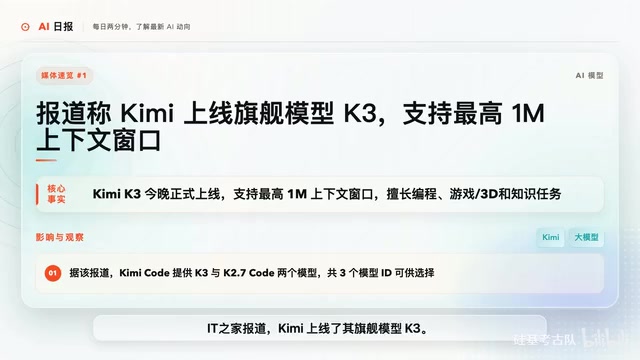
Kimi Code offers multiple model IDs for developers to choose from, including K3 and K2.7 Code. This "multi-tier" supply strategy reflects a vendor approach to balancing performance and cost: not every task requires the most powerful model. Offering different tiers allows coverage of high-complexity scenarios while keeping inference costs under control for lighter workloads.
Why Ultra-Long Context Matters for Coding
Ultra-long context windows are especially critical in coding scenarios. Understanding large codebases holistically, refactoring across files, and tracking requirements across long conversations all depend heavily on a model's ability to "remember" more information.
However, achieving ultra-long context windows isn't just a matter of scaling up parameters — it requires multiple core technical breakthroughs. The computational complexity of the attention mechanism grows quadratically with sequence length, creating a significant compute bottleneck for vanilla Transformers on very long sequences. To address this, the industry has developed improvements like Sparse Attention and Sliding Window Attention. Positional encoding extrapolation is equally critical — RoPE (Rotary Position Embedding) and its improved variants such as YaRN and LongRoPE have become the mainstream choice for current long-context models. On the engineering side, KV Cache memory management techniques (e.g., PagedAttention) directly determine the practicality of long-context inference. Kimi previously built a differentiated competitive advantage through long-document processing, and K3 doubles down on this foundation — reflecting how long context has evolved from a "distinctive feature" into a baseline requirement for flagship models. The combination of task-specific optimization for coding and strong long-context capability gives K3 direct competitive standing in the AI coding race.
MiniMax Code 2.0: Full Overhaul of Desktop Agent Architecture
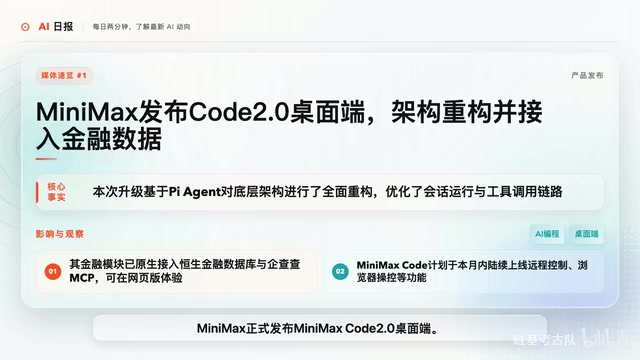
MiniMax has officially released MiniMax Code 2.0 for desktop. This upgrade is built on its Agent framework, featuring a complete overhaul of the underlying architecture with a focus on optimizing task execution and tool-calling pipelines.
Financial Module and MCP Tool Integration
One of the highlights of MiniMax Code 2.0 is its native integration of a financial module, incorporating data sources such as Hundsun's financial database and Qichacha, with tool invocation implemented via MCP (Model Context Protocol). Users can experience these capabilities directly in the web version.
MCP is a protocol standard proposed and open-sourced by Anthropic in late 2024, designed to solve the problem of standardizing connections between AI models and external tools and data sources. Before MCP, every AI application had to develop separate integration interfaces for each data source, resulting in massive amounts of duplicated "M×N" integration work. MCP simplifies this to an "M+N" relationship by defining a unified client-server communication specification (based on JSON-RPC 2.0) — each AI client only needs to support the MCP protocol, and each data source only needs to implement one MCP Server, enabling interoperability between the two. MiniMax Code 2.0's native MCP integration means its Agent architecture can connect to the hundreds of third-party Servers already in the MCP ecosystem with relatively low friction, without needing to build custom adapters for each data source — a forward-looking architectural choice.
Additionally, MiniMax plans to roll out features like remote control and browser manipulation. These capabilities all point in the same direction: moving Agents beyond code generation to operating external environments, calling real data, and completing end-to-end task loops. The native financial data integration also signals that vendors are extending from general-purpose tools into vertical industry scenarios.
Anthropic Launches Browser Integration for Claude
Anthropic has introduced a new browser integration feature for its chatbot Claude. The feature allows Claude to access users' stored security credentials (such as usernames and passwords), granting it permission to perform actions in the browser on the user's behalf.

Balancing Convenience and Security
This feature marks a significant acceleration in AI assistants moving from "conversation" to "action." When Claude can log into websites, fill out forms, and autonomously execute operations, its practical value increases dramatically.
At the same time, giving an AI access to user credentials introduces complex security challenges. On the security architecture side, the industry has developed several core principles for action-oriented Agents like this: the principle of least privilege requires that the Agent obtain only the minimum permissions necessary to complete a specific task, preventing lateral spread in the event of credential leakage; Human-in-the-Loop mechanisms require explicit user confirmation for high-risk operations (such as form submissions or account changes), rather than fully autonomous execution; and reversibility by design prioritizes executable paths that can be undone, maintaining complete operation logs to support auditing and rollback. Additionally, a new class of attack vectors targeting Agents — prompt injection — deserves serious attention: malicious web page content can inject instructions to the Agent visually or through text, hijacking its behavior. How permission boundaries are defined, how credentials are protected, and how unintended actions are rolled back are all questions that must be answered before such features can be safely deployed — and they represent shared challenges for all action-oriented Agents today.
Trend Watch: Agent Execution Capability Becomes the New Competitive Axis
Looking across these developments, a clear throughline emerges: AI is moving from "generating content" to "executing tasks."
This shift is often described in academic and industry circles as a paradigm migration from Generative AI to Agentic AI. The core pattern of generative AI is a single-turn or multi-turn "input prompt → output content" interaction; Agentic AI introduces a "perceive-plan-execute" loop architecture (the ReAct framework is an early representative), enabling models to decompose complex goals, select tools, observe execution results, and adjust strategies. This paradigm shift introduces two key engineering challenges: first, error accumulation in long-chain tasks, where a slight drop in per-step accuracy gets amplified exponentially across multiple steps; second, the reliability of tool calls, where the model must accurately understand usage constraints for tools and generate invocation parameters that conform to specifications.
CodeWell brings multi-model coding capability to the terminal; Kimi K3 strengthens coding and ultra-long context understanding; MiniMax Code 2.0 overhauls the Agent architecture and connects to real-world data; Anthropic gives Claude browser operation permissions. Four different paths, each covering a different node in the Agentic AI deployment chain: model capability, tool integration protocols, environmental operation permissions, and workflow integration — all pointing toward the same goal: building agents that can autonomously read their environment, invoke tools, and complete complex tasks.
For developers, the criteria for evaluating AI tools are shifting. Beyond the model's raw capabilities, depth of integration with existing workflows, the ability to call external tools and data, and the reliability and safety of task execution will become increasingly important considerations. The competition ahead will increasingly revolve around Agent execution capability.
Key Takeaways
Related articles

Disaster and Glory of the Apollo Program: The History We Must Revisit Before Returning to the Moon
From the fatal Apollo 1 fire to Apollo 8's daring lunar orbit to Apollo 11's successful landing—revisiting the disasters, fears, and compromises of the Apollo program and their lessons for today's return to the Moon.
Netflix Trust Exercise Turns Into Firing Trap: Where Are the Boundaries of Corporate Trust?
A Netflix employee was fired after sharing private info in a trust exercise. We analyze the risks of corporate trust exercises and how employees can protect themselves.

AMD CDNA5 Architecture Deep Dive: Technical Evolution and the AI Computing Competition Landscape
Deep analysis of AMD's CDNA5 architecture covering Chiplet packaging upgrades, HBM memory evolution, and low-precision compute optimization, examining how AMD challenges NVIDIA's AI chip dominance.