AI Coding Agents in Practice: A Framework from Technical Optimization to Organizational Transformation
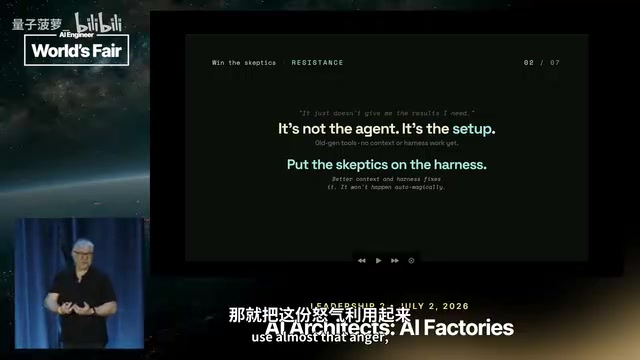
A practical framework for adopting AI coding agents, from technical optimization to organizational transformation.
AI coding agent adoption is blocked less by technology than by organizational readiness. This article presents a comprehensive framework covering developer identity shifts, evolving team collaboration models, platform-level reuse of context and toolchains, and organizational change management strategies — guiding engineering teams from artisanal coding to industrialized software production.
From Technical Optimization to Organizational Restructuring
Most current industry discussions about AI coding agents focus on the technical layer — optimizing agent loop mechanisms, building test toolchains, and tuning prompt strategies. But a technical leader from the engineering frontlines pointed out in a talk that the real obstacle to AI coding agent adoption isn't the technology itself — it's that organizations aren't ready.
Just as continuous delivery was met with skepticism when it was first proposed in 2009, when people today say "lights-out factories won't work for us," the underlying message is "we're not ready yet." Continuous Delivery was systematically articulated by Jez Humble and David Farley in their 2010 book of the same name. Its core idea is keeping software in a releasable state at all times, enabling fast and reliable delivery through automated build, test, and deployment pipelines. When this concept was first introduced, countless enterprises considered "deploying daily" or "releasing at any time" to be impractical — database migration risks, compliance audit requirements, and legacy system coupling made many teams hesitant. Yet over a decade later, continuous delivery has become an industry standard. This history closely mirrors the organizational resistance AI agents face today: technical feasibility was never the biggest barrier — organizational inertia and cultural adaptation are. Technology will eventually become a commoditized service; the real competitive differentiation will come from how organizations restructure their collaboration models around AI agents.
The Shifting Identity and Skill Set of Developers
Many predict that developers will become "conductors" and "orchestrators" of agents, but this shift triggers an identity crisis in practice. Numerous developers have expressed: "We didn't sign up to write better prompts — we're engineers, we're technical people." Simply transitioning from coding to writing specification documents makes many engineers feel their skills are being hollowed out.
The turning point came with the introduction of toolchains and loop mechanisms. The AI coding agent's Agent Loop refers to its iterative workflow: receive instructions → analyze the problem → generate code → execute verification → observe results → revise the approach — repeating this cycle until the task is complete or a termination condition is met. The Toolchain is the collection of external capabilities an agent can invoke, including code search, file read/write, terminal command execution, test running, code linters, and more. The quality of the toolchain directly determines the agent's capability ceiling — there's a world of difference in engineering effectiveness between an agent that can only generate text and one that can run tests, view error logs, and search codebases. When teams began building tools and designing constraint mechanisms for agents, a new technical pathway opened up: developers could help agents through programming, not just prompt writing. This reignited the enthusiasm of engineers who had felt displaced — their expertise found a new purpose.
For those "resisters" who are skeptical about AI-generated code quality, the right approach isn't to persuade or ignore them, but to channel their critical thinking toward improving context and optimizing toolchains. The core mindset shift is: stop fixing the code agents generate, and start improving the system that generates the code. As someone once said years ago, "Don't build things — build the thing that builds things." This is the mental leap from artisanal workshop to industrial production.
The Evolution of Team Collaboration Models
In practice, team rituals are undergoing subtle changes. Retrospectives no longer discuss "what went wrong with the code" but instead reflect on "why did the system let the agent hit the same wall repeatedly." In planning sessions, tasks naturally stratify: well-defined tasks with clear boundaries can be directly assigned to agents, while ambiguous requirements needing exploratory discussion are still handled by human teams.
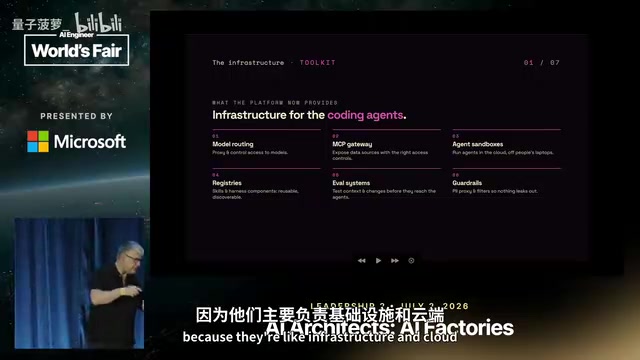
The role of team leads becomes even more critical — they need to set the pace of evolution, pushing teams at the right time from "optimizing prompts" to "building reusable context," and then advancing to "designing general-purpose toolchains." This intentional, staged constraint prevents teams from devolving into fragmented, inefficient silos.
At the same time, productivity gains create ripple effects: when development teams' output surges, downstream GTM teams and users may not be able to keep up. GTM (Go-To-Market) refers to the strategy and execution teams responsible for bringing products to market, typically spanning marketing, sales, and customer success functions. When AI agents dramatically boost development efficiency, the rate of feature output can far exceed downstream teams' capacity to absorb it — marketing can't prepare positioning documents fast enough, sales can't learn new features quickly enough, and customer support can't update knowledge bases in time. This is the classic "bottleneck migration" phenomenon: bottlenecks in a system never disappear — they simply move from one stage to another. Therefore, automation needs to extend across the entire value chain — including requirements gathering, product delivery, and user support.
Two key metrics can measure a team's AI agent collaboration maturity:
- Number of human interventions: Should decrease as context and toolchains mature
- System reuse rate: The multiplier effect where a single optimization benefits everyone
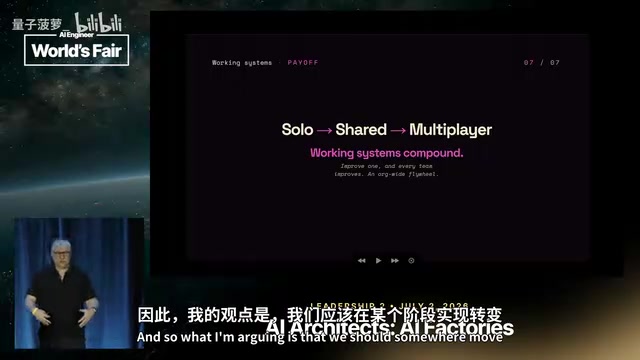
The "multiplier effect" here deserves deeper understanding. The software industry has long celebrated the "10x engineer" — a top individual whose productivity is ten times that of an average engineer. While this concept has some validity, it's being redefined in the AI agent era: the key is no longer extraordinary individual performance, but system-level multiplier effects — a single optimization to context or toolchain can simultaneously boost the effectiveness of all people and agents using that system. This is fundamentally a paradigm shift from "individual heroism" to "infrastructure thinking." It's not about making a single 10x engineer stronger — it's about making one system improvement benefit all collaborators.
Platformization: From Team Sharing to Organization-Wide Reuse
Once a single team validates the AI agent collaboration model, the next step is to crystallize these capabilities into an organization-level platform. Platform Engineering is a new discipline that has evolved from the DevOps movement in recent years. Its core idea is building an Internal Developer Platform (IDP) that provides product teams with self-service infrastructure and tooling capabilities. Gartner predicted that by 2026, 80% of software engineering organizations will have established platform teams. Traditional platform engineering focuses on infrastructure layers like CI/CD pipelines, container orchestration, and observability, but platform engineering in the AI agent era needs to expand into entirely new domains. Platform engineering teams need to broaden their scope: beyond traditional infrastructure and API gateways, they must now address skill registries (managing catalogs of capabilities agents can invoke), evaluation systems (measuring agent output quality), coding agent guardrails (preventing agents from executing dangerous operations), identity management, and other new areas.
But ownership of this work is unclear — platform teams typically aren't directly responsible for developer experience, while developer experience teams lack infrastructure control. A clear owner is needed to drive this cross-domain, centralized initiative and build "paved roads":
- Reusable context libraries: Common components like authentication shouldn't be reinvented by each team — they should be registered as shared context
- Standardized toolchains: If teams use the same code linters and security scanners, these should be encapsulated as reusable components
- Governance mechanisms: To prevent skill and context sprawl, clear ownership, testability, modularity, and security reviews are essential
Reaching consensus is difficult — sometimes as heated as the "tabs vs. spaces" debate. In practice, a catalog of 3-4 "paved roads" may emerge for teams to choose from, with custom solutions allowed but self-maintained.
Cost visibility is also an important responsibility of platform teams. AI agents frequently call large language model APIs during task execution, and each call incurs token-based charges. A complex task might involve dozens of agent loop iterations, accumulating significant API costs. If developers can't see the cost of each agent iteration, they won't proactively optimize. By surfacing cost metrics, teams are incentivized to reduce ineffective iterations and optimize context design — for example, providing more precise context to reduce the agent's "fumbling" attempts, or selecting different model sizes for tasks of varying complexity.
Organizational Change Management Strategies
For VPs of Engineering, the strategies for driving AI agent adoption are nothing new: hackathons, lunch-and-learns, success story sharing, Slack channels, champion programs... These are standard change management techniques used for everything from Agile transformations to DevOps adoption.
But the "distribute licenses + provide training + let a thousand flowers bloom" laissez-faire approach has been proven ineffective. The right approach is to give team leads and platform teams clear mandates, treating AI agent collaboration as a team-level capability, not an individual one. This is crucial: if AI tool adoption is treated as a personal choice, the result is typically a few early adopters experimenting actively while most people wait and watch, failing to achieve the team-level paradigm shift in collaboration. Only by building it as a team capability can reusable assets be systematically accumulated.
On the hiring front, emerging job titles (AI Product Engineer, Frontier Deployment Engineer, Agent Engineer, AI Engineer) currently lack unified standards and can't serve as skill verification, but they can signal intent to attract interested talent. A pragmatic interview process looks like this:
- Practical test: Give candidates an exercise and encourage them to fully leverage AI tools to solve the problem
- Code walkthrough: Ask them to explain their solution choices and engineering judgment — testing taste and technical depth
- Collaboration assessment: Evaluate whether they're willing to share and collaborate openly, or if they prefer a lone-wolf style
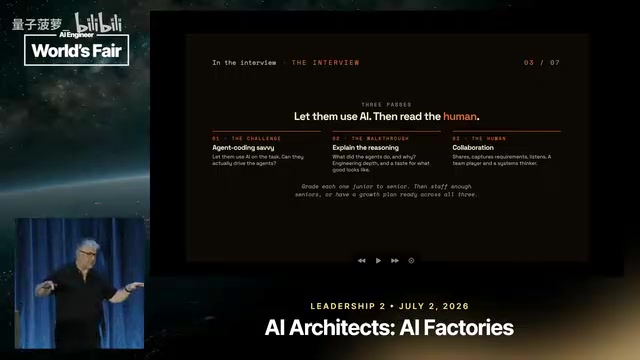
Candidates don't need to excel in all three dimensions — AI application, engineering capability, and collaborative culture — but you should at least know where they need coaching. Note that what's being assessed here isn't a machine learning background or AI specialist credentials, but the ability to integrate AI tools into engineering practice. This distinction is critical: traditional AI/ML engineers need deep understanding of model architectures, training processes, and mathematical foundations, while engineers in the AI agent era need to understand how to design effective context, build tool interfaces agents can invoke, and evaluate and constrain agent behavior — an entirely new skill spectrum.
For managing up, traditional ROI metrics (license counts, delivery speed improvements, quality gains) are all hard to definitively prove. A more practical approach is to present the two metrics mentioned earlier: the downward trend in human interventions and the increase in system reuse rates. These more intuitively demonstrate the team's progress along the AI agent collaboration maturity curve.
When leadership wants to limit spending due to cost concerns, the right response isn't "cut the budget across the board" but "optimize spending efficiency" — help teams choose appropriate models, provide model selection education, and improve context and toolchain design to reduce iteration costs.
From Lights-Out Factories to Dimmer-Switch Factories
The discussion about team size continues. The ideal "one-person full-stack" team needs backup (vacation coverage), becoming two people. Add production support and incident handling, and you need a third. Factor in junior engineer development, and you still end up stabilizing at small teams of 3-5 people.
A more important realization: the fully autonomous "lights-out factory" may be an overly aggressive goal. The "lights-out factory" concept originates from manufacturing, referring to a fully automated factory requiring no human operation — because no workers are needed, even the lights can be turned off. In the AI coding context, it's a metaphor for AI agents autonomously completing the entire pipeline from requirements understanding to code writing, testing, and deployment. While partially realized in manufacturing (such as Japan's FANUC robot factories), software engineering faces unique challenges: the ambiguity of requirements, the trade-offs in architectural decisions, and the contextual dependencies of business logic all make full de-humanization far more complex than physical manufacturing.
In reality, a "dimmer-switch factory" is more likely — adjusting the degree of autonomy based on the risk level of different functions. High-risk changes (such as payment system core logic, user data processing pipelines, security-related components) require stricter auditing, provenance tracking, and verification mechanisms, while low-risk scenarios (such as UI styling adjustments, documentation generation, test case supplementation) can tolerate higher autonomy. This differentiated autonomy strategy captures the efficiency dividends of AI agents while maintaining human judgment and accountability at critical junctures.
The core organizational task is to capture knowledge into skill libraries, context, and constraint mechanisms — this is the concretization of business context. Evolving from continuous delivery to continuous learning, true resilience isn't about making systems infallible, but about being able to replace quickly, learn quickly, and maintain reliability under high rates of change. "Continuous learning" here refers not only to team members' learning and growth, but more importantly to the learning capacity of the organizational system itself — every agent failure should translate into better context, more refined guardrails, and more precise tools, making the system smarter and more reliable with each iteration.
Conclusion
The winners of the AI era won't be lone heroes, but enterprises that systematically improve across team, platform, and organizational levels. Technology itself will be commoditized — organizational capability is the enduring moat.
For teams exploring AI coding agents, this talk provides a clear implementation framework: from fixing code to improving systems, from individual skills to team sharing, from team practices to platform reuse, from platform services to organizational transformation. This isn't a technology upgrade — it's a comprehensive transformation spanning tools, processes, and culture.
Key Takeaways
Related articles

Chain of Thought Isn't Just for AI: How Humans Can Use CoT to Improve Thinking Quality
Chain of Thought isn't just a prompt trick for large models. Starting from a Hacker News discussion, this article analyzes why CoT works for human thinking too, breaks down actionable ways to transfer it, and highlights the key differences between human CoT and machine CoT.
Cloudflare Teams Up with OpenAI: Closi…
Cloudflare Teams Up with OpenAI: Closing the Loop from Vulnerability Discovery to Defense with AI
Cloudflare uses OpenAI Daybreak to investigate security vulnerabilities and generate reviewable remediation plans, while developers use Codex to boost coding efficiency and quality.

Orca Multi-Agent Orchestration in Practice: A Guide to Parallel Collaboration with Claude and Codex
Orca is Stable AI's free open-source agent workbench supporting 34 agents like Claude Code and Codex in parallel. Learn its Git worktree isolation, multi-model orchestration, and mobile management.