AI Coding Assistants Are Rising — Is Low-Code AI Getting Pushed to the Margins?

Flowise's shutdown reveals low-code's ceiling in complex AI agent systems as coding assistants redraw the boundary.
The shutdown of Flowise, a popular open-source low-code AI orchestration tool, highlights a key tension: visual workflows shine for simple, linear AI pipelines but buckle under the complexity of multi-agent systems, state management, and error handling. Meanwhile, AI coding assistants like Cursor are dramatically lowering the bar for writing code, eroding low-code's core "save time" advantage. The conclusion isn't that low-code is dead — but that the division of labor is sharpening: low-code owns speed and prototyping, while code owns complexity and production-grade control.
The Signal Behind Flowise's Shutdown
Recently, Flowise — a well-known open-source, low-code AI orchestration tool — announced it is gradually winding down operations. One line from its official announcement is particularly thought-provoking: "The typical rigid, workflow-based low-code approach quickly hits a ceiling when faced with complexity."
This reads like a farewell note from a single tool, but it reflects a deeper shift underway in AI development. As AI applications evolve from simple "question-and-answer" patterns into complex agentic systems, the visual orchestration that low-code tools pride themselves on may actually become a liability. Meanwhile, the maturation of AI coding assistants is redefining what it means to "write code" in the first place.
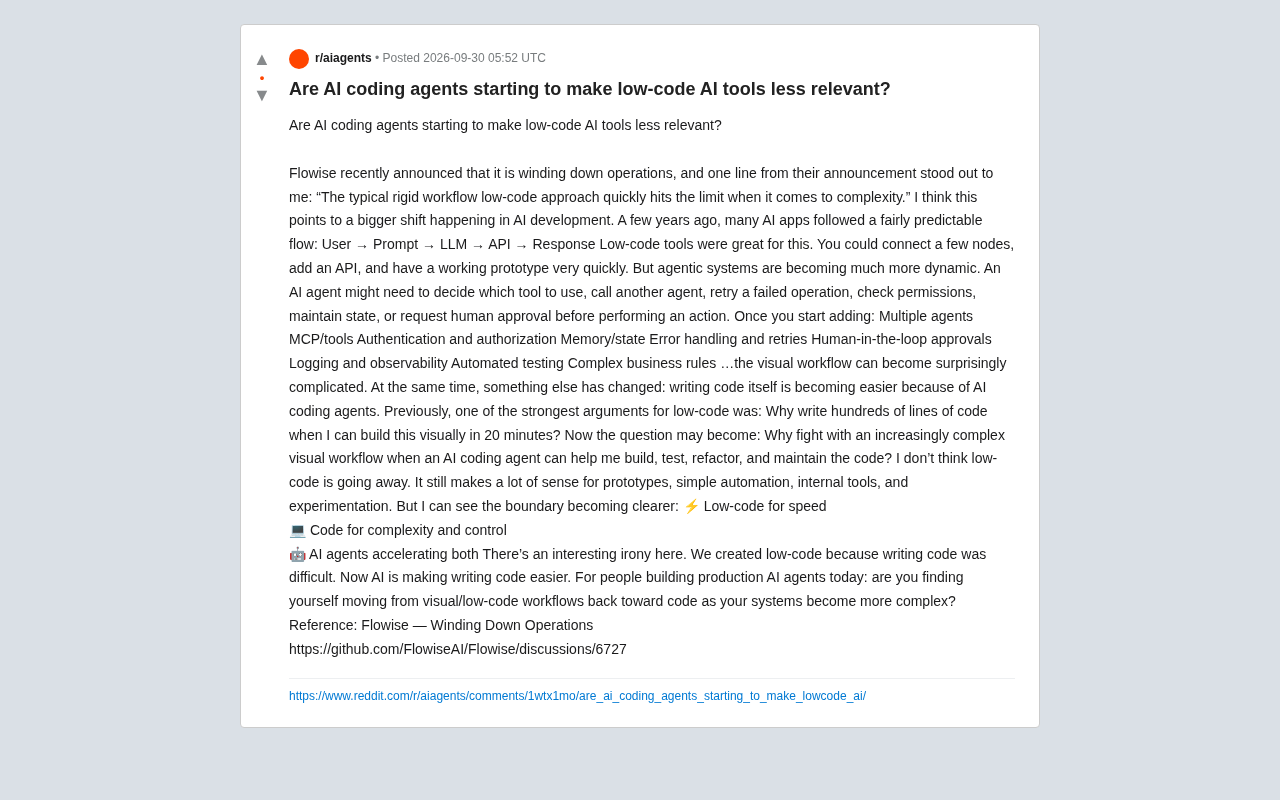
The Problem Low-Code Was Built to Solve
A few years ago, most AI applications followed a fairly predictable flow:
User → Prompt → LLM → API → Response
For this kind of linear pipeline, low-code tools were a near-perfect solution. You'd connect a few nodes, plug in an API, and have a working prototype running in twenty minutes. The most compelling argument for low-code was refreshingly simple: "If I can build this visually in 20 minutes, why would I write hundreds of lines of code?"
That logic still holds in prototyping, simple automation, internal tooling, and experimental contexts. Low-code genuinely lowered the barrier for non-professional developers to build AI applications — a contribution that shouldn't be dismissed.
Agentic Systems Broke the Visual Comfort Zone
The problem lies in how AI application architectures have evolved. Today's agent systems are far more dynamic than before. A single AI agent might need to:
- Decide which tool to call
- Invoke another agent for collaboration
- Retry failed operations
- Check permissions
- Maintain state and memory
- Request human approval before taking action
When you start layering in multi-agent collaboration, MCP/tool calling, authentication and authorization, memory and state management, error handling and retries, human-in-the-loop approvals, logging and observability, automated testing, and complex business rules, what was once a clean visual workflow becomes unexpectedly bloated.
Put simply, low-code excels at expressing "linear and deterministic" processes, but struggles to elegantly handle the branching, looping, exception handling, and stateful logic that real production systems require. The more nodes you connect, the messier the canvas gets — and the intuitive advantage that visualization was supposed to provide disappears entirely. This is the core pain point behind Flowise's reference to "rigid workflows."
A note on MCP: Model Context Protocol (MCP) is an open protocol introduced by Anthropic in late 2024, designed to standardize how AI models interact with external tools and data sources. Think of it as the "USB port" of the AI world — it unifies the way LLMs call various tools, allowing tools from different vendors to be invoked directly by any MCP-compatible agent. In multi-agent systems, MCP means a single agent may need to dynamically discover and call dozens of tools, each with different parameter structures, error responses, and permission checks. This kind of dynamic composition logic is nearly impossible to express clearly on a visual canvas, yet it can be handled elegantly with a few lines of loops and conditionals in code — which is one major reason why tool-call-heavy agentic systems tend to favor code-based implementations.
AI Coding Assistants Have Shifted the Balance
The other half of this shift comes from code itself. The biggest selling point of low-code used to be "writing code is too hard" — but AI coding assistants (i.e., Coding Agents) are rapidly erasing that gap.
When AI can help you generate, test, refactor, and even maintain code, the classic question gets flipped:
Rather than wrestling with an increasingly complex visual workflow, why not just have an AI coding assistant write the code for me?
Code has inherent advantages that low-code can't easily match — full version control, unlimited expressiveness, a mature testing and debugging ecosystem, portability, and auditability. As the cost of writing code drops significantly thanks to AI, low-code's moat around "saving time" shrinks accordingly.
A note on Coding Agents: The Coding Agents referred to here are fundamentally different from basic code completion tools. Early tools like GitHub Copilot primarily offered single-line or snippet completions at the cursor. New-generation Coding Agents — such as Cursor, Devin, and Claude Code — can understand the context of an entire codebase and autonomously handle the full loop: decomposing requirements, creating files, refactoring across files, running tests, and iteratively fixing errors based on output. This shifts "writing code" from a mentally demanding task requiring deep syntax recall into something closer to product thinking — describing requirements and reviewing results. For AI application development specifically, boilerplate framework code (like LangChain/LlamaIndex chain calls, vector retrieval, and memory management) happens to be exactly the kind of repetitive structure that AI coding assistants generate best. This further compresses the unique advantage low-code once held in the "quick onboarding" use case.
The Boundary Is Getting Clearer, Not Disappearing
It's worth emphasizing: this does not mean low-code will die. A more accurate read is that the division of labor between the two is becoming sharper:
- ⚡ Low-code owns speed: prototyping, simple automation, internal tools, rapid experimentation
- 💻 Code owns complexity and control: production systems, multi-agent architectures, anything requiring strict state and security management
- 🤖 AI agents accelerate both ends: speeding up both visual assembly and code generation
There's an intriguing paradox here: we originally invented low-code because writing code was too hard. Now AI is making writing code easier. The very premise that gave rise to low-code is quietly being undermined by AI.
What This Means for Production Developers
For teams building production-grade AI agents, one real trend is worth watching: as system complexity grows, more and more developers are "flowing back" from visual/low-code workflows to writing code. This isn't a failure of low-code — it's the natural result of use cases diverging.
When choosing your tools, ask yourself a few questions: Will this system eventually need multi-agent collaboration? Does it involve complex logic around permissions, state, and approvals? Does it require rigorous testing and observability? If most answers are "yes," then writing code directly — powered by AI coding assistants — is likely the more sustainable path. If you're just quickly validating an idea, low-code is still king for efficiency.
AI hasn't made low-code meaningless. It has redrawn its boundaries — and those lines are growing sharper with every new wave of agentic systems.
Related articles

WorkBuddy Full Guide: How an AI Coworker Takes Over Workplace Automation
What is WorkBuddy? This article analyzes the core capabilities of this full-scenario AI agent: autonomous execution with deliverable results, local file processing, multi-agent parallelism, and workplace automation workflows, helping you judge its essential difference from ordinary AI chat tools.

The Truth About AI Agents: A Hundred Lines of Code + an LLM, Deconstructing the Agent's Underlying Logic
AI agents aren't a new AI species—just a language model plus tools, a loop, and a goal. Here's the underlying logic: how 100 lines of Python hit a 75% fix rate, why the harness beats the model, and Gartner's "agent washing."

AI Agent Deployment: Three Things Developers Should Do
AI Agent deployment doesn't require rushing into multi-agent systems. This article outlines an actionable deployment path and engineering acceptance thresholds for developers, covering human baselines, bounded single-agent scope, and a controlled code-modification loop.