AI Coding Boosts Code Volume by 30%, So Why Is Project Delivery Stuck in Place?

Harvard study: AI coding agents boost code volume by 30%, but delivery doesn't rise—the bottleneck shifts to review.
Two Harvard researchers, using real data from 700+ companies through March of this year, found that adopting AI coding agents increased lines of code by about 30% on average, but completed tasks and projects showed no significant improvement. The study identifies the bottleneck as having shifted from code generation to code review: review time per change rose 49%, and changes requiring revision nearly doubled. The cause is that review depends heavily on human contextual understanding and judgment bandwidth, and AI code lacks author trust, leading to more careful checking and more frequent rework. The article recommends AI-assisted initial review screening, using submission-to-merge cycle time instead of lines of code as a metric, and controlling change size, while noting the sample comes from a single platform's customers and generalizability still needs verification.
Title
AI Coding Boosts Code Volume by 30%, So Why Is Project Delivery Stuck in Place?
Meta Description
Harvard research based on data from 700+ companies finds that adopting AI coding agents increases code volume by 30%, but project completion shows no clear improvement. Review time rises 49%, rework rates nearly double—the bottleneck has shifted from writing code to reviewing it.
Article Content
When AI can write more code, does it follow that companies can deliver more software? A new study by two Harvard researchers offers a counterintuitive answer: code volume is up, but project completion hasn't kept pace. The bottleneck isn't generation—it's review.

Research Background: Real Data from 700 Companies
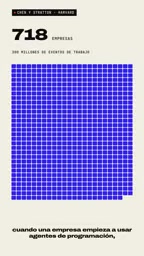
The study was conducted by two Harvard researchers, with a sample covering more than 700 companies. The data runs through March of this year and all comes from customers of a single code analysis platform. In other words, this is observational data from real engineering environments, not idealized lab tests.
The study examines how companies perform after adopting AI coding agents. It tracked two core metrics: code output volume and task/project completion. The gap between these two metrics forms the central finding of the entire study.
Coding agents are AI systems with a degree of autonomous planning and execution capability. They can write code, modify files, run tests, and perform other tasks based on natural language instructions. Unlike earlier tools that only offered code completion suggestions, they are closer to a "virtual developer" that can independently advance task steps. These agents are typically built on large language models, interact with their environment through tool calls, and correct their own output over multiple iterations. Because their output speed and autonomy are significantly higher than humans', companies often expect them to directly amplify delivery capacity. However, agent-generated code still requires human review and integration, and the unpredictability of agent behavior makes the verification step even more critical.
Key Finding: 30% Code Growth Didn't Translate into Delivery
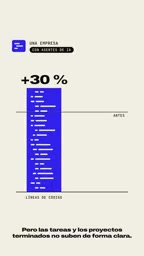
The data shows that after companies began using coding agents, lines of code increased by an average of about 30%. But then again, the number of completed tasks and projects showed no clear, significant improvement.
This result is worth pondering. Lines of code is an "input-side" metric of engineering activity, while completed projects are the "output side." Input rose by 30%, yet output barely budged—indicating there is an overlooked bottleneck somewhere in the production chain.
The researchers' explanation points to the review stage.
The Bottleneck Shifts: From Writing Code to Reviewing Code
In software engineering, any change must go through human review before being merged into the main branch. AI agent-generated code can't bypass this gate either—and this gate is being overwhelmed by AI's output speed.
According to the research data, the time spent reviewing each change increased by 49%, while the number of changes sent back for revision nearly doubled. This means: the more AI writes, the faster human reviewers' workload grows, and the rework loop becomes more frequent.

This finding overturns the intuition that "accelerating AI coding accelerates delivery." The cost of writing code has fallen, but the cost of verifying code correctness has risen—and the latter may even become the new dominant factor in the entire process.
Code review is a quality control mechanism in software engineering: before a developer's change is merged into the main branch, other engineers check its correctness, readability, security, and design consistency, and decide whether to approve or send it back for revision. Review is both a technical gate and a means of knowledge sharing and risk control. In traditional workflows, review workload grows roughly in sync with code output; but when AI agents dramatically increase code output speed, the arrival rate of review requests may exceed human reviewers' processing capacity, creating queues and backlogs. The simultaneous rise in review time and return rates is a direct manifestation of this supply-demand imbalance, turning review from a supporting step into the critical path that determines delivery pace.
Why Review Becomes the New Bottleneck
From a practical engineering perspective, this result isn't really surprising.
Review is a highly context-dependent task. Reviewers need to understand the intent of a change, evaluate edge conditions, and judge whether regression risks are introduced. AI can generate code at near-infinite speed, but human reviewers have limited attention and judgment bandwidth. When the supply side suddenly surges, the processing capacity on the demand side doesn't expand in sync.
Another factor is the "trust discount" on AI code. Because the generated code doesn't come from a familiar colleague, reviewers often need to check the logic more carefully rather than relying on trust in the author's ability. This lack of trust translates directly into increased review time and higher return rates.
The research also points to a structural contradiction: code generation tools optimize the act of "writing," while a company's real delivery bottleneck may have long existed in downstream stages like review, testing, and integration. Optimizing only the upstream is equivalent to pushing more pressure downstream.
Change size refers to the scope of modifications contained in a single code commit, usually measured by the number of files involved, lines of code, or amount of logic changed. Engineering research has long found that the larger the change size, the lower the review quality, the higher the defect escape rate, and the more reviewers tend to give superficial approvals. AI agents often generate large amounts of code at once, easily forming "large changes" that further exacerbate review burden. Splitting AI output into small batches of independently verifiable changes can reduce the cognitive load of each review, improve defect detection rates, and shorten the cycle from submission to merge—making it one of the most direct process measures for addressing the review bottleneck.
Practical Implications for Companies
This study doesn't say AI coding has no value—it says the location and manner of value release need to be redesigned.
Several actionable directions: first, extend AI capabilities into the review process itself—for example, using AI for initial screening, generating change summaries, and flagging high-risk modifications to reduce human reviewers' cognitive load; second, adjust the measurement system—don't use lines of code to measure AI's returns, but focus on cycle time from submission to merge; third, control the size of individual changes—small-batch, high-frequency changes are more conducive to review throughput than large-batch generation.
It should be noted that the study's data runs through March of this year and the sample comes entirely from customer companies of a single analysis platform, so the generalizability of the conclusions still requires more independent data for verification. But the question it raises is sharp enough: when writing code is no longer the bottleneck, where is the next gate for engineering organizations?
One-line Summary
Harvard study: AI coding agents increase code volume by 30%, but delivery doesn't increase—the bottleneck shifts to review.
Paragraph Summary
Two Harvard researchers, using real data from 700+ companies through March of this year, found that after adopting AI coding agents, lines of code increased by an average of about 30%, but the number of completed tasks and projects showed no significant improvement. The study points out that the bottleneck has shifted from code generation to code review: the time spent reviewing each change increased by 49%, and the number of changes requiring revision nearly doubled. The reason is that review relies heavily on human contextual understanding and judgment bandwidth, and AI code lacks the trust foundation of an author, leading to more careful checking and more frequent rework. The article suggests using AI to assist with initial review screening, replacing lines of code with submission-to-merge cycle time as a metric, and controlling individual change size, while noting that the sample comes from a single platform's customers and the generalizability of the conclusions still needs verification.
Related articles

Chain of Thought Isn't Just for AI: How Humans Can Use CoT to Improve Thinking Quality
Chain of Thought isn't just a prompt trick for large models. Starting from a Hacker News discussion, this article analyzes why CoT works for human thinking too, breaks down actionable ways to transfer it, and highlights the key differences between human CoT and machine CoT.
Cloudflare Teams Up with OpenAI: Closi…
Cloudflare Teams Up with OpenAI: Closing the Loop from Vulnerability Discovery to Defense with AI
Cloudflare uses OpenAI Daybreak to investigate security vulnerabilities and generate reviewable remediation plans, while developers use Codex to boost coding efficiency and quality.

Orca Multi-Agent Orchestration in Practice: A Guide to Parallel Collaboration with Claude and Codex
Orca is Stable AI's free open-source agent workbench supporting 34 agents like Claude Code and Codex in parallel. Learn its Git worktree isolation, multi-model orchestration, and mobile management.