AI Coding Model Leaderboard: Opus 5.5 Crowned, Gemini Neon Stages a Comeback

Tech blogger Berman releases an AI coding model tier list, revealing that collaboration pleasantness and quota efficiency determine productivity more than benchmark scores.
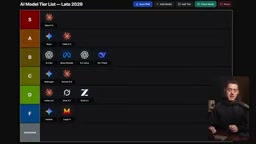
Tech blogger Matthew Berman published an AI coding model tier list based on everyday coding workflows, comparing models from Claude, Gemini, OpenAI, Meta, and Chinese labs. Claude Opus 5.5 holds S-tier alone for its best balance of quality, cost, and quota efficiency; Gemini Neon is the biggest dark horse, with collaboration experience close to or better than Opus 5.5, ranking above the highest-quality but costly Fable 5.2. Both OpenAI models land in B-tier—Astra requires repeated correction, while Soul is specialized in computer operation. In the open-source camp, DeepSeek v4.1 Flash earns B-tier but faces a "good yet hard to use" dilemma due to subscription ecosystem pressure. The core signal: as capability gaps narrow, collaboration pleasantness and output per unit quota become decisive factors.
S-Tier's Lone Champion: Why Opus 5.5 Remains the Top Choice
AI coding models have entered a phase of "multiple strong contenders," but the actual experience varies enormously from model to model. Well-known tech blogger Matthew Berman published a model tier list based on everyday coding workflows, putting models from Claude, Gemini, OpenAI, Meta, and Chinese labs on the same table for comparison. The value of this list isn't in the absolute rankings, but in the fact that it reveals something obscured by parameter leaderboards: a model's "collaborability" often determines productivity more than benchmark scores.
In Berman's list, only one model holds S-tier: Claude Opus 5.5. His assessment is blunt: it's the model with the best balance of "quality, cost, and collaboration pleasantness," and his default choice for the vast majority of his work.
Interestingly, he singles out "quota efficiency" as a separate scoring dimension. Opus 5.5 consumes a relatively restrained amount of quota under the Claude subscription system, meaning the same subscription allowance can support more actual work. By contrast, Fable 5.2—widely regarded as the "highest quality globally"—is more capable but has significantly higher token prices and quota consumption, so it only lands in A-tier. Berman only calls on it for the thorniest problems or when cross-validating other models' outputs.
This reveals a pragmatic signal: when the capability gap between models narrows to a certain point, usable output per unit cost becomes the decisive factor. Opus 5.5 wins not because it's the strongest in any single dimension, but because it has no obvious weaknesses.
Quota efficiency refers to the model invocation volume obtainable per unit time or per dollar of subscription fee under subscription-based services (such as Claude Pro/Max, ChatGPT Plus, etc.). Different models consume different amounts of quota: models with greater capability, longer context, or more reasoning steps typically deduct more quota per request. Therefore, even if two models have the same monthly fee, the one with higher quota efficiency can support more actual work. For developers writing large amounts of code daily, this dimension often determines a tool's practicality more than raw benchmark scores—because coding is a high-frequency, multi-turn interaction scenario, and the rate of quota consumption directly affects whether the workflow will be forced to interrupt.
Inside the Claude Family: The Awkward Position of Sonnet and Haiku
The internal ranking within the Claude product line is quite interesting. Sonnet 5.5 was marketed as the "best knowledge work model" at launch, but in Berman's coding scenario it only earned a C-tier. The reason is realistic: its quota consumption isn't far from Opus 5.5's, yet the capability gap is obvious, so users naturally lack a reason to choose it.
Haiku 5.5 fares even worse, judged D-tier. In Berman's words, the quality loss from downgrading from Opus to Haiku is too great, and the price discount isn't enough to compensate. This judgment is especially valuable for heavy users—under a subscription model, "cheap" is no longer defined by unit price, but by how much usable code each unit of quota returns.
Gemini's Turnaround: Neon Is the Biggest Dark Horse
The most dramatic twist in the list comes from Google. Berman admits that if he had made this ranking a few weeks earlier, most Gemini models would have been relegated to D-tier or lower. But the arrival of Neon changed the situation.
According to his account, even the Google team was surprised by Neon's popularity, publicly stating they "didn't expect to have such a model on their hands." Neon isn't positioned as a Fable-level high-quality flagship, but rather as offering a collaboration experience close to Opus 5.5—Berman even finds it "more pleasant" than Opus 5.5, just slightly less capable. His usage strategy shifted accordingly: all tasks from simple to moderately difficult go to Neon, with only the harder ones going back to Opus.
Ultimately Neon landed in A-tier, ranked ahead of Fable 5.2. This is one of the most counterintuitive rankings in the entire list, and it shows that "ease of use" may have long been underestimated in real workflows.
Gemini's other models weren't so lucky. The highly anticipated Carbon was judged F-tier for instability, poor performance on long tasks, and slow responses; the workhorse model Hydrogen, though rarely used by Berman himself, earned C-tier and ranked ahead of Sonnet by virtue of being cheaper than Sonnet 5.5 with comparable capability.
Collaboration pleasantness is a non-traditional but critical scoring dimension in Berman's list, referring to the overall smoothness of developer-model interaction: whether the model accurately understands intent, whether it requires repeated correction, whether output formatting is stable, and whether responses are timely. It isn't directly correlated with benchmark scores—a high-scoring model may add mental overhead by over-explaining, making unauthorized changes to unrelated code, or frequently requesting clarification. In real coding workflows, this friction accumulates into significant time costs, so a medium-capability model with high collaboration pleasantness may produce more actual output than a strong model that needs constant pushing.
OpenAI: Astra Needs "Hard Pushing," Soul Is Specialized but Excellent
Both models in OpenAI's current generation are placed in B-tier, but for completely different reasons.
6.2 Astra is the flagship, and Berman thinks it's "not that bad," but there's still an obvious gap from Opus 5.5. The key issue is usage cost—not monetary cost, but mental cost: to get ideal results, users must repeatedly push and correct the model, and this friction discounts overall efficiency. With Neon already offering a smoother experience, Astra's appeal drops further.

6.2 Soul is a different case. Berman calls it the strongest computer-operation and browser-control model currently available, with advantages in speed and cost, and excellent video editing performance too. But precisely because its strengths are too narrow, it isn't prioritized for coding tasks and ends up in B-tier—Berman admits he was tempted to put it in A-tier, but after hesitation kept the original judgment.
The Open-Source Camp: DeepSeek Pragmatic, Mistral and GLM Lack a Foothold
Open-source models are generally mid-to-low tier in this list, but not without bright spots.
DeepSeekAd v4.1 Flash earned B-tier for strong coding and building capabilities, extremely low price, and open weights. Berman readily admits he doesn't use it much—his Claude, Gemini, and ChatGPT quotas are already sufficient—but the model's quality deserves recognition. This "good but unusable" assessment actually reflects a structural problem in the current AI coding tool market: distribution channels and subscription bundling are influencing actual model adoption rates.
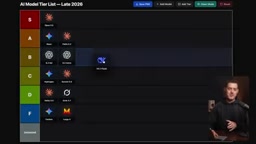
Mistral Large 4 Le Chonk was judged F-tier; Berman says he can't find a use case for it and gives only limited credit for open weights. GLM 5.3 and DeepSeek V4 Pro are both D-tier, with the latter considered less capable than American closed-source models, its only advantage possibly being cost. Kimi K3.1 Pro was described as "the best Chinese AI model," also landing in D-tier. Tongyi 4 Max follows closely behind.
Meta's Muse Wonderful is another small surprise; Berman finds it as easy to collaborate with as Neon, and although it's less capable and less fun than the latter, it still earned B-tier. Muse Spark and Muse Ember were placed in the pending zone due to insufficient testing, with Spark being an open-weights model.
Open weights and open source are often used interchangeably in the AI model context, but they have different meanings. Open weights means the trained parameter files can be publicly downloaded, and anyone can deploy, fine-tune, or quantize them independently, but the training data, code, and process aren't necessarily public; a strictly open-source model also requires that training code and data be accessible. For developers, the practical significance of open weights is: the ability to run locally to avoid API fees and privacy risks, fine-tune for specific domains, and be free from subscription quota limits. DeepSeek and Meta's Muse Spark are both open-weights models, which is one reason Berman gave them extra credit in his evaluation.
Three Judgments Behind the List
The most intriguing aspect of this tier list is that it places "collaboration pleasantness" and "quota efficiency" on equal footing with model capability. For developers who write large amounts of code daily, a strong model that requires constant correction may produce less actual output than an obedient medium model.
The second signal is Google's speed of recovery. Neon's reputation reversal shows that model competition is far from settled—a single successful product iteration can change the developer community's overall impression.
The third signal is the situation of open-source models. Open-source forces like DeepSeek and Meta are no longer weak in capability, but under the squeeze of the subscription ecosystem, there's an obvious gap between "good to use" and "actually being used." Berman himself admits that even when a model is good, he finds it hard to muster the motivation to switch.
It should be noted that this list reflects a single creator's subjective experience under a specific workflow, and model rankings change rapidly with version iterations. For developers, the more valuable approach is to use its evaluation dimensions—quality, cost, quota efficiency, collaboration friction—to build their own testing checklist rather than copying the rankings.
The bundling effect of the subscription ecosystem is key background for understanding current model adoption rates. Mainstream AI coding tools (Claude Code, Cursor, GitHub Copilot, etc.) are typically deeply tied to specific model families, and the marginal cost for users to switch models within an already-paid subscription system is very low, while trying new models outside the system requires additional payment, API key configuration, and adapting to different interaction styles. This leads to vast differences in actual usage between models of similar capability—distribution channels and subscription bundling become stronger determinants of adoption than model quality. Berman's "good but unusable" assessment of DeepSeek v4.1 Flash is a direct manifestation of this effect.
One-line Summary
Tech blogger Berman releases an AI coding model tier list, revealing that collaboration pleasantness and quota efficiency determine productivity more than benchmark scores.
Related articles

The Gemini 4 Trio and 3.8 Flash: A Full Comparison of Positioning, Pricing, and Benchmarks
A comparison of Gemini 4 Neon, Carbon, Argon, and Gemini 3.8 Flash: positioning, context, API pricing, Artificial Analysis and Arena benchmark scores, and available entry points.

New Jersey Joe Sandwich: Meat and Coleslaw on Triple-Decker Rye
New Jersey Sloppy Joe isn't a ground beef burger—it's triple-decker rye bread with meat, Swiss cheese, and coleslaw, plus Russian dressing. Learn the authentic Essex County method and family recipe.

Genie 4's New Trick: Change Scenes in Real Time While Exploring Generated Worlds, and Add Characters Too
Google Genie 4 adds real-time prompting: enter new prompts while exploring generated worlds to add characters or switch scenes, with native audio adapting in sync. Available to eligible Google AI Ultra subscribers in Project Genie.