The Gemini 4 Trio and 3.8 Flash: A Full Comparison of Positioning, Pricing, and Benchmarks

Clarifying the positioning, scores, pricing, and entry points of Gemini 4's Neon, Carbon, Argon, and Gemini 3.8 Flash.
Based on a Bilibili creator's analysis plus official pricing and third-party benchmarks, this article sorts out four often-confused Gemini models. Neon, Carbon, and Argon belong to Gemini 4, positioned as the complex-coding mainstay, the long-horizon capability-ceiling model, and the efficient low-latency version; 3.8 Flash belongs to Gemini 3 and focuses on low-cost scale with explicit caching. Artificial Analysis V5.0.2 scores are Neon 62, Carbon 60, Argon 51, and Flash 31, but the thinking tiers differ, so comparisons need caution. Neon is the most expensive, Carbon and Argon are the same, and Flash is the lowest, with discount deadlines. Thinking tiers significantly affect scores, latency, and bills. The article also stresses that product entry points differ from API availability: Anti-Gravity removes Argon and Flash on November 30, but their APIs remain Stable.
Gemini 4 Neon, Carbon, Argon, and Gemini 3.8 Flash are four names that have been appearing together a lot lately. They look like four tiers of the same series, but they actually belong to two different generations: Neon, Carbon, and Argon are part of Gemini 4 and focus on reasoning; 3.8 Flash belongs to Gemini 3 and leans toward low-cost, large-scale work. Based on an analysis by a Bilibili creator, combined with official pricing pages and third-party benchmarks such as Artificial Analysis, this article clarifies their positioning, scores, pricing, and available entry points.
First, distinguish three things: model names, product entry points, and billing units
The same model may have completely different permissions in the Gemini App, Google Anti-Gravity, and the Gemini API. The Gemini App is a consumer-facing assistant, Anti-Gravity is a coding and agent workbench, and the API is an interface that developers call by token. A token is the basic unit the model uses to process text, and API bills are mainly calculated by input and output tokens.
Buying a subscription does not mean you get API quota, and being able to see a model card does not mean the current App will definitely let you select it. According to the creator's summary, the models currently manually selectable in the Gemini App are Hydrogen, Neon, and Carbon (Pro does not have Carbon; only Ultra does); in Anti-Gravity, both paid Pro and Ultra can use Neon, Carbon, Argon, and 3.8 Flash, but the latter two will be removed on November 30.
Artificial Analysis Composite Index and Coding Agent Index
Artificial Analysis is an independent third-party AI model evaluation organization. Its Intelligence Index combines multiple benchmarks such as knowledge work, coding, scientific reasoning, and general capability into a weighted 0–100 score, making cross-model comparison easier. Because different models' thinking levels and tool configurations affect results, the organization usually reports results for each tier separately under the same testing protocol, and readers should note whether the configurations are consistent when comparing. The Coding Agent Index is a sub-index that specifically evaluates the ability of a "model + coding agent framework (such as Anti-Gravity CLI)" combination to complete real coding tasks. It reflects not only the model itself but also the collaborative performance of the toolchain. The Arena text leaderboard (LMArena) uses an Elo-style ranking based on blind human voting, measuring subjective preference rather than objective correctness, so it often differs in ordering from the composite index. Each of the three leaderboards has its own focus, and looking at any one alone can easily lead to misjudgment.
The three Gemini 4 models: positioning and capability boundaries
Neon: the mainstay for complex coding and production-grade workflows
Neon was released on November 18. It is a new model adapted from Carbon, positioned for complex coding, analytical reasoning, and production-grade enterprise workflows. It can read text, images, audio, video, and PDFs, but outputs text; the API provides a unified context window of 1,048,576 tokens, with input, thinking, and output sharing this quota. By default it outputs 65,536 tokens synchronously, and longer outputs can go through background Long Decode, up to nearly 1 million tokens.
Thinking intensity supports Low, Medium, High, and High (as in the original text, suspected to be a typo for High and a higher tier), with High as the default. On the Artificial Analysis V5.0.2 composite index, Neon scores 62 at High and 60 at High; but the average task cost at High is $6.44 and takes 25.9 minutes, while dropping to High reduces the cost to $3.74 and the time to 4.8 minutes. The highest score is not free.
Carbon: the long-horizon model that pushes the capability ceiling
Carbon was widely released on November 10. Based on Argon, it is the model Google describes as specifically challenging the capability ceiling, leaning toward long-horizon tasks, multi-step coding, complex debugging, open scientific research, and agent workflows that require repeated verification. Google says it will spend more thinking than Argon to explore hypotheses, perform deeper reasoning, and run longer verification loops. The context is also about 1,048,576 tokens, supporting Low, Medium, and High, with Medium as the default.
One easily overlooked difference: the non-streaming single foreground output limit for Carbon and Argon is 32,768 tokens, lower than Neon's 65,536. Artificial Analysis gives Carbon 60 points at the High tier, but the average duration is 38.2 minutes, output speed is about 54 tokens per second, and cost is $7.76. It also has another ace — on the Arena text leaderboard, Carbon High ranks first with 1527 points. Carbon is not completely overshadowed by Neon; it is slower, but it still has its place in preferred long tasks and some difficult problems; Google also admits that it occasionally runs slowly or times out, and high thinking tiers consume more tokens.
Argon: the efficient version with an advantage in latency
Argon was widely released on October 13 and was the first frontier model publicly released in this Gemini generation. Google's current API pricing page directly describes it as the efficient version of Carbon — faster responses and fewer tokens consumed per turn. It also has a unified context of about 1,048,576 tokens, supports Low, Medium, and High, with Medium as the default.
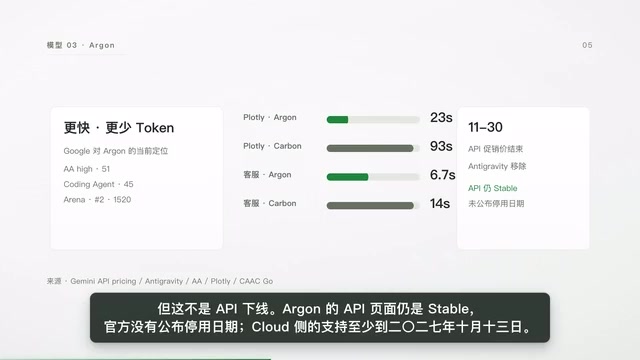
The API standard is the same as Carbon: $2 input and $10 output per million tokens, with the discounted price until November 30, doubling on December 1. Artificial Analysis gives Argon 51 points at the High tier and 45 on the Coding Agent Index, indeed lower than Neon and Carbon; however, on the Arena text leaderboard it is second, 20 points (as stated in the original text, suspected to be a mix of ranking and score). In some independent tests, its latency is better: in the Plotly data analysis test, Argon's median time per turn is 23 seconds, while Carbon is 93 seconds; in another customer service agent test, Argon's typical wait is 6.7 seconds, while Carbon is 14 seconds.
Argon and 3.8 Flash will leave the Anti-Gravity model selector on November 30, but this is not an API shutdown — Argon's API page is still Stable, and no retirement date has been announced. Cloud testing support lasts at least until October 13, 2027 (as shown in the screenshot).
Gemini 3.8 Flash: another line for low-cost scale
3.8 Flash was released on September 2 and belongs to Gemini 3, not Gemini 4. It is positioned for low-cost, production-grade, agent, software engineering, tool calling, and complex knowledge workflows. The input context is about 1,048,576 tokens, and the output limit is 65,536, with the two as separate budgets; it does not have the nearly 1 million Long Decode of Gemini 4, and supports Low, Medium, and High, with Medium as the default.
It can be used on the API free tier. The current paid price is $0.75 per million input tokens and $3.75 per million output tokens, with the discounted price until December 31, doubling on January 1, 2027. It also has a key difference: it supports explicit caching, where developers can actively put repetitive content into the cache; Gemini 4 currently only supports implicit caching automatically determined by the system.
Artificial Analysis gives it only 31 points at the High-Down tier, and it ranks 11th on the Arena text leaderboard with 1498 points, but its output speed is about 99 tokens per second, and the median cost per task tracked by Arena is also the lowest among the four. It still has a place for high-frequency, budget-sensitive tasks with clear boundaries.
The difference between explicit and implicit caching
Caching mechanisms are used to reduce the token cost of repeated context. Explicit caching allows developers to actively upload a fixed piece of content (such as a system prompt, long document, or codebase) and create a cache object; subsequent requests can reference the cache and be billed at a discounted price, but there is usually a separate charge for cache storage time, and developers must manage the lifecycle themselves. Implicit caching is when the server automatically determines which repeated prefixes are worth caching; developers do not need to act, but whether it hits and the size of the discount are not fully controllable. For scenarios that frequently call the same long context, explicit caching can bring more certain and significant cost savings; for tasks with variable calling patterns, implicit caching is less hassle but has unstable returns. When choosing a model, whether the cache type matches your workload often affects the actual bill more than the unit price difference.
How to read benchmark scores: compare within the same tier for fairness
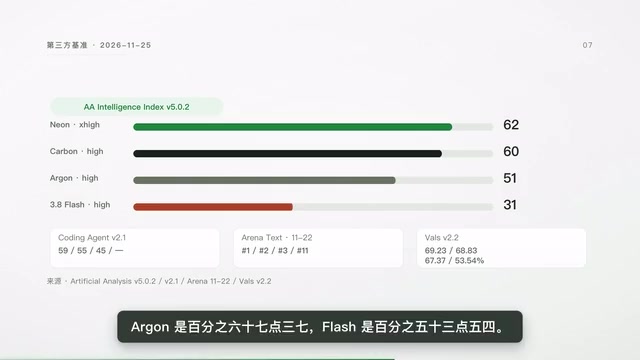
Artificial Analysis's composite index weights nine evaluations together, including knowledge work, coding, science, and general capability. The creator uniformly uses the V5.0.2 data read on November 25: Neon High 62, Carbon High 60, Argon High 51, and 3.8 Flash High 31. Note that Neon uses the highest tier, High, while the other three use High; these are not exactly the same configuration.
Coding Agent Index 2.1 tests the combination of the model plus Anti-Gravity CLI: Neon High 59, Carbon High 55, Argon High 45. Flash has no comparable data in the current V2.1, so no score is added. The Arena text leaderboard measures human preference; according to the November 22 snapshot, Carbon is first, Argon second, Neon third, and Flash eleventh.
Wealth Index leans more toward U.S. economic tasks: Neon 69.23%, Carbon 68.83%, Argon 67.37%, and Flash 53.54%. The standard error intervals of the top three overlap, so this gap cannot be regarded as a stable win or loss.
Pricing and billing: discount periods and thinking tiers both change the bill
API prices are calculated per million tokens, and output prices include thinking tokens — the longer the model thinks internally, the higher the bill. Current Standard prices: Neon input $3, output $15; Carbon and Argon are both $2 and $10; Flash is $0.75 and $3.75. The discounted prices for Carbon and Argon end on November 30 and become $4 and $20 on December 1; Flash's discount ends on December 31 and becomes $1.5 and $7.5 on January 1, 2027. Neon is still $3 input and $15 output, with no promotion announced.
All four models support Batch, usually at half the standard price; Batch aims to complete a batch of tasks within 24 hours. Flash has variable latency, and when capacity is insufficient it may directly return an error rather than automatically switching back to Standard. Caching also depends on type: Gemini 4 only has implicit caching, while Flash's explicit caching is still in Beta and charges separately for storage. Being cheap now and long-term cost are two different calculations.
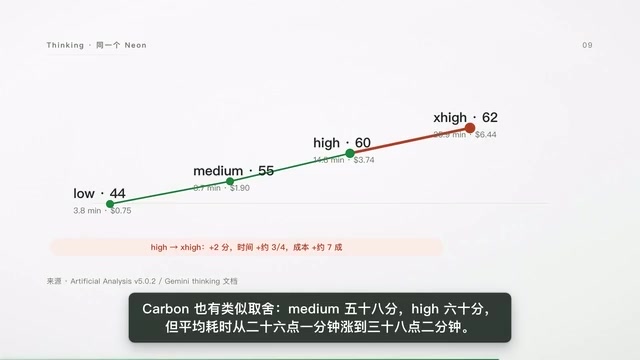
Thinking tiers significantly change results. Again for Neon in the same Artificial Analysis test: Low is 44 points, average duration 3.8 minutes, cost $0.75; Medium 55 points, 8.7 minutes, $1.9; High 60 points, 14.8 minutes, $3.74; High 62 points, 25.9 minutes, $6.44. From High to High, the score increases by only 2 points, the time increases by about 3.4 minutes (as in the original text), and the cost also increases by about 70%. Carbon has a similar tradeoff: Medium 58 points, High 60 points, but average duration rises from 26.1 minutes to 38.2 minutes.
The API's Max Super Tokens is the total upper limit for thinking plus the final answer. If too many are used for thinking, the answer may be truncated or even reduced to only a thinking summary. In practice, first determine task difficulty, latency requirements, and budget, then decide the thinking tier; maxing it out by default is not necessarily cost-effective.
The billing logic of Batch API and thinking tokens
The Batch interface allows developers to bundle and submit a large number of requests, which the server completes asynchronously within a target time limit (usually 24 hours). The price is generally half that of standard synchronous calls, making it suitable for offline evaluation, batch data labeling, large-scale content generation, and other latency-insensitive tasks. Note that Batch discounts and cache discounts usually cannot simply be stacked, and some models do not guarantee behavior in Batch mode that is completely consistent with synchronous calls. On the other hand, the output price includes "thinking tokens" — that is, tokens consumed by the model's internal reasoning before giving the final answer are also billed at the output price. This means that raising the thinking tier not only lengthens response time but also directly increases the bill; in long-thinking tasks, the thinking portion may even account for the majority of total output tokens. Therefore, budget estimates should be based on the total tokens of "thinking + answer," not just the visible answer length.
Available entry points and lifecycle
All four models are Stable in the Gemini Developer API, and no retirement dates have been officially announced, but product entry points are another matter. The models currently manually selectable in the Gemini App are Hydrogen, Neon, and Carbon (Pro does not have Carbon; only Ultra does); in Anti-Gravity, both paid Pro and Ultra can use Neon, Carbon, Argon, and 3.8 Flash, with the latter two removed on November 30. There is also a product difference here: Anti-Gravity's Neon context is up to 512K, while the API is 1M. The lifecycle of cloud testing is also not the same as the API — Argon is supported at least until October 13, 2027, and Flash at least until September 2, 2027. After the cloud platform stops support, the model may still continue to be offered through the Gemini API. To check availability, you need to see whether you are using the App, Anti-Gravity, Developer API, or Cloud.
Model lifecycle: Stable, Preview, and Cloud support windows
Model status in the Gemini API is usually divided into Stable (stable version, with an official commitment to longer-term availability) and Preview/Experimental (preview version, which may change or go offline at any time). Stable does not mean permanently available; the official team will still announce deprecation dates in advance. In addition, the support window for calls through cloud platforms such as Google Cloud Vertex AI is often independent of the Gemini Developer API: the cloud platform may promise support until a specific date (such as October 2027), and whether the model continues to be offered in the Developer API after expiration must be checked separately. Adjustments to model lists at product entry points (Gemini App, Anti-Gravity, etc.) are more frequent and are not directly tied to API availability. When evaluating technology choices, you should separately confirm the API status, cloud platform support period, and target product entry point to avoid mistaking a shutdown in one place for a complete discontinuation.
How to choose: a judgment framework by task
- The hardest, longest, open-ended tasks that require repeated exploration and verification: look at Carbon first.
- Complex coding and analytical reasoning, where you want frontier capability and care about waiting time: look at Neon first, and choose High or a higher tier according to the task.
- Deep work that favors efficiency and is latency-sensitive: Argon is still available in the API; if you rely on Anti-Gravity, remember that it will be removed on November 30.
- High-frequency, cost-sensitive, large-scale work with clear task boundaries: look at 3.8 Flash first; the free tier and explicit caching may both be useful.
These judgments come from official positioning and third-party tests; they are a starting point, not a guarantee. Actual results will also be changed by tools, prompts, cache hit rates, task difficulty, and thinking tiers, and rankings may change when tasks change. Neon currently has the highest score on the Artificial Analysis composite index, but the high reasoning tier is slower and more expensive; Carbon is reserved for the hardest, longest tasks, and the price of deep exploration is time and tokens; Argon is the efficient version — Anti-Gravity will say goodbye to it, but the API is still there; 3.8 Flash is one tier lower in score, but the free tier, low price, and explicit caching keep it suitable for large-scale work. Prices, leaderboards, and availability all have dates; before looking at a model, first look at which product you are actually in, what task you are using, and how large a thinking tier you enable.
One-line Summary
Clarify the positioning, scores, pricing, and entry-point differences among Gemini 4's Neon, Carbon, Argon, and Gemini 3.8 Flash.
Paragraph Summary
Based on a Bilibili creator's analysis and combined with official pricing and third-party benchmarks, the article sorts out four Gemini models that are often confused. Neon, Carbon, and Argon belong to Gemini 4 and are positioned respectively as the mainstay for complex coding, the long-horizon model that challenges the capability ceiling, and the efficient low-latency version; 3.8 Flash belongs to Gemini 3 and focuses on low-cost scale while supporting explicit caching. On the Artificial Analysis V5.0.2 composite index, Neon is 62, Carbon 60, Argon 51, and Flash 31, but the thinking tiers used are not consistent, so comparison requires caution. In terms of price, Neon is the most expensive, Carbon and Argon are the same, and Flash is the lowest, with discount deadlines for all. Thinking tiers significantly affect scores, latency, and bills. The article also emphasizes that product entry points are not the same as the API: Anti-Gravity will remove Argon and Flash on November 30, but their APIs remain Stable, and model selection should be judged comprehensively by task difficulty, latency, and budget.
Related articles

AI Coding Model Leaderboard: Opus 5.5 Crowned, Gemini Neon Stages a Comeback
Tech blogger Matthew Berman releases an AI coding model tier list: Claude Opus 5.5 holds S-tier, Gemini Neon surprises with A-tier, OpenAI Astra lands B-tier. How do open-source models like DeepSeek fare? We break down the scoring logic and practical takeaways.

New Jersey Joe Sandwich: Meat and Coleslaw on Triple-Decker Rye
New Jersey Sloppy Joe isn't a ground beef burger—it's triple-decker rye bread with meat, Swiss cheese, and coleslaw, plus Russian dressing. Learn the authentic Essex County method and family recipe.

Genie 4's New Trick: Change Scenes in Real Time While Exploring Generated Worlds, and Add Characters Too
Google Genie 4 adds real-time prompting: enter new prompts while exploring generated worlds to add characters or switch scenes, with native audio adapting in sync. Available to eligible Google AI Ultra subscribers in Project Genie.