AI Coding Model Selection Guide: A Tiered Strategy from Budget to Flagship

A practical tiered strategy for selecting AI coding models from budget options to flagship powerhouses.
As LLMs diverge sharply in cost and capability, smart developers no longer rely on a single "best" model. This guide breaks down a community-sourced tiered selection framework: use Mimo and Deepseek for everyday coding, Composer 2.5 for serious development, and flagship models like Grok 4.5 and GPT 5.6 Sol for system design and architecture planning.
The Era of Tiered AI Coding Models Has Arrived
As large model technology evolves at a rapid pace, the AI coding assistant market has developed a clear tiered structure. This stratification is no accident. Over the past two years, from open-source models like the LLaMA family to commercial flagships, large language models (LLMs) have diverged sharply across two dimensions — capability and cost. Inference costs for lightweight models have continued to fall while the reasoning depth of flagship models keeps climbing, and the price gap between the two can now exceed 100x. This is precisely what has transformed "tiered selection" from a possibility into a necessity.
A Reddit developer recently shared what they consider "every viable coding model right now," ranked from cheapest to most expensive while highlighting the best performers at each price point. Though subjective, the list reflects an important trend: developers no longer put blind faith in a single "strongest model" — they make fine-grained selections based on the nature of the task at hand.
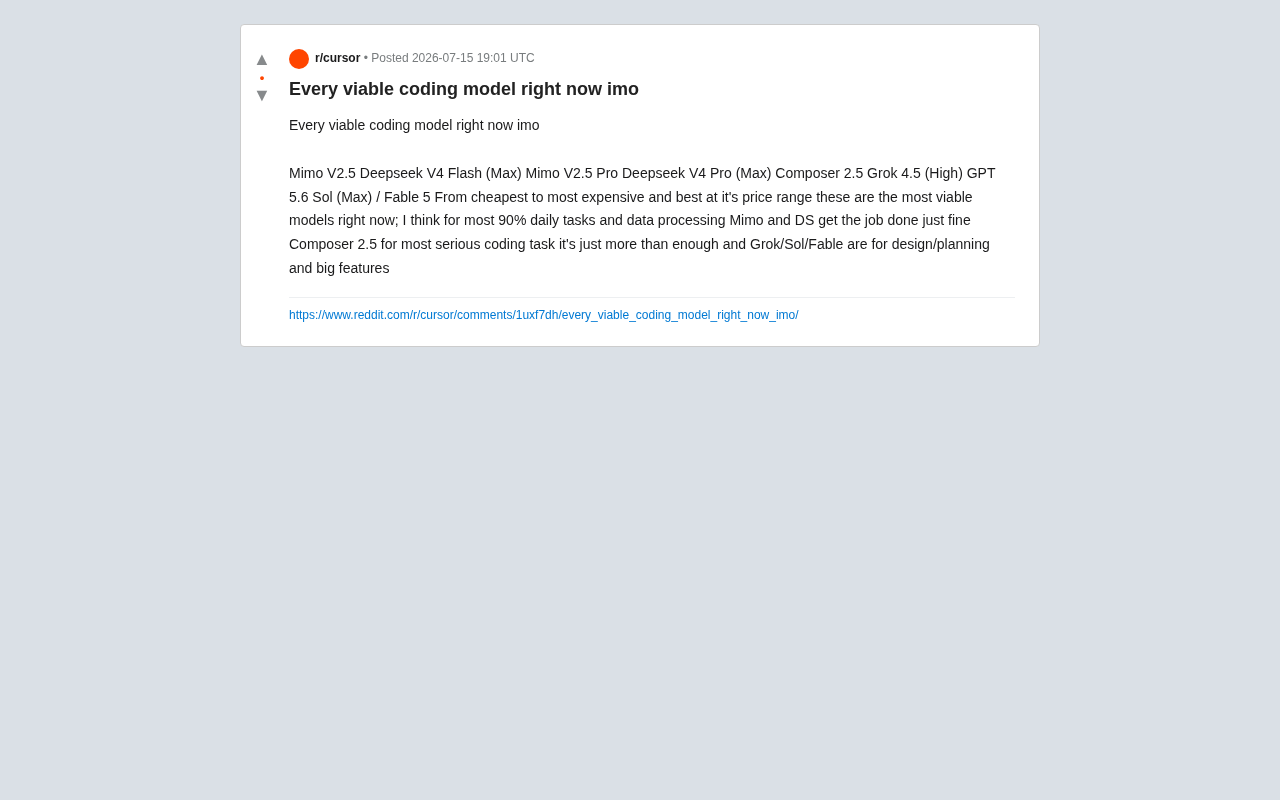
The list spans a full spectrum, from Mimo V2.5 and Deepseek V4 series, to Composer 2.5 and Grok 4.5, all the way up to premium options like GPT 5.6 Sol and Fable 5. These models don't exist in a simple hierarchy of better or worse — they cover a complete range of budgets and use cases.
The Logic Behind Price-Tiered AI Coding Model Selection
Entry-Level and Everyday Work: Mimo and Deepseek Lead the Way
For 90% of everyday tasks and data processing work, Mimo V2.5 and the Deepseek V4 series are more than sufficient. This assessment reflects a key reality in today's AI coding landscape: most coding work simply doesn't require top-tier reasoning capabilities.
Code completion, writing simple functions, script generation, data cleaning, and format conversion — these high-frequency but moderately technical tasks are exactly where budget-friendly models shine. The Deepseek series deserves particular attention in this space. Developed by a team under High-Flyer, a Chinese quantitative investment firm, Deepseek is an open-source LLM built on a MoE (Mixture of Experts) architecture with highly efficient training methods. It achieves performance comparable to or even surpassing flagship models on coding tasks, at a fraction of the compute cost. The release of Deepseek R1 in early 2025 drew widespread attention across the global AI community and became widely regarded as a technical benchmark for "doing more with less." Newer options like Mimo have further enriched this price segment, allowing developers to handle the vast majority of repetitive work at minimal cost.
This "good enough" philosophy is reshaping teams' cost structures. Rather than calling an expensive flagship model for every code completion, using high-value AI coding tools as the default engine in day-to-day workflows makes much more sense.
Serious Development: Composer 2.5 Hits the Sweet Spot
When task complexity rises to the level of "serious coding," Composer 2.5 occupies a mid-range price point while handling programming tasks that demand meaningful architectural understanding and contextual awareness — making it the "go-to tool" for many professional developers.
Serious coding typically involves multi-file collaboration, managing inter-module dependencies, following existing code conventions, and a fair amount of debugging and refactoring. These tasks place greater demands on a model's context window — the metric that determines how much code, files, and function definitions a model can "see" in a single session. Early GPT-3.5 supported only 4K tokens of context, while today's mid-range models typically support 32K to 128K tokens. This leap has made cross-file code comprehension and consistent output genuinely possible. Composer 2.5 strikes a balance between context depth and cost that neatly fills the gap between everyday tasks and flagship-level reasoning.
Design and Planning: Flagship Models Handle the Big Picture
Grok 4.5 (High), GPT 5.6 Sol (Max), and Fable 5 are explicitly positioned as tools for system design, technical planning, and large-scale feature development. This represents a philosophy worth paying attention to.
The value of these high-end AI coding models isn't in writing more code — it's in "thinking more clearly." System architecture design, breaking down technical approaches for complex features, holistic planning for large initiatives — these are the tasks that demand deep reasoning, a global perspective, and creative thinking, and they're the ones that justify the high call costs of top-tier models.
The pricier the model, the more it should be used for "decision-making" rather than "execution": use flagship models to plan the blueprint, mid-range models to build the main body, and budget models to handle the routine work. This forms a highly efficient cost-capability pyramid.
What This Selection List Reveals About AI Coding Industry Trends
Multi-Model Collaborative Workflows Are Becoming the New Normal
The most immediate insight from this list is that AI coding tools are undergoing a kind of "fragmentation." Developers are no longer choosing a single model — they need to build a multi-model orchestration workflow. This concept borrows from the "microservices" design philosophy in software engineering: decompose work that was once handled by a single model into multiple specialized processing nodes, and dynamically route sub-tasks to the appropriate model based on their complexity and cost sensitivity. At the tooling level, mainstream coding IDE plugins like Cursor and Continue.dev have already begun natively supporting multi-model routing configurations, allowing developers to assign different models for different scenarios such as code completion, code review, and architecture suggestions. This brings both flexibility and cost optimization opportunities, while also increasing the complexity of tooling management.
You may have noticed that the model naming conventions in the list (e.g., GPT 5.6, Deepseek V4, Grok 4.5) reflect the community's intense focus on iteration speed. Regardless of how specific version numbers change, the underlying tiered selection logic remains clear and holds long-term reference value.
Cost-Efficiency Is Becoming a Core Competitive Advantage
In the past, model competition often centered on "who scores higher on benchmarks." Standard code-generation evaluation suites like HumanEval, MBPP, and SWE-bench were once the primary reference for developer selection. However, the industry has grown increasingly aware that there's a significant gap between benchmark scores and real-world development experience: a model might top standard tests yet perform poorly when dealing with legacy code, non-standard frameworks, or complex business logic in actual projects. This phenomenon of "benchmark inflation" is a key reason developers have shifted toward community experience sharing and real-world usage reputation.
Today, discussions in developer communities have noticeably shifted toward "what capability can I get at what price point." The rise of the Deepseek series is the best illustration of this trend — it proved that in the practical context of coding, value per dollar is more compelling to real users than absolute peak performance.
This also means that the AI coding tools that succeed in the developer market going forward may not be the smartest ones, but rather those that deliver the best experience at a specific price point.
Rational Selection Matters More Than Chasing the Latest Release
For individual developers and teams alike, the most practical takeaway from this list is: don't blindly pursue the most powerful model — allocate resources according to the task. Use budget models for routine tasks, mid-range models for core development, and flagship models for architecture decisions. This tiered strategy ensures quality while significantly controlling costs.
Conclusion: Model Selection Intelligence Is Itself a Technical Skill
This "viable coding model" list from the Reddit community is just one person's perspective, but it precisely captures the core logic driving today's AI coding tools: moving away from single-model worship toward tiered, multi-model collaboration. As LLMs continue to diverge across the dimensions of capability and cost, and as multi-model workflow tooling matures, developers who know how to select the right AI coding tool for each task will gain significant advantages in both efficiency and cost. In an era when AI-assisted coding is rapidly maturing, the wisdom of model selection has itself become an important technical skill.
Key Takeaways
Related articles

Network Doctor: An Open-Source Terminal Tool for Network Fault Diagnosis
Network Doctor is an open-source terminal network diagnostic tool that integrates ping, dig, curl, and traceroute, automatically detecting connectivity in stages and outputting fault conclusions in natural language.

LangChain Guardrails Explained: Building Safe and Controllable AI Agents
A detailed guide to LangChain Guardrails covering layered ecosystem architecture, middleware implementation, deterministic and model-driven protection for building production-grade secure AI Agents.

Deep Dive into Microsoft's AI Security Tools: Does Performance Really Surpass the Competition?
Microsoft launches enterprise AI security tools claiming superior performance. This deep analysis examines core capabilities, ecosystem advantages, and risks to guide enterprise security decisions.