AI Comic Drama in Practice: Using a Video Agent to Precisely Generate a Specific Shot
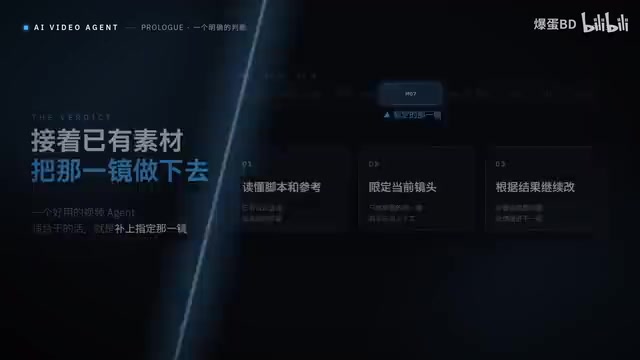
A video agent should read scripts and references, limit the current shot, and absorb visual feedback to reduce loss from settings to final output.
Through the five-second look-back scene of the seventh shot in the 30-second AI comic drama trailer *Borrowed Life Lamp*, the article summarizes three core capabilities of a good video agent: using the complete script, character image, and scene starting image as production basis rather than just a single image plus prompt; limiting generation to the currently needed shot for on-demand reshoots without rerunning the whole film; and supporting specific feedback on frame issues (what to keep, what to correct), which the agent turns into the next shot draft. The author emphasizes the agent doesn't replace final judgment, and results still need human acceptance. Its core value is reducing information loss from pre-production settings to final output.
Making an AI comic drama is most frustrating not when the script stalls or character design is hard, but when all the prep work is done and you get to the generation step—only to realize you have to re-explain everything you've already decided. Character appearance, scene positions, plot motivations—all of it has to be stuffed back into the model, the resulting footage's movements may not connect, and if you want to change one thing, you don't know which sentence to start from.
This time, using a video agent to make the seventh shot of the 30-second comic drama trailer Borrowed Life Lamp—a five-second look-back scene—gave me a very clear judgment about what capabilities a good video agent should have: the job it's suited for is to take your existing materials and continue the specified shot from there. The concrete value comes down to three points: reading the script and references, limiting the scope to the current shot, and continuing to revise based on the output.
Point 1: Make the script and reference images truly become production basis
Many tools can also accept reference images, but uploading them and actually using them are two different things. My materials this time were a complete 30-second trailer script, the protagonist's character image, and a starting image showing the positions of the cloud bridge and the shop door. The content to be done for the seventh shot is: the protagonist has already reached the exit, hears a sound from inside the shop, and this look back must convey the psychological turning point of his decision to go back and resist.
Just checking "did the character turn his face" is not enough. The complete script explains why he looks back, the character image gives the appearance, and the starting image establishes the spatial relationships. The video agent reads all these materials together, sorts out the starting point of this shot—why he looks back—and the endpoint—then prepares a draft.
This point solves how the earlier settings continue to participate in subsequent shot production. Creators don't need to translate what they've already figured out again; the script and reference images themselves are the production basis. This is the first watershed for judging whether a video agent is practical: does it only accept a single image plus a prompt, or can it digest a complete set of production materials?
Multimodal conditional input is the key technology that distinguishes a video agent from single-image generation tools. Traditional text-to-video usually accepts only a first-frame image plus a prompt as input, and the model lacks constraints on the scene's spatial layout, character appearance consistency, and plot context. A video agent, by introducing multiple modal conditions such as the script (text), character reference images (identity features), and scene starting images (spatial relationships), builds a shot-level "context state" before generation. This is similar to the system prompt and context window in large language models, allowing the model to align with existing production settings when generating each frame, thereby avoiding problems such as character face changes, spatial jumps, and broken motivations.
Point 2: Only push the one shot currently needed
Sometimes in making a film, all that's missing is a look back, an expression, or a connecting action. The characters and scenes are set; what needs to be solved is just this small segment of performance.
This time I limited the scope to the seventh shot: the person has already stood still on the threshold, pauses, then looks back. How he walked over earlier is only context; the action of gripping the hook later is left for the next shot. This round, I only prepared drafts and generated around these five seconds, without doing other shots.
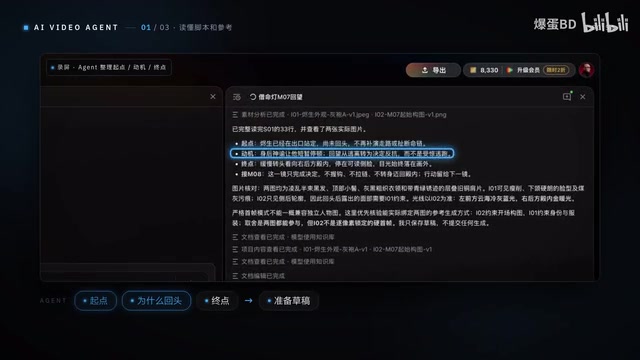
For people who already have materials on hand, the benefit of this limitation is very practical: the missing shot can be filled in first, without rerunning the entire film for a five-second shot. The role of the video agent here is not "generate from scratch" but "reshoot on demand." It needs to understand the boundaries of the shot, know what is context and what is the content to be produced this time, rather than redoing the entire story.
Shot-level conditional generation means the model uses only the boundaries of the current shot as constraints during generation, treating the content of previous and subsequent shots as unmodifiable context. This differs from one-time full-film generation: it breaks long videos into multiple short segments, each generated independently but sharing character and scene states. Technically, the agent needs to maintain cross-shot state memory, recording information such as character positions, clothing, and lighting, and update only the actions within the current shot when generating it. The advantage is that local modifications do not affect the whole, and creators can fill in missing shots on demand without rerendering the entire film for a five-second performance.
Point 3: When revising, you can speak directly to the problems in the frame
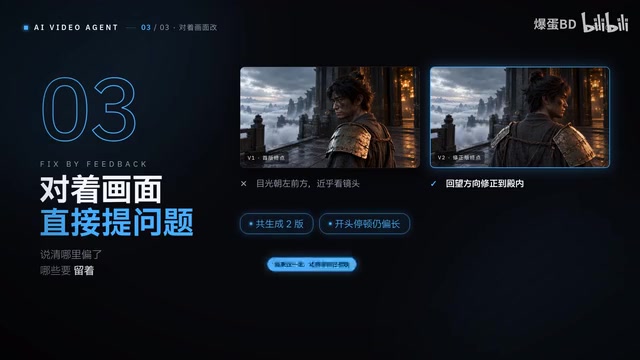
After the first version came out, the handboard, character, and lighting were basically carried over, but the final look was toward the left front, with the gaze almost meeting the camera. What I wanted was a look back from inside the shop, and it didn't work.
So my feedback was very specific: keep the character, camera position, and lighting all unchanged; the nose tip and eyes face the shop on the right; the shoulders turn naturally with the head. The agent takes this feedback to prepare the new version's requirements, then generates these five seconds.
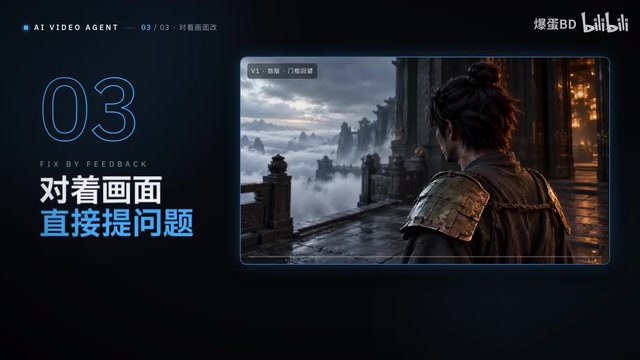
The key is that you only need to clarify what's off and what to keep, and it organizes the feedback into the next version's shot draft. The direction of the look back in the second version was corrected. This interaction method of "speaking to the problems in the frame" is closer to a real director's workflow than repeatedly tweaking prompts—see the problem, point it out, keep what's right, change what's wrong.
Iterative correction based on visual feedback means users directly point out specific problems in the frame in natural language (such as "gaze toward the left front," "nose tip toward the right"), and the agent parses this feedback into executable modification instructions while preserving unmentioned attributes (such as camera position and lighting). This is similar to inpainting and attribute disentanglement in image editing, but places more emphasis on the balance between semantic understanding and local constraints. The system needs to distinguish between "keep" and "correct" instructions and map them to generation parameters or condition vectors, thereby precisely adjusting target attributes in the next version without breaking other aligned settings.
Human acceptance is still required
This time a total of two versions were generated, and the pause at the beginning is still a bit too long. In the end, you still have to accept this part yourself. The video agent can take in materials, limit the scope, and absorb feedback, but it won't make the final judgment for you.
My conclusion is: if you already have a script and character references on hand and are only missing the realization of a certain shot, this video agent is worth using here. The three things it can do—bring existing materials close to production, limit the task to the current shot, and bring specific feedback close to the next round of revision—solve exactly these troubles for creators: no need to repeatedly organize tasks, no need to re-explain settings, and after the output, you know where to continue revising.
The value of AI video tools is not to replace creators in making decisions, but to reduce the loss between "I've thought it through" and "it's been made." This five-second look-back scene shows that this loss can indeed be pushed lower.
One-line Summary
A video agent should be able to read the script and references, limit the current shot, and absorb visual feedback, reducing the loss from settings to final output.
Paragraph Summary
Through the five-second look-back scene of the seventh shot in the 30-second AI comic drama trailer Borrowed Life Lamp, the article summarizes the three core capabilities a good video agent should have: first, using the complete script, character image, and scene starting image together as the production basis, rather than only accepting a single image plus a prompt; second, limiting the generation scope to the currently needed shot, enabling on-demand reshoots without rerunning the entire film; third, supporting specific feedback on problems in the frame (what to keep, what to correct), which the agent organizes into the next version's shot draft. The author also emphasizes that the agent does not replace final judgment, and the generated results still require human acceptance version by version. Its core value lies in reducing information loss from early settings to final output.
Related articles

Fifty Years Studying Power: Robert Caro's Writing and Insights on Power
Robert Caro reflects on 50 years studying power: Lyndon Johnson's persuasion and leverage, Robert Moses's transformation from idealist to ruthless builder, the dilemmas of large-scale construction, and his methods of compressing themes and solitary focus in biography writing.

Can a $20,000 Robot Do Your Chores? The Test Results Are Surprising
A YouTube test video shows how a $20,000 robot responds to commands like washing dishes, turning off lights, taking out trash, and feeding the dog. This article analyzes its real capability boundaries, the state of voice interaction technology, and how far household robots are from mainstream adoption.
The Complete Guide to Running AI Models Locally: Inference Engines and Tool Stack Explained
A systematic breakdown of the complete local LLM tool stack: from PyTorch and GGML compute libraries to llama.cpp, vLLM, SGLang inference engines and Ollama, LM Studio wrapper layers, with benchmark data on performance differences and selection logic.