AI Conquers the International Mathematical Olympiad: Lessons from the Final Problem

AI reasoning models went from near-zero to solving all 6 IMO problems, marking a milestone in machine logical reasoning.
The IMO has long been a benchmark of peak human intellect, but AI's progress there has been breathtaking: from near-total failure before 2024, to solving 4 of 6 problems in 2024, to publicly available reasoning models solving all six in 2025. The final problem was especially extreme — only 6 of 603 world-class competitors scored full marks. Requiring both an optimal tiling construction on a 2025×2025 grid and a rigorous proof of its optimality, this problem's conquest by AI signals real advances in long-chain reasoning and formal argumentation, hinting that more high-level cognitive tasks once considered uniquely human are being redefined.
AI's Leap Forward in Math Competitions
The International Mathematical Olympiad (IMO) has long been regarded as the ultimate test of human intellectual ability, bringing together the sharpest young problem-solvers from around the world. AI's progress in this competition is one of the most striking technological narratives of recent years.
As outlined in a video by 3Blue1Brown (Grant Sanderson), before 2024, AI could barely answer IMO-level questions at all. Then Google DeepMind's model solved 4 out of 6 problems in that year's competition — a landmark breakthrough. The following year, models from multiple organizations could solve every problem except the last one. And this year, publicly available reasoning models, given appropriate prompting, are capable of solving all six problems.
The steepness of this progress curve is remarkable: from "almost entirely wrong" to "almost entirely correct," AI needed only a very short span of time. This reflects not only the leap in large language model reasoning capabilities, but also the maturation of the "reasoning model" approach as a technical paradigm.

Reasoning Models are an important branch in the recent development of large language models. Their defining feature is that before producing a final answer, the model generates an internal "Chain-of-Thought" process — breaking down problems step by step and verifying intermediate results. Compared to traditional models that output answers directly, reasoning models show significant advantages on multi-step mathematical and logical tasks. Notable examples include OpenAI's o1/o3 series and Google DeepMind's Gemini reasoning variants. Training these models typically incorporates reinforcement learning, using "whether the final answer is correct" as a reward signal to encourage the model to independently discover effective reasoning paths, rather than simply mimicking solution steps seen in training data.
The Final Problem That Stumped Everyone
Looking back at the 2025 competition, the last problem stands out as especially fascinating. Among 603 participants — each one of the six best young problem-solvers their country had to offer — only 6 achieved a perfect score on this problem. That ratio alone speaks to its extraordinary difficulty, even for world-class human competitors.

The problem is set on an extremely large square grid. The original statement uses a 2025×2025 grid, though a smaller version is easier to visualize. The rules involve covering the grid with tiles whose edges must align with the grid lines and which cannot overlap. The key constraint is: exactly one unit square in each row must remain uncovered, and exactly one unit square in each column must remain uncovered.
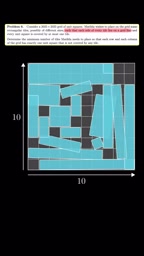
The International Mathematical Olympiad (IMO) is held annually, with each participating country sending up to six competitors, typically high school students. The competition consists of six problems answered over two days — three problems per day — with each problem worth a maximum of 7 points. Problems span algebra, combinatorics, number theory, and geometry, but deliberately exclude university-level topics like calculus, testing instead creative elementary mathematical reasoning. The IMO is widely considered the world's most difficult high school mathematics competition. Score distributions are extremely spread out — typically only a tiny handful of students achieve the maximum total of 42 points, and the final problem (P6) is almost always the lowest-scoring, with only single-digit numbers of competitors earning full marks in any given year.
Why This Problem Is So Hard
The difficulty of this problem doesn't lie in producing a numerical answer. The task is to find the minimum number of tiles needed to satisfy the properties described above — but that's only part of the challenge.
As an IMO problem, the true test is providing a rigorous proof that every other possible tiling arrangement must use more tiles. In other words, you must not only construct the optimal solution, but also mathematically seal off all other possibilities.

This dual requirement — construct a solution and prove its optimality — is precisely what makes combinatorial optimization problems the most skill-differentiating type at the IMO. They don't test fluency with formulas; they test the ability to build a rigorous logical chain from scratch. This also happens to be the area where AI has historically been weakest.
What It Means That AI Can Solve This
AI's ability to tackle problems like this carries significance well beyond "getting a math problem right." The rigorous proofs required by difficult IMO problems are, at their core, verifiable, multi-step logical reasoning. If a model can reliably complete tasks of this kind, it signals real progress in long-chain reasoning, counterexample elimination, and formal argumentation.
It's worth reflecting on this: only 6 of the world's top human competitors achieved a perfect score, yet a publicly available reasoning model can solve the problem with appropriate prompting. This doesn't mean AI has "surpassed" human intelligence — but it does demonstrate the possibility of machines approaching, and in some cases matching, the highest human performance on specific structured reasoning tasks.
For those tracking the boundaries of AI capability, the fact that this "last IMO problem AI couldn't solve" has now been cracked marks a symbolic turning point. It serves as a reminder that high-level cognitive tasks once considered exclusively human territory are being redefined at a pace that continues to surprise.
It's worth noting that there remains a methodological gap between "solving a problem with appropriate prompting" and "reliably solving a problem under competition conditions." In research settings, it's common to allow multiple samples — letting the model attempt the problem independently several times and taking the best result — and to carefully engineer prompts for specific problem types. Human competitors, by contrast, have only one attempt. For this reason, some researchers distinguish between "pass@k" (at least one success in k attempts) and single-attempt pass rates. That said, the overall improvement in AI capability on tasks of this kind is genuine; the debate centers mainly on how to more fairly quantify and compare the gap between human and machine performance.
Conclusion
From solving 4 problems in 2024 to solving all six today, AI's progress at the mathematical olympiad is both a demonstration of technical capability and a public test of what "real reasoning" actually means. The combinatorial challenge that once defeated machines and stumped the vast majority of human competitors also happens to offer, in its solution process, a beautiful journey of intuition and discovery — and that's a dimension well worth savoring as we try to understand what AI's advances truly signify.
Related articles

MCP Protocol in 60 Seconds: A Real Session, Message by Message
Dissecting a real MCP session message by message: how an Agent dynamically discovers tools, forwards call requests, and has an MCP server execute them — all in just 9 JSON messages, with the model and reasoning loop untouched.

n8n 40-Minute Masterclass: Build Your First AI Automation Workflow from Scratch
Distilled from a 40-minute n8n masterclass: the core differences between automation, AI, and AI Agents, a comparison of n8n's four deployment methods, and a complete guide from dashboard to your first workflow.

Why Does a 35GB Quantized Model Blow Up an 80GB GPU? The Truth About KV Cache VRAM
Why does a 35GB 4-bit quantized LLM still blow up an 80GB GPU? This article breaks down the four components of inference VRAM, provides precise KV Cache formulas, compares GQA vs DeepSeek MLA memory, and offers production-grade OOM prevention like FP8 KV Cache.