AI Cracks a 25-Year-Old Math Problem: How Artificial Intelligence Is Transforming Mathematical Research

AI systems solve a 25-year-old math problem, signaling a new era of human-AI collaborative scientific discovery.
AI systems have successfully solved a mathematical problem that remained open for 25 years, combining large language models with symbolic reasoning in hybrid architectures. Breakthroughs like DeepMind's FunSearch and AlphaGeometry demonstrate AI's growing capacity for original mathematical discovery. Formal verification tools like Lean and Coq ensure rigor, while human-AI collaboration compresses research timelines from decades to months, raising profound questions about the nature of mathematical understanding.
A Math Problem Shelved for 25 Years
At the intersection of mathematics and computer science, certain problems have always quietly lingered in the corners — not because they're unsolvable, but because they're so difficult that researchers temporarily chose to take detours around them. A recent development that has attracted widespread attention: an AI system successfully solved a mathematical problem that had remained open for approximately 25 years. This is not merely a victory at the algorithmic level — it marks a fundamental shift in the role artificial intelligence plays in mathematical reasoning and scientific discovery.
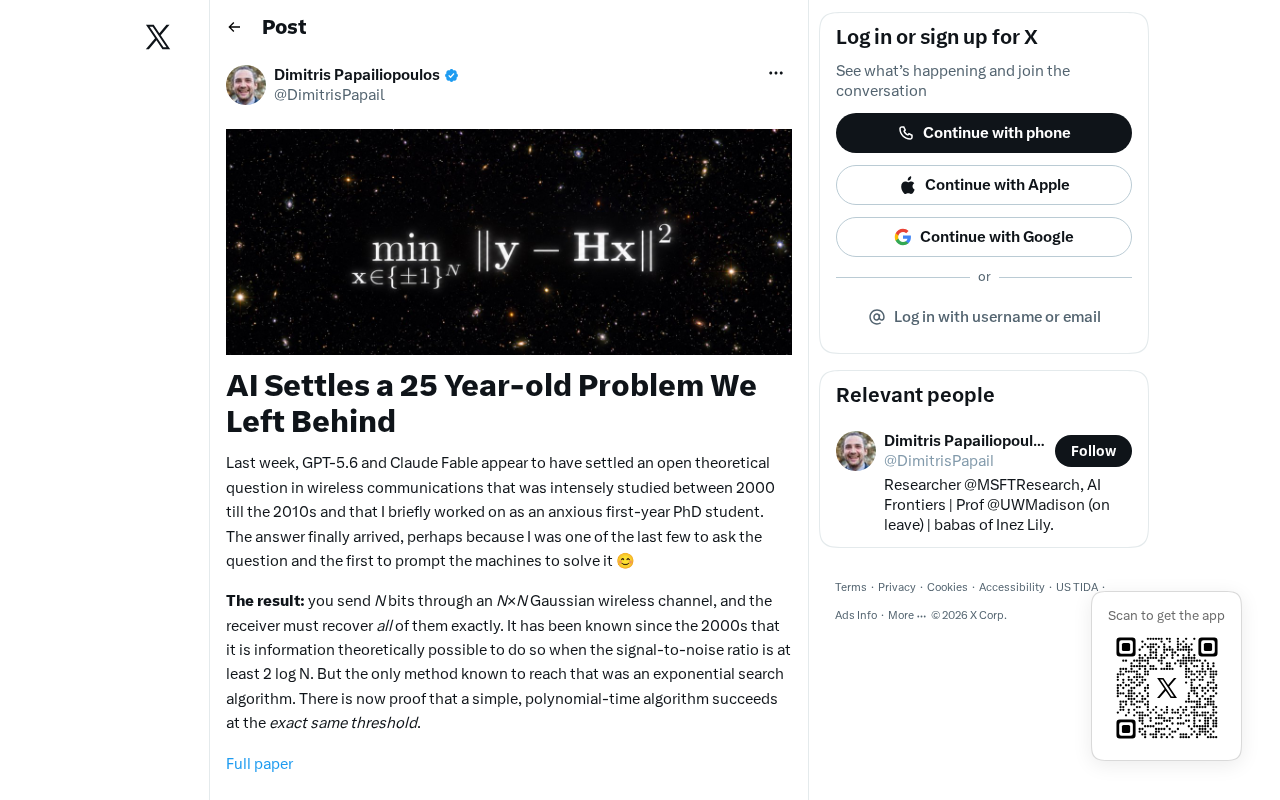
The so-called "25-year problems" typically refer to propositions that were clearly formulated in the late 20th century but couldn't be fully resolved due to limitations in computational tools and theoretical frameworks of the time. In the history of mathematics, problems being shelved for decades is hardly rare — Fermat's Last Theorem took 358 years from its proposal in 1637 to Andrew Wiles's proof in 1995; the Four Color Theorem was proposed in 1852 but wasn't proven until 1976 with the help of computers. In the late 1990s, combinatorics, graph theory, and computational complexity theory produced numerous such problems: their statements were concise and clear, but their solution paths involved astronomical levels of combinatorial explosion, exceeding what computational tools and human intuition could reach at the time. The mathematics community has a habit of "temporarily shelving" such problems, waiting for new methods to emerge. And now, AI has assumed exactly that role of the "new method."
Why This AI Math Breakthrough Deserves Attention
Unlike traditional brute-force computation, modern AI systems — especially those combining large language models with symbolic reasoning in hybrid architectures — can discover patterns and paths in vast search spaces that human researchers struggle to perceive. This hybrid architecture merges the strengths of two traditional AI paradigms: neural networks based on statistical learning excel at pattern recognition and intuitive leaps, while logic-rule-based symbolic systems provide rigorous reasoning guarantees. The large language model generates candidate hypotheses and heuristic exploration directions, while the symbolic reasoning engine verifies the logical validity of each step. The breakthrough of this architecture lies in the fact that neural networks provide heuristic search capabilities similar to human "mathematical intuition," while symbolic systems serve as an incorruptible logical defense line. Together, they complement each other to form problem-solving capabilities that surpass any single method.
Therefore, AI isn't simply "computing faster" — in a certain sense, it's "thinking differently." When a long-dormant problem is picked up again and solved, what it reflects is an iteration in methodology, not merely a stacking of computational power.
AI's New Role in Mathematical Research
Over the past few years, artificial intelligence applications in mathematics have evolved from "assistive tool" to "collaborative partner." In earlier days, machines were primarily used for numerical verification and large-scale enumeration; now, AI has begun participating in formulating conjectures, exploring proof paths, and even constructing complete proofs.
From Verification to Discovery: DeepMind's Continued Breakthroughs
Organizations like DeepMind and OpenAI have been making sustained efforts in AI mathematical research in recent years. The most representative breakthroughs include:
FunSearch is a work published by DeepMind in Nature in late 2023. Its core idea combines large language models with evolutionary algorithms. The system has the LLM generate Python programs (representing mathematical constructions), then an automatic evaluator scores the mathematical objects output by those programs. High-scoring programs are retained and fed back to the LLM as context to generate improved variants. This process simulates the mutation-selection cycle in biological evolution. FunSearch surpassed the best known human constructions on the cap set problem (a classic problem in extremal combinatorics), marking the first time AI made a contribution to an open mathematical research problem that exceeded existing human results.
AlphaGeometry, also developed by DeepMind and published in Nature in early 2024, specifically targets Euclidean geometry proof problems. It employs a neural-symbolic hybrid architecture: a language model trained on synthetic data proposes auxiliary constructions (such as adding auxiliary lines or points), while a symbolic reasoning engine based on algebraic methods (the Deductive Database) performs rigorous logical deduction from known conditions. In tests on historical International Mathematical Olympiad (IMO) geometry problems, AlphaGeometry solved 25 out of 30 problems, approaching gold medalist performance. This work demonstrated that AI can exhibit near-top-human capability in mathematical reasoning that requires creative construction.
These advances repeatedly confirm a trend: AI already possesses the ability to make "original discoveries" in specific domains. The recent solution of the 25-year-old problem is a continuation of this series of advances. The AI system, through deep understanding of existing mathematical knowledge combined with large-scale search and verification mechanisms, ultimately found the key breakthrough that human researchers had long failed to capture.
The Human-AI Collaborative Research Paradigm
It's worth emphasizing that these kinds of achievements are almost never accomplished by AI "alone." A more accurate description is: human researchers define the problem, design the search framework, and verify the correctness of results, while AI efficiently explores the vast space of possibilities. This division of labor in human-AI collaboration dramatically compresses exploration cycles that would otherwise take years or even decades.
The Technical Logic Behind AI Conquering Math Problems
To understand how artificial intelligence tackles these long-unsolved problems, several key technical pillars must be recognized.
Closed-Loop Integration of Search and Generation
Modern AI mathematics systems typically combine "generation" and "evaluation" into a closed loop: the model continuously proposes candidate solutions or constructions, while the evaluator (often a rigorous formal verification tool) judges their correctness and quality. Through thousands of iterations, the system gradually approaches the optimal solution.
The essential difficulty of many mathematical problems lies in their solution spaces exhibiting exponential or higher-order combinatorial explosion. For example, in extremal problems in graph theory, a graph with n vertices has 2^(n(n-1)/2) possible configurations — traditional exhaustive search is completely infeasible, and the paths human intuition can explore are extremely limited. The advantage of AI systems is this: by learning from vast mathematical literature and existing proofs, models acquire heuristic pruning abilities that can concentrate the search in "promising" directions. Meanwhile, such problems typically have clear verification criteria — given a candidate solution, determining whether it satisfies the conditions is often achievable in polynomial time. This asymmetry of "hard to generate, easy to verify" (similar to the characteristics of NP problems) is precisely suited to AI's generation-verification closed-loop architecture.
Formal Verification: Ensuring Mathematical Rigor
The biggest difference between mathematical proof and engineering approximation is "rigor." If AI-generated results cannot be formally verified, they won't be accepted by the mathematics community. Therefore, proof assistants like Lean and Coq play a critical gatekeeping role in this process.
Lean and Coq are two mainstream Interactive Theorem Provers built on Dependent Type Theory. In these systems, mathematical propositions are represented as types, and proofs are terms constructed of that type. The type checker automatically verifies whether each step of reasoning is valid, thereby providing machine-checkable mathematical rigor. Lean was developed by Microsoft Research, and its mathematics library Mathlib has formalized over 100,000 mathematical theorems; Coq originated at France's INRIA research institute and was used to verify the computer proof of the Four Color Theorem.
In recent years, the integration of these tools with AI has become increasingly tight — AI is responsible for "guessing" proof strategies, while proof assistants are responsible for "judging" their correctness, forming a trustworthy automated mathematical research pipeline. They ensure that every step of AI's reasoning withstands logical scrutiny, giving the statement "AI solves mathematical problems" genuine academic weight.
The Significance and Controversy of AI Scientific Discovery
An Accelerator for Scientific Discovery
If AI can systematically solve problems that humans have "temporarily abandoned," the significance will extend far beyond any single problem. It means that a vast repository of dormant scientific problems could be reactivated. Conjectures, constructions, and optimization problems shelved due to lack of suitable tools all have the potential to see daylight again with the help of artificial intelligence.
The Philosophical Question of "Understanding"
However, these achievements also spark ongoing discussion: when AI produces a correct proof that humans find difficult to intuitively understand, are we truly "solving" the problem, or merely "passing" it?
Mathematician Paul Erdős once said that God has a book ("The Book") containing the most elegant proof of every theorem. The mathematics community has always valued the "beauty" of proofs — conciseness, unexpected connections, and deep structural insights are considered the core values of mathematical discovery. The 1976 computer proof of the Four Color Theorem first sparked this controversy: does a proof requiring the checking of hundreds of cases truly advance human understanding of the nature of graph coloring? Today, AI proofs push this discussion to new heights.
Supporters argue that a correct proof is knowledge in itself, and that AI may reveal mathematical structures humans never noticed; opponents worry that if mathematics devolves into "black-box verification," the discipline will lose its core significance as a human intellectual activity. The essence of this debate is: is mathematics a science about truth, or a humanity about understanding? Whether a complex proof found through machine search can deliver knowledge value equal to an elegant human proof remains a focal point of academic debate.
Conclusion: A Signal That AI Is Moving Toward the Scientific Frontier
Regardless of one's position, AI cracking a 25-year-old math problem is a clear signal: artificial intelligence is moving from consumer-level applications toward the serious scientific frontier. It is no longer merely a tool for chatting, writing code, or generating images — it is gradually becoming a genuine partner in expanding the boundaries of human knowledge.
For researchers, this represents both opportunity and challenge — the opportunity lies in an unprecedented improvement in exploration efficiency, while the challenge lies in how to redefine the boundaries between "discovery" and "understanding." It's foreseeable that an increasing number of mathematical problems "left in the past" will be picked up again and ultimately solved with AI's assistance.
(Note: This article is written based on discussion threads on Hacker News. For specific technical details, please refer to the official papers from the relevant institutions.)
Related articles

Will Outdated LLMs Become Nostalgia Symbols? The Cultural Value and Era Memory of AI Technology
Will ChatGPT and GPT-4 from 2023 become nostalgia symbols like retro game consoles? Exploring old LLMs' historical value, emotional significance, and how open-source models preserve AI history.

GPL vs MIT License: The Copyleft Philosophy Debate in the Open Source Community
An in-depth analysis of the core divide between GPL and MIT/BSD permissive licenses, exploring the pros and cons of Copyleft's viral clauses, the Rust rewrite movement's impact on license ecosystems, and how developers can choose the right open source license.

Seed7 Language Memory Safety Mechanisms: A Unique Path Through Value Semantics and Deterministic Reclamation
Deep dive into Seed7's memory safety mechanisms including bounds checking, value semantics, null pointer elimination, and deterministic reclamation, compared with Rust's ownership model.