Will Outdated LLMs Become Nostalgia Symbols? The Cultural Value and Era Memory of AI Technology

Exploring whether outdated LLMs from 2023 will become nostalgic cultural artifacts as AI rapidly evolves.
As AI models iterate at unprecedented speed, a viral tweet asks whether 2023-era LLMs like GPT-3.5 and GPT-4 will become nostalgia objects for future generations. This article explores technostalgia, the unique historical and emotional value of early AI models, the preservation challenges of closed-source vs. open-source systems, and why we may be living through a moment that future generations will look back on with fascination.
A Tweet That Sparked Reflection
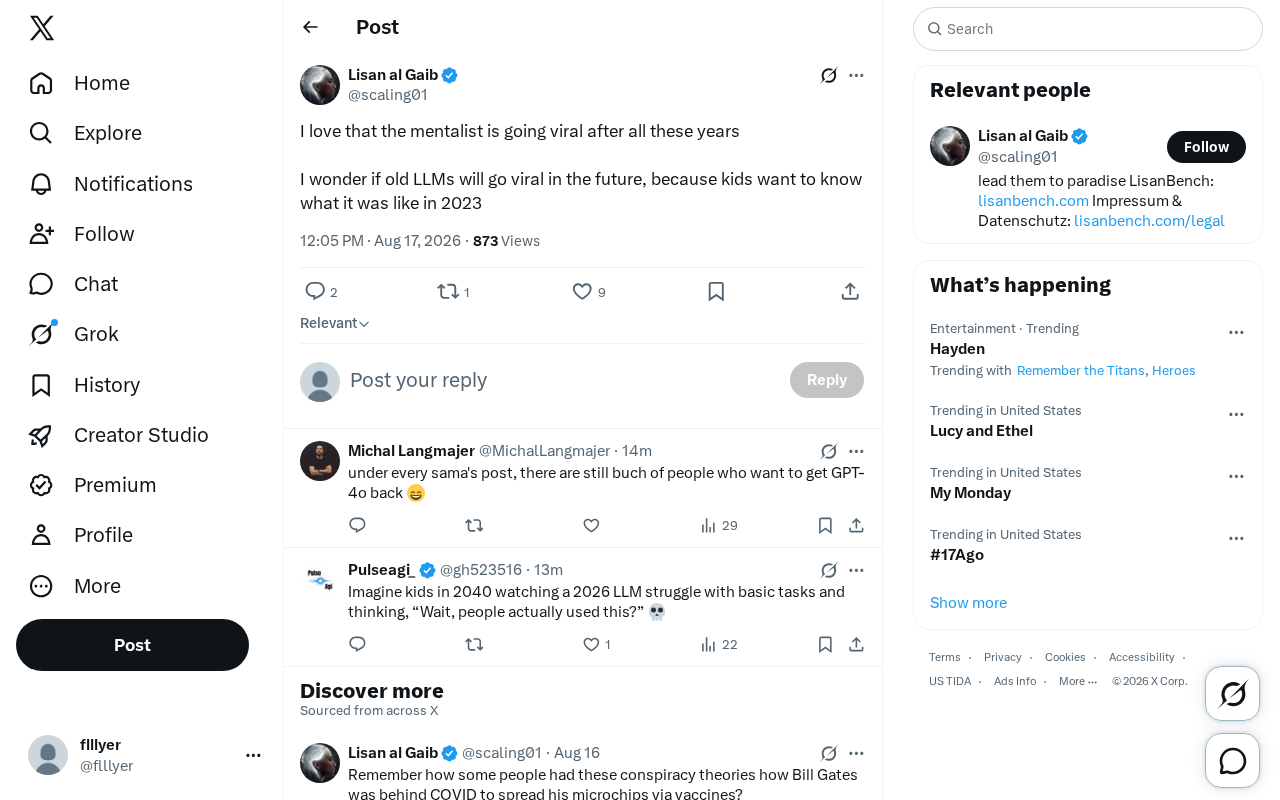
Recently, a tweet from Twitter resonated deeply within the AI community. The poster, musing about how the classic TV series The Mentalist had regained popularity years after its original run, posed an imaginative question:
"I'm curious — will old large language models (LLMs) go viral like this in the future? Because kids will want to know what AI was actually like in 2023."
This seemingly casual tweet actually touches on a thought-provoking topic: Can technology products, like TV shows and pop culture, become nostalgic symbols for a generation as time passes? In an era where AI technology evolves at breakneck speed, we may be witnessing the early stages of technology becoming "cultural artifacts."
Why Old Technology Becomes an Object of Nostalgia
Nostalgia Is Fundamentally About Era Memory
Human nostalgia for old things rarely stems from their technical superiority — it's because they carry the collective memory of a specific era. Retro gaming consoles, early Nokia phones, the "beep-boop" of dial-up internet — these technological products, once obsolete, are imbued with emotional value precisely because of their distinctive time-period imprint. Technostalgia, as a well-researched cultural phenomenon, has played out repeatedly throughout history: the Famicom/NES, released in 1983, completed the full cycle from mainstream to obsolete to retro cultural icon — Nintendo's 2016 release of the NES Classic Edition mini console is a textbook product of this cycle. The vinyl record revival in the streaming era and the return of film cameras in the digital age follow the same pattern. Scholar Svetlana Boym distinguished between "restorative nostalgia" (attempting to rebuild the past) and "reflective nostalgia" (contemplation of the passage of time) — future nostalgia for old AI models will likely embody both forms.
2023 was the inaugural year of the generative AI wave sparked by ChatGPT. On November 30, 2022, OpenAI released ChatGPT, a conversational AI product based on the GPT-3.5 architecture that surpassed 100 million users within just two months, setting a historic record for consumer application growth. GPT-3.5 employed RLHF (Reinforcement Learning from Human Feedback) technology, enabling the model to better follow human instructions and generate responses aligned with expectations. GPT-4, released in March 2023, further introduced multimodal capabilities — understanding image inputs and achieving top-10% human performance on various professional exams. The sudden emergence of GPT-3.5 and GPT-4 gave the general public their first visceral experience of conversational AI's power. The LLMs of that year, while perhaps seeming "clumsy" by today's standards, represent the historic moment when humanity first had large-scale intimate contact with general artificial intelligence.
Accelerating Iteration Makes "Old" Arrive Faster
Unlike traditional technology, the pace of iteration in the AI field is astonishing. From GPT-3 to GPT-4, to various multimodal and reasoning models, model capabilities have been completely transformed in just two or three years. This ultra-fast iteration rhythm means the time required for a model to "become old" has been dramatically compressed — today's cutting-edge model may be relegated to "last generation" by next year.
For this reason, the "nostalgia cycle" of AI technology may be far shorter than that of traditional technology. Perhaps we won't even need to wait for children to grow up before the LLMs of 2023 take on a strong "retro" character.
What Unique Value Do Old LLMs Possess
Living Fossils of Technological Evolution
For future researchers, developers, and AI enthusiasts, early large language models hold unique historical value. By comparing GPT-3.5's performance with subsequent models, one can intuitively understand how AI capabilities advanced step by step:
-
The frequent "hallucination" problem in early models: "Hallucination" in large language models refers to the model generating content that appears fluent and reasonable but contradicts facts. The fundamental cause lies in LLMs' working principle of probability-based next-token prediction — the model is essentially sampling from statistical distributions rather than retrieving facts from a reliable knowledge base. Early models like GPT-3.5 had quite high hallucination rates, especially in scenarios involving specific numbers, dates, and interpersonal relationships that require precise facts. Subsequent models have gradually mitigated this problem through Retrieval-Augmented Generation (RAG), larger-scale training data, more refined alignment training, and chain-of-thought reasoning, though it remains unsolved to this day.
-
Conversation fragmentation from limited context windows: The context window refers to the maximum text length a large language model can process in a single interaction, measured in tokens. GPT-3.5 initially supported only 4,096 tokens (approximately 3,000 English words), meaning longer conversation histories would be truncated, causing the model to "forget" earlier content. By 2024, mainstream models had expanded context windows to 128K or even 200K tokens, with models like Claude supporting million-level tokens. This progress relies on positional encoding improvements (such as RoPE — Rotary Position Embedding), sparse attention mechanisms, and more efficient KV cache management — all fundamental architectural innovations.
-
Relatively rigid response styles and logical chains
These are all vivid testimonies to technological evolution. Just as people today run decades-old games or retro computers to experience history, people in the future will very likely deploy open-source models from 2023 specifically to experience how AI "thought" in "that era." Early open-source models like LLaMA and Falcon have particular advantages here, as their weights are permanently preserved and can be reproduced at any time.
LLaMA (Large Language Model Meta AI) is an open-source large language model series released by Meta in February 2023, with multiple versions ranging from 7B to 65B parameters providing the open-source community with powerful foundation models. Falcon was developed by the Technology Innovation Institute (TII) in the UAE, known for high-quality training data and open licensing. The open-source nature of these models means anyone can download their weight files (typically parameter matrices of tens of gigabytes), run inference on local hardware, or even perform fine-tuning. The open-source model ecosystem has also spawned model hosting platforms like Hugging Face, forming a model-sharing infrastructure analogous to GitHub for code — this holds irreplaceable value for the historical preservation of AI technology.
Emotional and Cultural Significance
For those who lived through the AI explosion of 2022–2023, the experience of that first conversation with ChatGPT carries strong emotional resonance:
- The amazement when first asking AI to write poetry
- The excitement when first having it solve difficult problems
- The amused exasperation when first encountering its confident nonsense
These moments constitute unique era memories. When this generation becomes parents and tells their children about "the AI of our day," those old models naturally become cultural bridges connecting past and present.
Deeper Logic of AI Development Through the Lens of Nostalgia
The Preservation Problem of Large Language Models
This tweet actually raises a serious industry issue: How should we preserve key milestones in AI development history?
Closed-source models (like the GPT series), once taken offline by service providers, become permanently inaccessible to ordinary users. This means many important "AI artifacts" may disappear forever. The business model of proprietary models dictates the temporary nature of their services — companies like OpenAI regularly retire old API versions. For example, GPT-3's original davinci model was discontinued in 2024, and users can no longer call these historically significant early models. This situation is analogous to the "digital forgetting" phenomenon of early internet websites disappearing — an estimated 38% of web pages on the internet are no longer accessible.
By contrast, open-source models, with their publicly available weights and freely deployable nature, inherently possess the potential for long-term preservation. Once published, open-source model weight files can be infinitely copied and archived, much like open-source code. Institutions like the Internet Archive have begun paying attention to AI model preservation, but the industry has yet to develop systematic preservation mechanisms.
This also reinforces from another angle the importance of the open-source ecosystem for preserving technology history. Perhaps in the future, dedicated "AI Model Museums" will emerge, collecting and running classic models from various historical periods for future generations to experience and study.
A Reminder to Cherish Present-Day Technology Experiences
From a broader perspective, this imagination of "future nostalgia" also reminds us: We are living through an extraordinarily special moment in technology history. The AI conversations, code generation, and image creation we take for granted today were science fiction just a few years ago; in the future, they may be viewed as precious imprints of AI's dawn.
Conclusion
The renewed popularity of The Mentalist is fundamentally a cultural cycle. Whether AI technology will undergo a similar "nostalgia cycle" — the answer is very likely yes — only the rhythm will be faster and the form more unique.
The LLMs of 2023 represent the starting point of general artificial intelligence reaching the masses. No matter how far AI evolves in the future, the era when humanity first broadly conversed with "thinking machines" deserves to be remembered. Perhaps in the not-too-distant future, running a 2023-era model will become a retro indulgence for tech enthusiasts, much like those who insist on playing NES games today.
This is not merely a romantic imagining — it's a profound reminder about technology preservation, the value of open source, and the memory of an era.
Related articles

WorkBuddy Full Tutorial: Build an AI Office Automation Agent from Scratch
A complete WorkBuddy tutorial: installation, three working modes, multimodal picture book video practice, expert team agent building, and workflow configuration for low-cost AI office automation.

WorkBuddy Agent Complete Guide: From Beginner to Automation in 7 Days
Based on Bilibili's 256-episode WorkBuddy masterclass, this systematically breaks down Tencent's AI office workbench core capabilities: Agent principles, Skill encapsulation, cross-platform connectors, scheduled automation, knowledge bases, and zero-code development, with learning path recommendations.

8 AI Accounts, 7 Failed: An Honest Review of Using AI to Get Work Done
Only 1 of 8 AI-run Bilibili accounts succeeded. We break down the real difference between "performing AI" and "using AI to get work done."