AI Cracks Turing's Unfinished Problem: The Cryptography Breakthrough of Astra and Opus

Astra and Opus reportedly cracked historical ciphers Turing couldn't, marking a new era in AI capability evaluation.
The article examines a report that frontier AI models Astra and Opus have made progress on historical cipher texts that Alan Turing never fully cracked at Bletchley Park. The author frames this as "Turing's other test" — distinct from the classic Turing Test — since codebreaking demands genuine mathematical reasoning and yields objectively verifiable results. The piece argues this is significant both as a historical closure linking Turing's era to modern AI, and as evidence of a broader paradigm shift in AI evaluation: from the subjective "does it seem human?" to the objective "can it solve hard problems?" The author also urges caution, noting the original report lacks key technical details and independent verification.
Frontier Models Take On Turing's Wartime Legacy
More than eighty years ago, Alan Turing led a team at Bletchley Park to break Nazi Germany's Enigma cipher, a contribution that played a decisive role in the Allied victory in World War II. Now, that history has a fascinating new chapter: according to this report, frontier AI models such as Astra and Opus are completing the cryptographic work that Turing was never fully able to finish.
If the "Turing Test" measures whether a machine can pass itself off as human in conversation, this challenge points to another of Turing's great endeavors — codebreaking. The report calls it "Turing's other test," suggesting this is not about imitating human language, but about whether machines can continue — or even surpass — the work of the founding father of computer science in the domain of pure logical and computational reasoning.
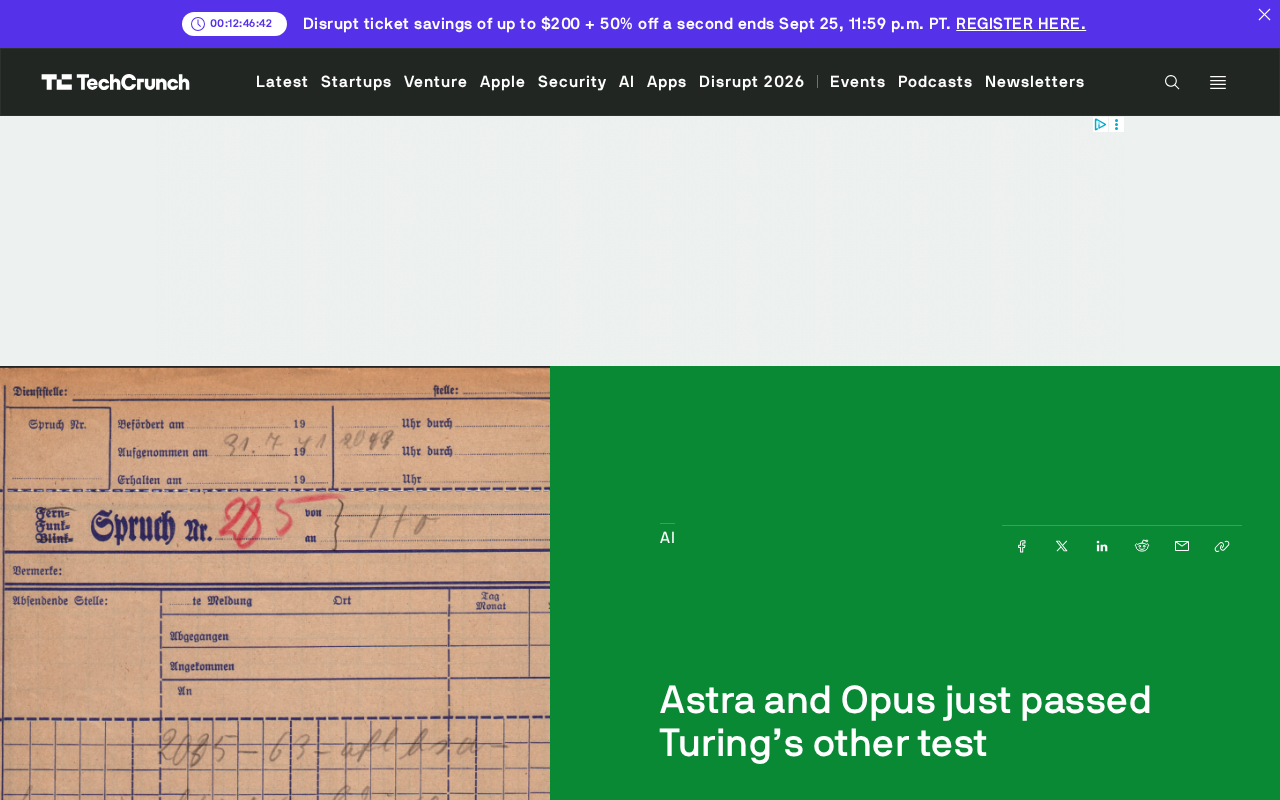
Enigma was an electro-mechanical rotor cipher machine used by Nazi Germany during World War II. Its core mechanism used a combination of multiple rotatable letter rotors, a plugboard, and a reflector to substitute plaintext letters one by one into ciphertext. Because the rotors advanced one position with each letter encrypted, the substitution rule changed with every keystroke, yielding a theoretical key space on the order of 10²³ — virtually impossible to crack by hand. Turing's key contribution at Bletchley Park was improving the Polish cryptanalysts' "Bombe" machine, designing an electro-mechanical computing device that could exploit known plaintext fragments ("cribs") to rapidly eliminate vast numbers of invalid keys, compressing decryption time into a practical range. However, some more advanced German cipher systems — such as the Lorenz cipher (nicknamed "Tunny") — as well as certain texts sealed away after the war, were never fully broken at the time. It is precisely these historically unresolved cipher texts that form the target of the current AI challenge.
From Conversational Imitation to Hard-Core Reasoning
It is worth reflecting deeply on the essential difference between these two kinds of "tests." The traditional Turing Test focuses on the surface appearance of intelligence — can a machine convince a person it is human? Codebreaking, by contrast, demands genuine mathematical reasoning, pattern recognition, and brute-force search optimization, with no room for bluffing. Success or failure is measured against a clear, objective standard.
This explains why results of this kind are so compelling. Contemporary large language models are frequently criticized as "stochastic parrots" — skilled at generating plausible-sounding text, yet lacking true logical reasoning. But if Astra and Opus have made genuine progress on cryptographic challenges, it would suggest these models' reasoning capabilities have crossed from mere linguistic imitation into a domain requiring rigorous chains of logic.
The "Stochastic Parrot" critique originates from a 2021 paper by Emily Bender and colleagues, On the Dangers of Stochastic Parrots. Its central argument is that large language models are fundamentally stitching together fragments of training data in a statistical sense, without any genuine understanding of the semantic meaning behind linguistic symbols — let alone abstract reasoning. This critique has sparked ongoing debate in the research community. Supporters argue that models' performance on mathematical reasoning, code generation, and logic puzzles remains heavily dependent on similar patterns seen in training data, and that accuracy drops sharply when problem wording is slightly altered. Critics point to models' progress on olympiad-level mathematics and protein structure prediction as evidence that this goes beyond mere pattern reproduction. The particular value of codebreaking tasks lies in this: the "correct answer" is extremely unlikely to appear in training data, so if a model successfully decrypts a cipher, it provides more compelling evidence for the position that models possess some form of symbolic reasoning.
Dual Significance: Historical and Technical
The symbolic weight of this development cannot be overlooked. Turing is the shared founding figure of both modern computing and artificial intelligence theory — he defined the boundaries of computability and proposed the standard for judging machine intelligence. Having modern AI — the spiritual heir to the test that bears his name — complete the cryptographic work he was unable to finish due to the technological limitations of his era creates a kind of historical closure in the story of computing.
From a technical standpoint, decrypting historical cipher texts is an excellent benchmark for evaluating AI reasoning. These tasks typically have clear, correct answers, vast search spaces, and verifiable intermediate steps — well suited to assessing whether a model possesses genuine problem-solving ability rather than simply matching patterns from training data.
A Note of Caution
It must be acknowledged that, based solely on the materials currently available, we cannot confirm the specific details of these results: Which cipher texts did Astra and Opus actually decrypt? What methods were used? Have the results been independently verified? These critical questions are not fully addressed in the original report.
For any claim that AI has achieved a major scientific breakthrough, appropriate skepticism is warranted both in academia and in industry. Codebreaking results require rigorous reproducibility verification, especially when they concern longstanding historical challenges. In the absence of further technical details, this news is better treated as a noteworthy signpost than as a settled milestone.
Implications for AI Capability Evaluation
Regardless of the specific outcomes, this episode reflects a shift in the paradigm for evaluating AI capabilities. The field is gradually moving from the subjective question of "does it seem human?" toward the objective question of "can it solve hard problems?" Tasks with clear verification standards — codebreaking, mathematical proof, code optimization — are becoming the new yardsticks for measuring the true capabilities of frontier models.
From the Turing Test to "Turing's other test," this shift may itself be more valuable than any single decryption result. It reminds us that the best way to judge machine intelligence may not be to see whether it can fool us, but whether it can genuinely solve problems we ourselves cannot.
A new wave of benchmarks centered on "hard verification" is emerging in the AI evaluation field, designed to address the shortcomings of traditional language benchmarks (such as MMLU and HellaSwag) in assessing reasoning ability. Notable examples include: FrontierMath (unpublished competition problems designed by professional mathematicians), SWE-bench (real-world software engineering bug fixes), and ARC-AGI (requiring induction of abstract rules from very few examples). What these benchmarks share is that answers can be definitively verified by programs or experts, problems are unlikely to appear in public training data, and solving them requires multi-step reasoning rather than single-step retrieval. Historical codebreaking aligns closely with this trend — it has an inherently objective verification standard, and the original ciphertext itself serves as a kind of "data contamination shield," since the correct plaintext simply did not exist on the internet before decryption. This makes it a uniquely valuable scenario for evaluating the true boundaries of AI reasoning.
Related articles

Understanding DeepSeek in 3 Minutes: The Rise from a Quant Hedge Fund to an Open-Source AI Leader
DeepSeek's history in 3 minutes: from High-Flyer Quant's compute build-up to V2's MLA inference cost cuts, V3's $5.576M training bill, R1's open-source global shock, and V4 with a $7B Series A.

Local Creative Writing Model Showdown: Fine-tuned Qwen3.8 27B Wins, DeepSeek v4.1 Underwhelms
Bilibili creator tests seven local creative writing models: Hemingway and HumanLike Chat based on Qwen3.8 27B perform best, DeepSeek v4.1 is plain, Dongfang Shuo ranks last with confused characters. Includes three test prompts, scores, and usage advice.

Liang Wenfeng's Three Big Bets: Why Did DeepSeek Open-Source Its 82% Gross Margin?
Why did DeepSeek open-source DeepInfer, its 82% gross margin inference framework, and then launch a hundred-billion funding round? An analysis of Liang Wenfeng's three big bets and the open-source strategy.