AI Crawler Block Rates Double: The Marketing Blind Spot Behind 13.47% Rejected Requests

Cloudflare Q3 AI crawler rejection hits 13.47%, doubling YoY, as publishers treat crawlers differently by purpose.
Cloudflare Radar data shows 13.47% of AI crawler requests were rejected in Q3 2025, more than double last year's 5.98%. Including 404s and rate limits, over 21.5% end in client errors. Site owners are differentiating: GPTBot has a reject-to-allow ratio of 1.60 for training, while OAI-SearchBot sits at 0.91. Crawl-to-referral ratios explain why — Anthropic crawls 988 pages per visitor, Perplexity 1,083, OpenAI 309, versus Google's 4.9. The article advises checking CDN/WAF settings and logs, rewriting robots.txt per user agent, and demanding crawler access logs from AI visibility vendors.
Title
AI Crawler Block Rates Double: The Marketing Blind Spot Behind 13.47% Rejected Requests
Meta Description
Cloudflare network Q3 data shows AI crawler request rejection rates climbing from 5.98% to 13.47%, with training and search crawlers treated differently. This article breaks down the marketing implications behind the data and offers actionable robots.txt and CDN configuration recommendations.
Article Content
The rate at which websites on the Cloudflare network reject AI crawlers is climbing rapidly. According to TechnologyChecker.io's analysis of Cloudflare Radar data, the proportion of rejected AI bot requests reached 13.47% in Q3, compared to just 5.98% a year earlier. That number has more than doubled — and it deserves serious attention from every brand currently investing in AI visibility optimization.
What the Q3 Data Reveals
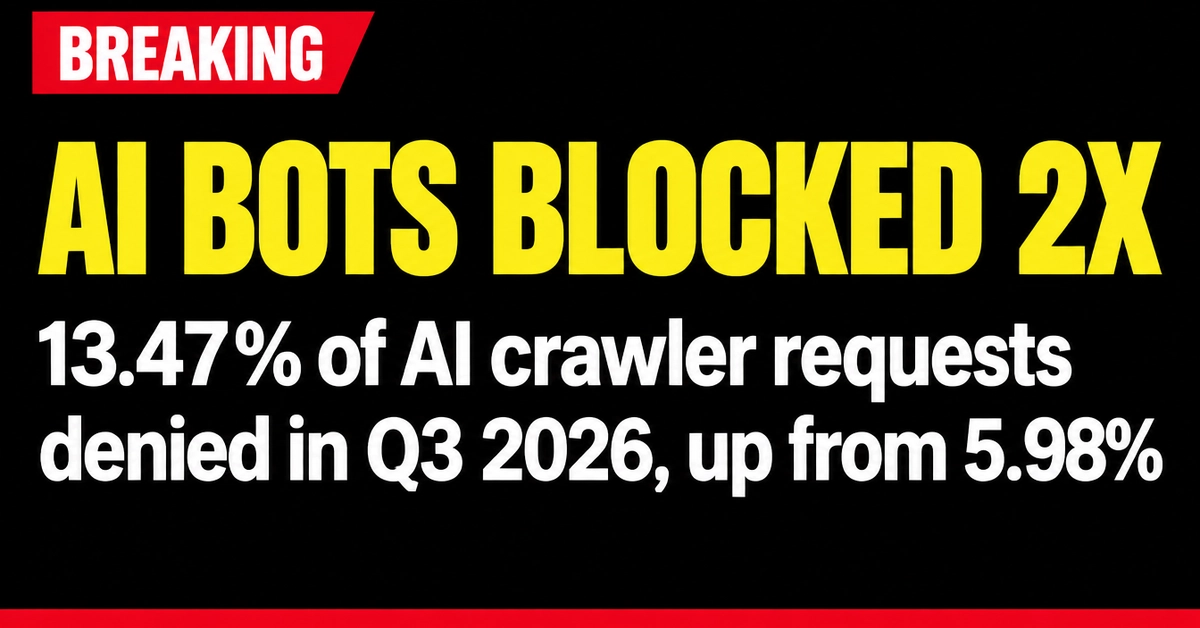
The core metric is the 403 Forbidden rate. In Q3 2025, 5.98% of AI crawler requests were turned away; by Q3 2026, that figure rose to 13.47%, and the September-only data (provisional) reached 14.25%. Add in 404 responses (5.86%) and rate-limit responses (2.22%), and at least 21.5% of AI bot requests now end in a client error.
The report also parsed 4,242 robots.txt files from a September 28 snapshot, tallying how often each bot was blocked versus allowed. GPTBot, which collects training data, was rejected 1.60 times for every time it was allowed. OAI-SearchBot, which crawls pages to answer queries in ChatGPT search, had a ratio of just 0.91. Site owners are becoming selective — saying no to training, yes to bots that drive traffic.
Search and user-triggered crawling activity is also surging, rising from 6.51% in Q2 2026 to 11.92% in Q3. A year ago, that figure was only 3.14%.
Referral traffic data explains where this sentiment comes from. According to the report, Anthropic's crawler needs to crawl 988 pages to refer a single visitor, OpenAI needs 309, and Perplexity needs 1,083. Google's ratio is 4.9. Content publishers have done the math.
The Difference Between 403 Forbidden, 404, and Rate Limiting (429)
These three responses mean entirely different things in crawler governance. 403 Forbidden means the server identified the requester and actively rejected it — usually the result of an explicit block by a WAF, CDN bot protection, or server rules. This is the most deliberate blocking signal. 404 Not Found means the target resource doesn't exist, which could mean the page was deleted, the URL structure changed, or the site is returning a response disguised as "not found" for specific user-agents to deter crawlers. 429 Too Many Requests is rate limiting, meaning the server hasn't permanently rejected the bot — it just considers the request frequency too high, usually paired with a Retry-After header asking for a retry later. So when the article adds up 403, 404, and 429 to arrive at "21.5% of requests ending in client errors," that's a strict reading: only 403 is an explicit policy rejection, while 404 and 429 are partly technical, recoverable failures. Understanding this distinction helps you determine whether AI crawler access failures on your site are a policy choice or a configuration accident.
What robots.txt and Parsed Samples Mean
robots.txt is a plain-text protocol file placed at the site's root directory, using directives like User-agent, Allow, and Disallow to tell crawlers which paths they may or may not crawl. It relies on crawlers voluntarily complying and has no enforcement power of its own, so in practice it often coexists with — or even contradicts — firewall-level blocking. When the article mentions parsing 4,242 robots.txt files from a September 28 snapshot, it means bulk-fetching these files from sites on the Cloudflare network and tallying the rules one by one to derive "how often each bot is blocked versus allowed." A GPTBot reject/allow ratio of 1.60 means that at the rule level, the number of sites explicitly banning it is about 1.6 times the number explicitly allowing it. Note that this kind of statistic only reflects declarations in robots.txt — it can't capture requests silently blocked at the WAF or CDN layer without a robots.txt declaration, so the actual rejection rate may be underestimated.
What This Means for Marketers and Business Owners
Many companies bought "AI visibility" audit services this year, rewriting page content for ChatGPT and Perplexity, yet never checked whether those engines could actually reach their websites.
A robots.txt file may welcome AI search crawlers, but firewalls, CDN rules, or bot protection settings could be quietly turning them away. Cloudflare's own bot protection features can do exactly that by default.
So the first thing is boring but critical: pull your server or CDN logs and look for access records from OAI-SearchBot, ChatGPT-User, PerplexityBot, Claude-SearchBot, and Googlebot. If they're getting 403 responses, no amount of content optimization will get you cited.
The second thing is a policy decision. Blocking training crawlers while allowing search and user agents has become the mainstream pattern, and it's a reasonable default for most service businesses. Your content won't be included in model training sets, yet it remains eligible to appear in the answers that bring in buyers.
These kinds of underlying plumbing issues often get overlooked when marketing and IT operate in separate silos.
The Conflict Between Cloudflare Bot Fight Mode and AI Crawler Identification
Cloudflare's Bot Fight Mode is a one-click bot protection feature available even on the free plan. It uses browser fingerprints, behavioral signals, and machine learning models to determine whether a visitor is human, a benign bot, or a malicious bot, then issues JavaScript challenges or outright blocks suspicious actors. The problem is that many AI scraping agents don't execute JavaScript, don't carry browser fingerprints, and look highly similar to automated attack tools in behavioral models — so they may be blocked by default, returning 403 or being challenged indefinitely. This is a separate mechanism from robots.txt: robots.txt is a "gentlemen's agreement," while Bot Fight Mode is technical enforcement. A common mistake companies make is updating robots.txt to allow OAI-SearchBot but forgetting that the WAF layer is still blocking it. When troubleshooting, check the user-agent field in Security Events logs at the same time to confirm the target crawler's actual response code — don't judge accessibility based solely on robots.txt declarations.
What to Watch and Do Next
There are three things you can do this week.
First, check your CDN or WAF bot settings. On Cloudflare, review Bot Fight Mode and any "Block AI" toggles, then confirm search crawlers are getting 200 responses.
Second, rewrite robots.txt with separate rules for each user agent. If you don't want to be used for training, disallow GPTBot, ClaudeBot, and CCBot. At the same time, explicitly allow OAI-SearchBot, ChatGPT-User, PerplexityBot, and Claude-SearchBot.
Third, before an AI visibility vendor shows you citation scores, ask them to show you crawler access logs first.
Then watch two numbers. The first is whether the Q4 rejection rate continues climbing past 14%. The second is the crawl-to-referral traffic ratio for OpenAI and Anthropic. If these engines start sending real traffic back, expect publishers to reopen their doors; if not, that 13.47% figure will keep rising before 2027.
One-line Summary
AI crawler rejection rates on the Cloudflare network hit 13.47% in Q3, doubling year-over-year, as publishers treat crawlers differently by purpose.
Paragraph Summary
Cloudflare Radar data shows 13.47% of AI crawler requests were rejected in Q3 2025, more than double last year's 5.98%. Counting 404s and rate limits, over 21.5% of requests end in client errors. Site owners are adopting differentiated strategies: GPTBot, used for training data, has a reject-to-allow ratio of 1.60, while OAI-SearchBot, which serves search answers, sits at just 0.91 — reflecting the mainstream "block training, allow search" pattern. Crawl-to-referral ratios further explain the sentiment — Anthropic crawls 988 pages per referred visitor, Perplexity 1,083, OpenAI 309, versus Google's 4.9. The article recommends businesses first check CDN/WAF bot settings and server logs to confirm AI search crawlers get 200 responses, then rewrite robots.txt by user agent, and demand crawler access logs from AI visibility vendors.
Related articles

Workbuddy for Absolute Beginners: How a Desktop AI Agent Fits Into Real Workflows
A beginner's guide to the Workbuddy desktop AI agent: installation, claiming credits, file management, and building automated workflows—compared with CodeX for fit and cost, helping professionals shift from AI question-askers to AI managers.

OpenAI's New Agent Stack: Computer Use, Decisions API, and Ultra-Fast Workflows
OpenAI Dev Day unveiled a new agent stack: Computer Use outperforms humans, Decisions API delivers ultra-low-latency classification via Luna, Agents API opens the same Computer Use capabilities, and GPT-6.1 Sol costs only one-seventh of Astra. Core updates, benchmark data, and developer insights.

Liang Wenfeng Open-Sources DeepInfo Inference Framework, Takes On U.S. Ban
DeepSeek open-sources its DeepInfo inference framework after its models, featuring GPU/CPU cross-pipelining, small-model prediction with large-model verification, and full Huawei Ascend and NVIDIA chip support—facing the U.S. federal ban head-on. This article analyzes its significance for AI deployment and open-source strategy.