AI Crypto Trading Bot Development Guide: Features, Process, and Cost

A systematic overview of AI crypto trading bot feature modules, development process, cost ranges, and risk boundaries.
This article provides businesses and developers with a complete picture of AI crypto trading bots, from concept to deployment. It defines the difference between AI and rule-based bots, covers adoption motivations, seven core feature modules, a seven-step development process, and reference costs of $50,000-$150,000 over three to six months. It emphasizes that no AI model can guarantee profits and that backtesting cannot definitively predict future performance.
AI Crypto Trading Bot Development Guide: Features, Process, and Cost
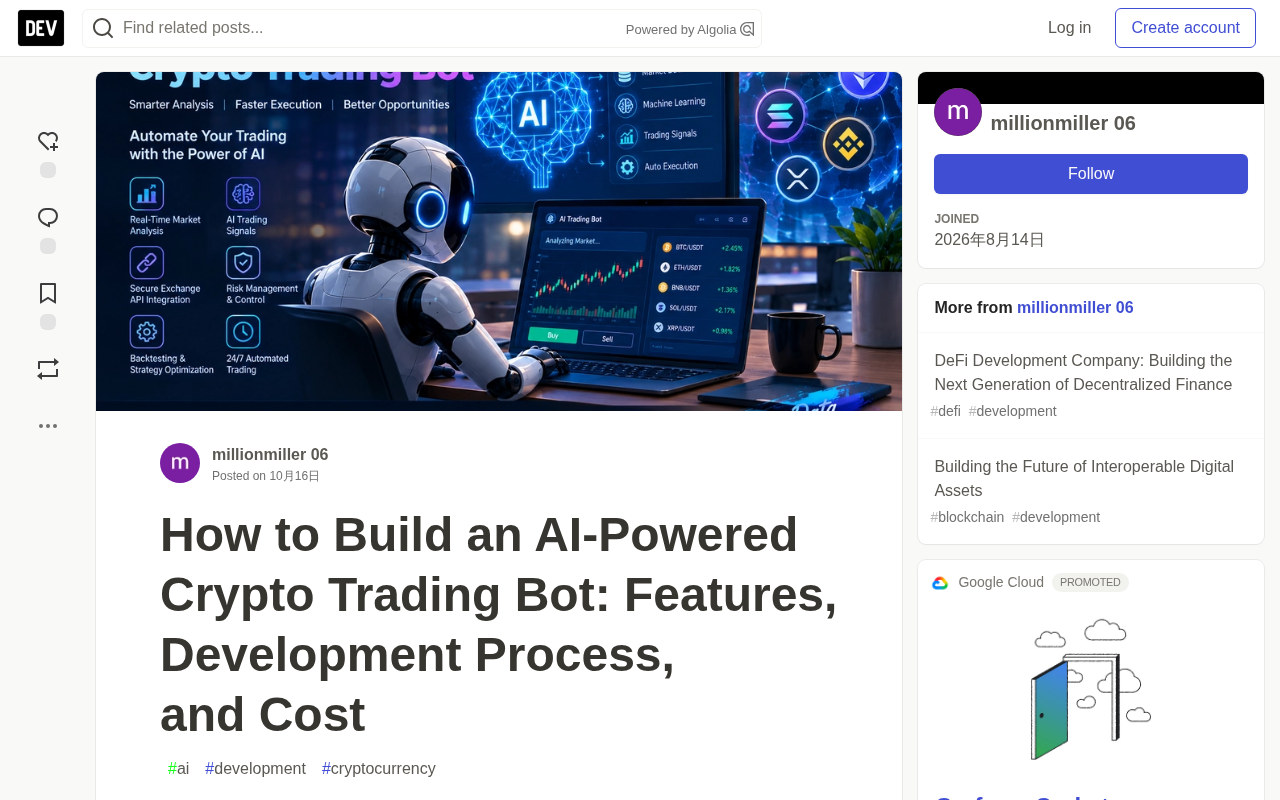
The cryptocurrency market operates around the clock, and manually monitoring multiple trading pairs, analyzing market conditions, and executing orders is a heavy burden for both individual traders and businesses. AI-powered crypto trading bots can automate parts of this process by connecting to exchange APIs, processing market data, and using machine learning models to generate trading signals.
For businesses looking to introduce automation into digital asset trading, understanding the full scope of AI crypto trading bot development is an important first step. A mature solution needs to integrate market data processing, artificial intelligence, exchange connectivity, backtesting, and risk control — rather than relying on automation alone.
What Exactly Is an AI Crypto Trading Bot
An AI crypto trading bot is software that connects to cryptocurrency exchanges via APIs, processes market information, and uses machine learning models to generate trading signals. Depending on its configuration, it can automatically execute buy or sell orders within preset limits.
Traditional rule-based bots follow fixed instructions written by developers. AI-driven systems, by contrast, can use historical and current data to identify patterns and estimate market conditions. But it's important to recognize clearly that AI models can make incorrect predictions, and their performance drifts as market conditions change. Therefore, a well-designed trading bot needs both an effective strategy and safeguards that limit risk exposure when the strategy underperforms — a point that many teams new to automated trading underestimate.
Why Businesses Consider AI Crypto Trading Bot Development
24/7 Market Monitoring
The cryptocurrency market never stops, and trading bots can monitor selected assets and trading pairs without requiring manual hour-by-hour attention.
Faster and More Consistent Execution
Automated systems can process signals and submit orders according to programmed rules. Actual execution speed depends on multiple variables, including the exchange, network latency, API limits, liquidity, and order type.
Multi-Market Analysis
Bots can simultaneously monitor multiple trading pairs and exchanges, helping businesses evaluate opportunities across different markets. However, fees, liquidity, and execution risk still need to be taken into account.
Strategy-Based Trading
Trading bots can be configured for different strategies such as arbitrage, grid trading, dollar-cost averaging (DCA), momentum, and mean reversion. The suitability of each approach depends on market conditions and user objectives.
Business and SaaS Opportunities
Entrepreneurs can build trading tools for internal use or create multi-user platforms offering strategy tools, dashboards, and subscription plans. Commercial platforms also require user management, access control, customer support, secure API key handling, and appropriate legal compliance review.
Core Features of an AI Crypto Trading Bot
Real-Time Market Data Pipeline
Bots need reliable data on prices, trading volume, order book depth, and trade history. Exchange API connections, WebSocket data streams, data normalization, and historical storage together prepare the information foundation for analysis and testing.
AI Strategy and Signal Generation
The strategy engine analyzes available data and generates buy, sell, or hold signals based on models and configuration. Depending on the project, this may include price pattern analysis, market regime detection, or sentiment analysis. Model outputs need careful evaluation — a high confidence score does not guarantee a profitable trade, which is an easily overlooked cognitive trap in AI trading system design.
Model Drift is a core issue that AI trading systems must continuously address. It refers to the phenomenon where a model's performance degrades over time in production, typically divided into two categories: Data Drift refers to changes in the statistical distribution of input features, such as shifts in market volatility structure, volume patterns, or correlation matrices; Concept Drift refers to changes in the relationship between features and targets themselves, such as a previously effective momentum factor failing after a policy shift. Because the crypto market operates 24/7, has rapidly changing participant structures, and is heavily influenced by regulatory news, drift tends to occur much faster than in traditional financial markets. Countermeasures include: continuously monitoring deviations between predicted distributions and actual outcomes, setting performance degradation alert thresholds, periodically retraining models with rolling window data, and automatically downgrading to more conservative strategies or pausing trading when significant drift is detected. Ignoring drift is one of the main reasons many AI trading systems perform well early after launch but see expanding drawdowns months later.
Exchange API Integration
API integration enables bots to fetch market data and submit orders to supported exchanges. Developers should carefully configure permissions, restrict unnecessary account access, protect credentials, and handle API errors and rate limits.
API Rate Limiting is a constraint set by exchanges to protect system stability by limiting request frequency, typically calculated by time window (e.g., per second, per minute) and weight, with different endpoints (placing orders, querying orders, pulling candlestick data) consuming different weights. If a bot polls at high frequency during sharp market swings, it can easily trigger throttling or even temporary bans, causing it to miss critical trading opportunities. A mature integration approach should use WebSocket subscription push instead of polling for market data, use exponential backoff algorithms to handle rate-limit responses, use local caching with differential sync for order states, and implement request queues with priority scheduling. Additionally, edge cases such as partial fills, rejected orders, and unknown order status after network timeouts need to be handled — these occur far more frequently in live trading than in test environments. API keys should be configured with the principle of least privilege, with withdrawal permissions disabled, and stored via environment variables or key management services — never hardcoded in code repositories.
Automated Order Execution
The execution layer converts strategy signals into exchange orders, requiring consideration of order types, partial fills, fees, slippage, latency, and rejected trades.
Risk Management
Risk control is critical for automated trading. Common safeguards include position limits, maximum drawdown thresholds, stop-loss rules, trade size limits, exposure limits, and emergency shutdown mechanisms.
Maximum Drawdown and Value at Risk (VaR) are two fundamental but often confused metrics in quantitative risk control. Maximum drawdown measures the largest decline in account equity from a historical peak to a subsequent trough, reflecting the actual loss magnitude in extreme scenarios, directly related to whether capital can withstand it and whether forced liquidation will be triggered. Value at Risk, on the other hand, estimates the maximum possible loss at a given confidence level (e.g., 95%) and holding period, but it does not describe how severe tail losses beyond that threshold can be. In crypto markets, due to price gaps, sudden liquidity drops, and frequent exchange failures, VaR models based on historical volatility assumptions often underestimate extreme risk, so in practice they are frequently supplemented with stress testing (simulating extreme scenarios) and Conditional Value at Risk (CVaR). For automated trading bots, a common practice is to set maximum drawdown thresholds that trigger automatic position reduction or shutdown, and to limit per-trade risk to a fixed percentage of account equity (e.g., 1%-2%), to avoid irreversible capital loss from consecutive losses.
Backtesting and Paper Trading
Backtesting uses historical data to evaluate strategies, while paper trading uses real-time market data and simulated funds to test system behavior without committing real trading capital. Both stages are important, but neither can guarantee future performance. Testing should account for trading costs, slippage, liquidity constraints, and the risk of overfitting to historical data.
Overfitting is the most insidious and dangerous trap in the backtesting stage. When strategy parameters are repeatedly adjusted to maximize returns on historical data, the model is actually memorizing historical noise rather than learning generalizable patterns, leading to sharp deterioration in out-of-sample performance. Common methods for identifying overfitting include: splitting data into training, validation, and test sets that are never used for parameter tuning; using Walk-Forward Analysis to simulate the rolling retraining process of real deployment; testing parameter sensitivity — if fine-tuning parameters causes large swings in returns, the strategy's robustness is questionable; and comparing strategy performance across multiple uncorrelated markets or time periods. Additionally, backtesting must guard against survivorship bias (delisted trading pairs not included), look-ahead bias (using information unavailable at the time), and underestimating trading costs. A strategy with an extremely high Sharpe ratio in backtesting should almost never be used directly in live trading without rigorous out-of-sample validation.
Monitoring and Analytics Dashboards
Dashboards can display order status, trading activity, realized and unrealized P&L, drawdown, model behavior, and system alerts. Monitoring helps teams detect errors and abnormal activity before they escalate.
Typical Use Cases for AI Crypto Trading Bots
Arbitrage: Evaluating price spreads across different exchanges or trading venues; profitability depends on fees, liquidity, transfer delays, and execution risk.
Quantitative Strategy Execution: Automatically executing strategies based on momentum, mean reversion, or inter-asset relationships.
DeFi and Decentralized Exchange Trading: On-chain bots can interact with decentralized exchanges and liquidity pools, but need to consider network fees, smart contract risk, slippage, and transaction ordering.
Grid Trading: Placing orders at intervals within a configured price range; performance depends on market behavior and selected parameters.
Dollar-Cost Averaging (DCA): Buying preset amounts at scheduled intervals, helping automate a consistent purchasing plan, but it does not eliminate market risk.
Market Making: Professional systems provide liquidity by posting buy and sell orders, requiring sophisticated inventory management and control of adverse price movements.
How to Build an AI Crypto Trading Bot: Step-by-Step Process
Step 1: Define Strategy and Project Scope
Choose the trading approach, supported exchanges, target assets, spot or derivatives requirements, and risk limits. Determine whether the bot is for personal use, a trading business, or a multi-user SaaS platform.
Step 2: Choose Technology and Integration Approach
Select programming tools, databases, cloud infrastructure, exchange APIs, and any blockchain connectivity the project requires. The architecture should support secure credentials, reliable data collection, and error recovery.
Step 3: Develop the AI Strategy Engine
Prepare historical data, select relevant features, train appropriate machine learning models, and define how signals are generated. The development process should include validation on data not used for training.
Step 4: Backtest Under Different Market Conditions
Evaluate the strategy across different periods — uptrends, downtrends, sideways markets, and high volatility. Review performance after accounting for estimated trading fees and slippage, and test whether the strategy still holds up beyond the development data.
Step 5: Implement Risk Controls and Logging
Add position limits, drawdown triggers, emergency stop mechanisms, access controls, and trade decision records. These controls should operate in parallel with the strategy engine, rather than relying entirely on AI predictions.
Step 6: Paper Trade and Deploy Gradually
Run the bot with simulated funds and real-time market data to identify execution issues and unexpected behavior. If the system meets established testing criteria, live deployment should begin with controlled exposure and continuous monitoring.
Step 7: Maintenance and Continuous Improvement
Monitor system performance, review model drift, update dependencies, investigate anomalies, and retrain models when necessary. Since market conditions and exchange APIs can both change, ongoing maintenance is essential.
AI Crypto Trading Bot Development Cost
Development costs vary depending on strategy, degree of AI integration, number of exchange connections, security requirements, and whether the product serves a single user or multiple clients. According to reference data from the Clarisco guide, AI-driven trading bot development costs approximately $50,000 to $150,000, with a development timeline of about three to six months. It should be noted that these figures are indicative references only; actual costs depend on project scope, team rates, infrastructure, audits, data services, and ongoing model maintenance.
How to Choose a Crypto Trading Bot Development Company
Choosing a development partner should not be based solely on portfolio or initial price comparison. Businesses should evaluate the other party's experience in exchange APIs, machine learning, trading systems, security, testing, and production monitoring.
Potential partners can be asked: How do you protect API credentials? How do you validate AI models? How do you test strategies under different market conditions? How do you handle failed orders and unexpected losses? For SaaS platforms, tenant isolation, billing, permissions, and customer-facing analytics capabilities should also be evaluated.
Development capabilities described by Clarisco include market data pipelines, machine learning models, backtesting environments, multi-exchange API management, live execution, monitoring dashboards, and post-launch support. Before starting a project, measurable technical requirements and testing plans should be defined. No development company or AI model can guarantee trading profitability.
Frequently Asked Questions
What is AI crypto trading bot development? It is the process of creating software that uses market data, AI models, and exchange integrations to generate trading signals and automatically execute orders according to established strategies.
How does an AI crypto trading bot work? The bot collects market data, processes it through strategies or AI models, generates signals, applies risk controls, and sends qualifying orders to exchanges via APIs.
What features should an AI crypto trading bot include? Important features include real-time data processing, strategy generation, exchange API integration, order execution, risk control, backtesting, paper trading, monitoring, and alerting.
How much does AI crypto trading bot development cost? According to reference data from the Clarisco guide, AI-driven bot development costs approximately $50,000 to $150,000. The final price depends on strategy complexity, integrations, security, infrastructure, and project requirements.
How long does it take to develop an AI crypto trading bot? The reference guide estimates about three to six months. More complex platforms may take longer, depending on scope and testing requirements.
Can an AI crypto trading bot guarantee profits? No. Market conditions change and models can produce inaccurate signals. Trading fees, slippage, liquidity, technical failures, and sudden price swings can all lead to losses.
What is the difference between rule-based bots and AI-driven trading bots? Rule-based bots follow predefined conditions, while AI-driven bots use models trained on data to identify patterns or estimate market conditions. Both require testing, monitoring, and risk control.
Why are backtesting and paper trading important? Backtesting uses historical data to evaluate strategies, while paper trading uses real-time market data and simulated funds to test the system. Both can reveal weaknesses before committing real capital, but neither can definitively predict future performance.
How do I choose a crypto trading bot development company? Evaluate their experience in exchange APIs, AI models, secure credential management, risk control, testing, monitoring, and ongoing maintenance. Request a clear scope and project-specific estimate.
Can a trading bot connect to multiple crypto exchanges? Yes, provided the chosen exchanges offer suitable APIs and the bot is designed to support them. Developers must account for differences in order types, rate limits, liquidity, fees, and API behavior.
One-line Summary
A systematic overview of AI crypto trading bot feature modules, development process, cost ranges, and risk boundaries.
Paragraph Summary
This article is aimed at businesses and developers looking to introduce automation, systematically outlining the full picture of AI crypto trading bots from concept to deployment. It first defines the difference between AI bots and traditional rule-based bots, emphasizing that model predictions can be wrong and performance drifts with the market. It then lists the main motivations for business adoption, including 24/7 monitoring, faster execution, multi-market analysis, and SaaS commercialization opportunities. The core features section covers seven major modules: real-time data pipelines, AI strategy engines, exchange API integration, automated execution, risk management, backtesting and paper trading, and monitoring dashboards. The development process is divided into seven steps, from defining strategy scope to continuous maintenance and model retraining. In terms of cost, reference data suggests approximately $50,000 to $150,000 with a timeline of three to six months. The article repeatedly emphasizes that no AI model or development company can guarantee profitability, and that backtesting and paper trading can reveal weaknesses but cannot definitively predict future performance.
Related articles

Chain of Thought Isn't Just for AI: How Humans Can Use CoT to Improve Thinking Quality
Chain of Thought isn't just a prompt trick for large models. Starting from a Hacker News discussion, this article analyzes why CoT works for human thinking too, breaks down actionable ways to transfer it, and highlights the key differences between human CoT and machine CoT.
Cloudflare Teams Up with OpenAI: Closi…
Cloudflare Teams Up with OpenAI: Closing the Loop from Vulnerability Discovery to Defense with AI
Cloudflare uses OpenAI Daybreak to investigate security vulnerabilities and generate reviewable remediation plans, while developers use Codex to boost coding efficiency and quality.

Orca Multi-Agent Orchestration in Practice: A Guide to Parallel Collaboration with Claude and Codex
Orca is Stable AI's free open-source agent workbench supporting 34 agents like Claude Code and Codex in parallel. Learn its Git worktree isolation, multi-model orchestration, and mobile management.