AI + Cybersecurity Beginner's Guide: From Zero to SRC Bug Bounty in Practice
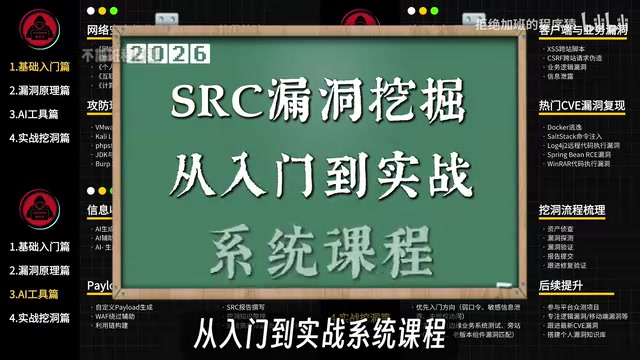
How AI tools lower the cybersecurity entry barrier, and a practical path from zero to SRC bug hunting.
This article introduces an "AI + Cybersecurity" SRC bug bounty course for beginners, structured into four progressive stages: fundamentals, vulnerability principles, AI tools, and hands-on practice. It covers high-frequency vulnerability types, asset gathering, CVE reproduction, and AI-assisted workflows. The article notes that AI tools reduce repetitive work but can't replace understanding of core principles, and it warns that transitioning to a big-company security role versus hunting bounties from home involves vastly different difficulty levels. It concludes with practical advice: don't skip fundamentals, reproduce every vulnerability hands-on, use AI as an efficiency tool, and set realistic expectations.
AI + Cybersecurity Beginner's Guide: From Zero to SRC Bug Bounty in Practice
Cybersecurity has always been a high-barrier field in tech, but the introduction of AI tools is changing the learning path. A systematic SRC vulnerability hunting course aimed at complete beginners has appeared on Bilibili, combining AI tools with cybersecurity learning in an attempt to lower the entry barrier.
Why AI + Cybersecurity Is Becoming a New Trend
The traditional cybersecurity learning curve is steep, and beginners often get stuck at several points: not understanding vulnerability principles, not knowing how to set up test environments, and feeling overwhelmed by the massive amount of assets. The design philosophy of this course breaks the learning path into four progressive stages—foundational basics, vulnerability principles, AI tools, and hands-on bug hunting—with each stage solving a specific problem.
The value of this layered approach is that it acknowledges the reality of "zero background." Many security tutorials assume learners already have prerequisite knowledge in network protocols, programming languages, and Linux operations, causing a large number of beginners to give up at the very start. By making foundational basics a standalone section, the course attempts to fill this gap.

Breaking Down the Core Course Modules
High-Frequency Vulnerability Principles and Asset Information Gathering
The high-frequency vulnerability principles covered in the course are the foundation of SRC bug hunting. Without understanding how vulnerabilities like SQL injection, XSS, and SSRF form, it's impossible to identify them in real-world scenarios. The focus of this section isn't memorizing vulnerability types, but understanding the logic behind how vulnerabilities arise—why insufficient input validation leads to problems, and why permission control flaws get exploited.
Asset information gathering is the first step in hands-on practice. In SRC scenarios, the first step to finding a target is mapping out the attack surface: subdomains, open ports, historical leaked information, etc. AI tools can assist with automated scanning and result analysis in this phase, reducing the time cost of manual investigation.
SRC and the Bug Bounty Mechanism: SRC (Security Response Center) is an official vulnerability collection platform established by enterprises. White hats submit vulnerabilities through the platform and receive points, bounties, or recognition after review and confirmation. Major domestic SRCs include self-built platforms from vendors like Tencent, Alibaba, and ByteDance, as well as third-party crowdsourced testing platforms like Butian and Vulnerability Box. Unlike black-hat activities, SRC bug hunting is legally authorized testing—the scope of vulnerabilities and testing rules are clearly defined by the platform or vendor, and operations beyond that scope may violate the law. For beginners, SRC is both a practice ground and a source of income, but review standards, reward levels, and response speeds vary significantly across platforms, making it especially important to choose a platform suited to your skill level.
Analysis of Common High-Frequency Vulnerability Types: SQL injection originates from user input being concatenated into database query statements without filtering, allowing attackers to read, tamper with, or even delete data. XSS (Cross-Site Scripting) occurs when a page directly renders user input as HTML, causing malicious scripts to execute in others' browsers—it's divided into reflected, stored, and DOM-based types. SSRF (Server-Side Request Forgery) exploits the server's ability to initiate internal network requests, allowing attackers to access internal systems that would otherwise be unreachable. There are also file upload, privilege escalation, command execution, and more. The key to understanding these vulnerabilities lies in grasping the "trust boundary"—when a system mistakenly trusts external input, vulnerabilities arise. This is also why the course emphasizes principles over memorizing types.
CVE Vulnerability Reproduction and Hands-On AI Tools
CVE vulnerability reproduction is the bridge connecting theory and practice. By reproducing known vulnerabilities, learners can intuitively see the complete process of how a vulnerability is triggered and understand the difference before and after a patch. The course incorporates CVE reproduction into its system, indicating that it focuses on verifiable learning outcomes rather than staying at the conceptual level.

The addition of the AI tools section is what distinguishes this course from traditional security tutorials. AI applications in the security field currently focus on several directions: assisting with code auditing, automated vulnerability scanning, log anomaly detection, generating test cases, etc. For beginners, AI tools can reduce the burden of repetitive work, allowing people to focus their energy on understanding vulnerability logic.
The Value of CVE and Vulnerability Reproduction: CVE (Common Vulnerabilities and Exposures) is a public vulnerability numbering system maintained by MITRE. Each confirmed vulnerability is assigned a unique identifier, such as CVE-2021-44228 (Log4Shell). Combined with platforms like NVD (National Vulnerability Database), you can look up the severity, affected versions, and remediation solutions for vulnerabilities. The significance of reproducing CVEs lies in the fact that it provides a standard answer—you can clearly know under what conditions a vulnerability is triggered and which piece of code the patch fixed. With the help of lab environments like Vulhub and Vulfocus, beginners can quickly set up reproducible vulnerability scenarios, transforming abstract principles into actionable experience. This is a key step from "understanding" to "being able to use."
SRC Bug Hunting in Practice
The hands-on bug hunting section is the culmination of the entire course. SRC (Security Response Center) platforms provide white hats with a legal channel for submitting vulnerabilities, and finding your first vulnerability is a milestone for many beginners. The course promises to "help you find your first vulnerability in life." Whether this goal is achievable depends on multiple factors: target selection, vulnerability type matching, report writing quality, and more.
What You Can Do After Learning: Career Paths and Realistic Expectations
The course describes two paths: switching careers to become a white hat at a big company, or hunting vulnerabilities from home to earn bounties. The difficulty levels of these two paths differ greatly.
Security positions at big companies typically require a solid computer science foundation, programming ability, a security knowledge system, and relevant project experience or certifications. An introductory course can provide a knowledge framework, but there's still a gap to the job requirements. The barrier to earning bounties is relatively more flexible, but competition is fierce, and unstable income in the early stages is the norm for beginners.
The support of AI tools does shorten the distance from zero to entry-level, but it cannot replace understanding of underlying principles. Tools can help you scan, but judging whether a scan result constitutes a real vulnerability, how to construct an effective PoC, and how to write a vulnerability report that passes review—these still depend on human judgment.
Learning Advice for Beginners
If you plan to follow this course, here are a few practical suggestions:
- Don't skip the basics. Network protocols, how HTTP works, and at least one programming language (Python preferred)—these are the foundation for everything that follows.
- Reproduce every vulnerability hands-on. Watching videos and personally setting up an environment to reproduce are two different things; only the latter truly builds muscle memory.
- Use AI tools wisely. Treat AI as an efficiency tool rather than a replacement. Use it to accelerate information gathering and code analysis, but maintain skepticism and verification of results.
- Set reasonable expectations. Your first vulnerability may take weeks or even months. Staying patient is more important than chasing quick results.
The core ability in cybersecurity is continuous learning and independent thinking. AI tools will keep updating, vulnerability types will keep evolving, but the mindset of analyzing problems and verifying hypotheses is effective long-term.
One-line Summary
How AI tools lower the cybersecurity entry barrier, and a practical path and realistic expectations for beginners going from zero to SRC bug hunting.
Paragraph Summary
This article introduces an "AI + Cybersecurity" SRC bug hunting course aimed at zero-background learners, dividing the learning path into four progressive stages: foundational basics, vulnerability principles, AI tools, and hands-on bug hunting. The course covers high-frequency vulnerability principles, asset information gathering, CVE reproduction, and AI-assisted tools, with the goal of helping beginners find their first vulnerability. The article points out that AI tools can significantly reduce repetitive labor in code auditing and automated scanning, but cannot replace understanding of underlying principles. It also reminds readers that the difficulty gap between switching to a big-company security role and hunting bounties from home is enormous—the former requires a solid computer science foundation and project experience. Finally, it offers learning advice: don't skip the basics, reproduce every vulnerability hands-on, treat AI as an efficiency tool rather than a replacement, and set reasonable expectations of weeks to months.
Related articles

Black Forager Alexis Nelson: From Foraging to Publishing, Happy Snacking, Don't Die
Black Forager Alexis Nikole Nelson visits Talks at Google, sharing her journey from childhood plant walks with her mother to publishing the cookbook Happy Snacking, Don't Die!, revealing the racial and land history behind foraging's rise and fall in America.

How to Present Your Ideas Effectively: Three Types of Revelation Talks
Revelation talks are the most direct way to convey ideas. This article breaks down three types — Wonder Walk, Dynamic Demo, and DreamScape — with classic examples from David Gayo, Michael Pritchard, and Sylvia Earle.

Modern Web Guidance: Letting AI Write Native Declarative Dialog Popovers
Google's Modern Web Guidance makes AI coding assistants prefer native declarative dialog capabilities over repetitive JavaScript event listeners, measurably cutting boilerplate code.