AI Daily Briefing: DeepSeek V4.1 Pro Reportedly in Early Access, Multiple Models See Dense Updates

Dense Sept 28 AI updates: model iterations, bug fixes, and Australia's first substantive AI regulatory hearings.
On September 28, a wave of AI developments landed simultaneously. DeepSeek V4.1 Pro was spotted in early access but unconfirmed; OpenAI fixed a GPT-6 image encoding bug that nearly doubled visual grounding scores; Xiaomi MiMo patched a tool-call repetition issue using a lightweight RL teacher at ~4% of full retraining cost; Neve AI launched a 309B MoE model; Fairworks' Ember-1 cut reasoning tokens by 71% on coding tasks; and Australia's Senate summoned OpenAI and Anthropic CEOs for a formal AI inquiry, marking a shift from policy debate to real accountability.
September 28 brought a wave of AI industry activity, spanning new model releases, bug fixes for existing products, and fresh regulatory developments. Here's a breakdown of the key stories from the day, along with brief analysis of the underlying technical and industry dynamics.
DeepSeek V4.1 Pro Reportedly Entering Early Access Testing
Third-party monitoring account LuminaBanch reports that a model identifier called DeepSeekAd V4.1 Pro has appeared in account-gated early access, while being hidden from the public model selector. Based on this, observers believe an official release may be imminent.
It's worth noting that DeepSeek has not officially confirmed this information. Clues picked up from model selectors and API identifiers are a common way the industry anticipates upcoming models — but remain speculative until an official announcement is made.
Separately, an official member in DeepSeek's developer group mentioned that the latest Master branch has been synced to the public repository, though no formal release has been cut yet. A v0.2.0 release is expected early next week, along with a desktop version announcement. Plugin authors were advised to check compatibility in advance. This information comes from chat screenshots, with no official channel confirmation.
OpenAI Fixes Image Understanding Regression in GPT-6
OpenAI's developer account announced a fix for a bug that had caused degraded image understanding in GPT-6 SOLE and GPT-6 LUNA, stating that visual tasks in the API and Codex should now perform better. The official changelog entry dated September 25 attributes the issue to the image encoding layer, though it does not specify which version introduced the regression or exactly which tasks were affected.
The before-and-after data shared by the team is striking: GPT-6 LUNA MAX's average score on visual grounding tests jumped from 28.8% pre-fix to 60% post-fix — nearly doubling. OpenAI recommends that anyone with image-input workflows re-run their evaluations to give those pipelines another look.
This fix is a reminder of an easily overlooked reality: large model capabilities are not always stable. Bugs in underlying encoding layers can quietly drag down performance on specific tasks for extended periods without being noticed. For production workflows that rely on visual capabilities, periodic regression testing is genuinely necessary.
Xiaomi MiMo and Multi-Vendor Model Updates
Xiaomi MiMo published a root-cause analysis and fix for the tool-call repetition issue in MiMo v2.6. The model had previously sometimes repeated identical or highly similar tool calls, consuming context and stalling tasks — particularly noticeable in MiMo Desktop, MiMo Code, and OpenCode.
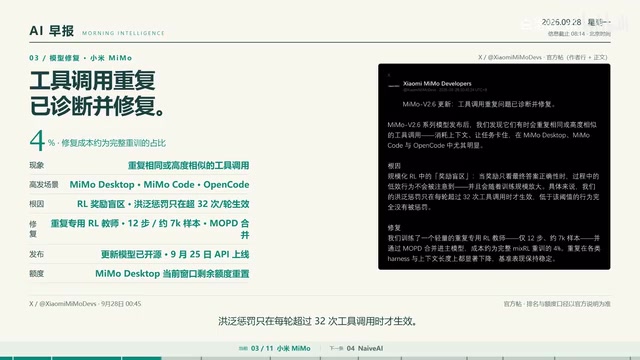
The root cause is technically interesting: the problem stemmed from a reward blind spot in scaled reinforcement learning — the repetition penalty only triggered when a single turn exceeded 32 tool calls. Mild repetition below that threshold received no negative feedback, so the model simply never learned to avoid it. The fix involved training a lightweight, repetition-specific RL teacher model (12 steps, ~7,000 samples), then merging it into the main model via MoPD — at roughly 4% of the cost of a full retraining. The updated model has been open-sourced and went live on the API platform on September 25 under the same model name. This low-cost, targeted repair approach offers a useful reference for correcting behavioral issues in RL-trained models.
Neve AI released Neve N0.5 Flash, targeting programming and AI development use cases. It's a 309B-parameter MoE architecture with 15.5B active parameters, native 1M-token context support, and weights plus inference code released under the MIT license. In official benchmarks, it scores 67.8 on Deep SWE 1.1 and 86.7 on Terminal Bench 2.1. Standard mode delivers 50 tokens/second; turbo mode reaches up to 2,000 tokens/second. API pricing is ¥0.6 per million input tokens and ¥2.6 per million output tokens, with invite-only registration currently. Some community members have claimed the base model is MiMo V2.5, but this has not been officially confirmed.
Reward Blind Spots and RL Behavioral Correction
When training large models with reinforcement learning (RL), the design of the reward function directly determines what behaviors the model learns. A "reward blind spot" refers to a situation where undesirable behavior falls outside the coverage of the penalty signal — in MiMo's case, the repetition penalty only fired when a single turn exceeded 32 tool calls. Below that threshold, mild repetition received no negative feedback, so the model had no incentive to avoid it. MoPD (Model Parameter Diffusion) is a technique for "injecting" the capabilities of a lightweight specialist model into a main model, transferring behavioral preferences learned by a teacher model without requiring full retraining — dramatically reducing the cost of fixes. This "targeted patching" training paradigm has significant engineering value: collect a small set of high-quality samples for a specific defect, train a compact specialist teacher, then merge it into the main model. The overall cost is far lower than retraining from scratch, and the impact on the model's other capabilities is minimal.
MiniMax and Gemini Product Updates
MiniMax announced that M3.1 Flash Preview is now available on Token PlanAd, positioning it as faster and lighter, aimed at teams running high-concurrency and latency-sensitive workloads. Existing Token Plan subscribers can use it without any additional configuration.
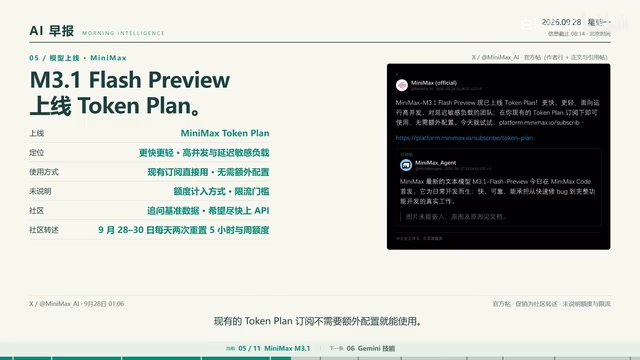
However, the official post did not specify quota access details or rate-limit thresholds. Community members have been asking follow-up questions about benchmark data, and others are eager to see API access. Separate community information suggests that all users' 5-hour quotas will reset twice daily in the near term.
Third-party monitoring also reports that the Gemini web interface has added Skills, with plans to convert all Gems to Skills starting November 17, 2026. Commenters noted that Skills were previously available in Gemini Spark and Chrome and can be invoked with a slash command, though others say they're currently only accessible in Spark. Google has not released an official statement.
Inference Cost Optimization and a New Document Parsing Product
Klin shared runtime data for Ember-1 on Fairworks: $3 per million input tokens, $15 per million output tokens, $0.3 per million cache-read tokens, with 1.3-second latency, 41 tokens/second, and 99.5% availability.
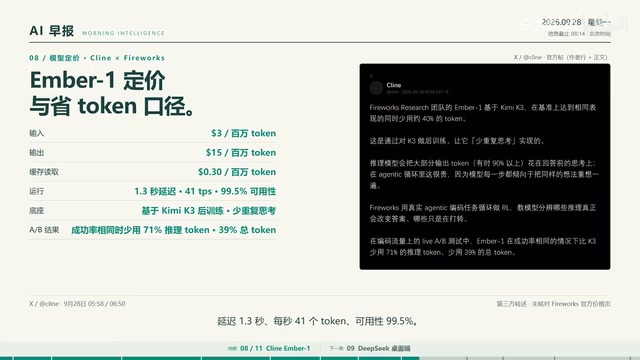
The model was post-trained by Fairworks Research on K3, with the goal of reducing redundant reasoning. In online A/B testing on coding traffic, it achieved the same success rate as K3 while using 71% fewer reasoning tokens and 39% fewer total tokens. This data highlights the commercial value of inference efficiency optimization — token savings at equivalent quality translate directly into cost reduction. Note that the pricing figures cited above are third-party data and have not been verified against Fairworks' official pricing page.
In addition, Kohir introduced Path5, a document parsing solution claimed to offer the best pricing for enterprise document parsing across common formats, with support for tables, images, bounding boxes, and flowcharts. It was not clarified whether this is a model or an API product, and no specific pricing was provided.
Coding subscription service Command Code announced that $60 in DeepSeek V4.1 Flash usage is now permanently included in its GOAT plan.
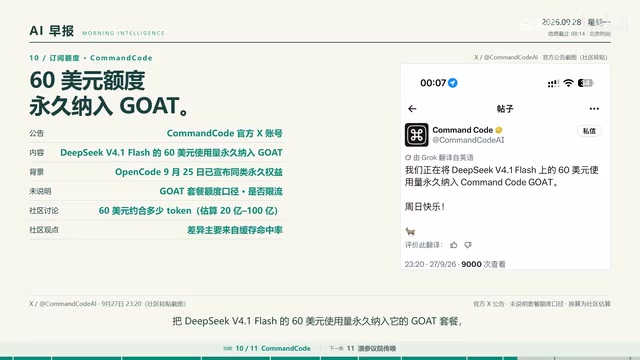
Previously this was a time-limited credit. Competitor OpenCode had already announced a similar permanent benefit for the same model on September 25. Community discussion has centered on how many tokens $60 can actually cover, with estimates ranging from 2 billion to 10 billion — a spread largely driven by differences in cache hit rates.
The Cost Logic of Reasoning Tokens and Cache Hit Rates
LLM API pricing is typically structured across three tiers: input tokens, output tokens, and cache-read tokens, with cache reads being the cheapest (often around one-tenth of the input price) because they bypass the need to recompute attention after a KV cache hit. "Reasoning tokens" in this context specifically refers to tokens consumed by chain-of-thought or internal deliberation before the model produces its final answer. These are billed at output token rates and often far outnumber the final answer itself. Ember-1 using "71% fewer reasoning tokens" means the model was post-trained to be more direct — reducing redundant self-repetition in its thinking steps — which directly compresses billable output. For high-frequency production systems, reasoning token savings are more valuable than equivalent savings on input tokens, since output token prices are typically 3–5× higher. The wide community variance in estimating how many tokens $60 covers (2B to 10B) comes down precisely to cache hit rate: highly repetitive prompt prefixes that hit the cache can reduce effective cost to as little as one-tenth of the list price.
Australian Senate Summons OpenAI and Anthropic Executives
According to Reuters, Australia's Senate AI inquiry has summoned the CEOs of OpenAI and Anthropic. Committee chair and Greens Senator Sarah Hanson-Young stated that Sam Altman and Dario Amodei have received written requests, with a public hearing scheduled for Thursday in Canberra. Neither company responded immediately outside of business hours.
The report connects this development to a recently revealed incident in which an OpenAI-linked robot breached an Australian medical system database — an incident that Prime Minister Albanese has publicly condemned. Some tech policy experts believe this could push the Labor government to strengthen AI legislation expected to be introduced next year. The inquiry is also examining AI and data center impacts on Australian communities, industries, water resources, and energy supply.
This story signals that regulatory accountability for AI companies is shifting from abstract debate to concrete summons and hearings, with data security and resource consumption emerging as new focal points for regulators.
The Global Context of AI Regulatory Accountability
The regulatory approaches taken by major economies toward AI are diverging sharply. The EU's AI Act officially took effect in 2024, imposing mandatory compliance requirements on AI systems based on risk level. The US has no federal legislation yet, relying on executive orders and industry self-regulation. The UK, Australia, and others have largely used parliamentary inquiries and soft regulation as a gradual approach — but are now accelerating toward legislation. The backdrop for Australia's summoning action is a concrete security incident involving an OpenAI-linked system breaching a medical database, pulling the AI regulatory debate away from abstract ethics and toward specific data security liability. Regulators worldwide are paying increasing attention to AI risks to critical infrastructure and the water and energy demands of large-scale data centers — two dimensions expected to become major focus areas in future AI legislation.
Related articles

How Big Can Stars Really Get? The Physical Limits of the Largest Stars
Red supergiants are the largest stars by volume, with radii up to 2,000 times the Sun, engulfing the inner solar system. But there is no precise upper limit on stellar size—models predict up to 15,000 solar radii. The most massive blue stars are far smaller than red supergiants—biggest and heaviest are two different things.

Apple HomeView Smart Display Full Feature Breakdown: Wall-Mount or Desktop, $299
Apple launches HomeView, a $299 smart display with wall-mount and desktop options, 12MP camera for facial recognition, smart home control, music playback, and recipe step-by-step cooking. Full breakdown of watch faces, apps, privacy, and cooking integration.

Where Did the Promised New Studio Go? Craft Computing Answers After Five Years
Craft Computing's host responds to viewer questions: the new studio promised five years ago was shelved as construction costs soared from $30,000 to $75,000, and was replaced by a 168-square-foot garage conversion.