AI Daily Briefing: Nano Banana 2.1 and Mistral Large 4 Launch on the Same Day

Flagship models, decision APIs, and Agent protocol standards land simultaneously as AI shifts from model-building to scalable Agent deployment.
This roundup covers a dense wave of AI developments: Mistral launched the 1T-parameter MoE flagship Large 4, Google released a 4K image editing model and an on-device multimodal embedding model, and Amazon published a diffusion language model. Decision models emerged as a notable trend, with OpenAI, Perplexity, and Empiro Labs each releasing decision APIs or models. On the agent infrastructure front, Codex Auto Review opened its dual-layer review architecture for free, Personal Agent Protocol was announced by a multi-company coalition, and GitHub rebuilt its Git infrastructure to handle AI agent concurrency. In capital news, OpenAI is negotiating a $30B raise at a $1.4T valuation, DeepSeek is closing a ~100B yuan round, and Kling AI is preparing a Hong Kong IPO.
Flagship Model Frenzy: Mistral and Google Go Head-to-Head
Another wave of foundation model releases has arrived. Mistral AI launched a public preview of its flagship model Mistral Large 4 — nicknamed Led Trunk — now available via API to all users. This natively multimodal Mixture-of-Experts (MoE) model packs roughly 1 trillion total parameters, activating approximately 49 billion per token. This sparse activation design keeps inference costs manageable while preserving the capability ceiling of a massive model. Mistral claims it leads among open-weight models on critical workloads like cybersecurity, with full model weights slated for release by end of month.
Meanwhile, Google launched Nano Banana 2.1, an image generation and conversational editing model now available through the Gemini API, with a rollout underway across Gemini apps, Search AI Mode, AI Studio, and Google Ads. Google highlights improvements in visual design, mask-based editing, and subject consistency over the previous generation, with a maximum output resolution of 4K. On third-party Arena leaderboards, the model ranks fifth, sixth, and fourth in tattoo images, image editing, and multi-image editing respectively — solid performance, though not top of the charts, reflecting just how competitive the image generation space has become.
What is MoE (Mixture of Experts)? MoE is a sparsely activated neural network architecture made up of multiple "expert" sub-networks. During inference, only a small subset of experts is activated to process each input, while the rest remain dormant. This allows the model to scale total parameter count dramatically without a proportional increase in compute. In Mistral Large 4's case, only ~49B of its 1 trillion parameters are activated per token — making the actual compute load comparable to a dense 49B model, while retaining the knowledge capacity of a much larger one. The core challenge of MoE lies in routing stability: ensuring each expert receives balanced training examples and avoiding scenarios where some experts are overloaded while others go nearly unused.
Embeddings and Diffusion: Two New Paths in Model Architecture
Google also released Embedding Gemma 2, a lightweight multimodal embedding model optimized for on-device use. It maps text, code, images, video, and audio into a unified embedding space using a modular 740M-parameter encoder with flexible vector dimensions. All weights are available for download under the Apache 2.0 license. For developers building retrieval or semantic matching on the edge, a compact yet capable embedding model like this is a meaningful addition.
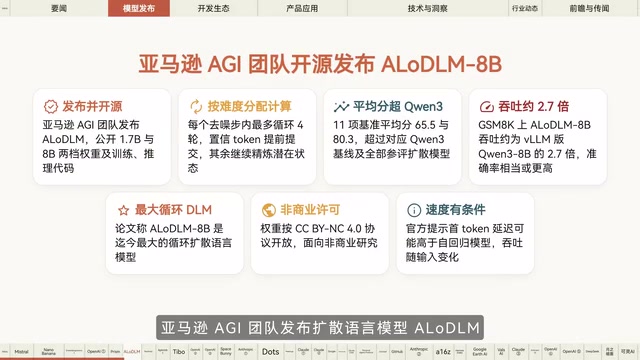
On the architecture innovation front, Amazon's AGI team released a diffusion language model, publishing weights at both 1.7B and 8B parameter scales along with training and inference code. These models generate tokens in parallel while allocating compute based on difficulty — confident tokens are resolved early and used as context, while harder tokens go through up to four rounds of iterative refinement. This "compute-proportional-to-difficulty" approach offers a compelling complement to the autoregressive generation paradigm.
Academia is equally active: a joint team from Fudan University, Tencent Hunyuan, and Zhejiang University open-sourced Prism, an audio-video co-generation framework capable of natively generating and training videos with sound at 720P, 1080P, and 2K resolutions. OpenAI, meanwhile, published a batch of mathematical results produced by its internal frontier models — 722 manuscripts in total. The models were posed roughly 4,000 open research questions, averaging about 3 hours of ChatGPT Pro compute per result. OpenAI acknowledged that these outputs are at varying stages of verification and that unformalized portions may contain errors — a candid admission of uncertainty that's worth recognizing.
What is an Embedding Model? Embedding models map raw data across different modalities (text, images, audio, etc.) into a shared high-dimensional vector space, where semantically similar content sits close together. This property underpins applications like Retrieval-Augmented Generation (RAG), semantic search, and cross-modal matching. A unified multimodal embedding space means you can query a video clip with a text description, or find similar audio using an image — without training a separate matching model for every modality pair. Embedding Gemma 2's flexible vector dimensions let developers trade off between semantic precision and storage cost: higher dimensions improve discrimination but increase index size and retrieval latency. At 740M parameters, the model strikes a pragmatic balance between capability and resource footprint for on-device deployment.
What is a Diffusion Language Model? Diffusion language models borrow from image generation: rather than generating tokens one at a time left-to-right like autoregressive models, diffusion models "denoise" all positions simultaneously, iteratively refining random noise into coherent text over multiple rounds. Amazon's implementation introduces dynamic compute allocation by difficulty — high-confidence positions are locked in early and serve as context anchors for subsequent rounds, while lower-confidence positions continue iterating for up to four passes. This combination of parallel generation and adaptive compute allocation theoretically offers lower end-to-end latency than autoregressive generation on long sequences, with more flexible control over global coherence.
Decision Models and the Expanding Agent Ecosystem
Decision models emerged as a clear trend in this cycle. OpenAI announced Decisions API is now open for public testing to all developers, enabling applications to select the appropriate model, tool, or action in near-real-time. Powered by GPT-6 Luna and supporting text and image inputs, it's positioned as a core building block for agent pipelines. Perplexity updated its open-weight multimodal decision model Decider, claiming top scores on the new Hugging Face Decision Index benchmark, while cutting its Decision API pricing in half. Empiro Labs also debuted its first decision model, Aplomb-E, supporting text, image, video, and audio in a single request.

The coding agent space continues to accelerate: Codex lead Teebo announced Auto Review is now free for all users logged in via ChatGPT accounts, without consuming subscription credits. The feature deploys a second agent to review every action taken by the primary agent, intercepting high-risk or off-intent operations. This "agent-supervising-agent" two-layer architecture is becoming a standard approach to improving automation safety. Anthropic, meanwhile, merged Project Glasswing with its existing CVP into an expanded cybersecurity verification program, offering three tiers — defense, red team, and specialized — to vetted security professionals.
OpenAI also consolidated its API pricing tiers from five levels down to three: Build, Launch, and Grow. The new top tier, Grow, requires only $500 in cumulative API spend to qualify, and existing organizations will be migrated automatically.
What is a Decision Model? Decision models are purpose-built for "choosing the next action" scenarios, as distinct from general-purpose language models optimized for fluent text generation. Their core task is to rapidly output structured action instructions given the current context, available tools, and goal — not to produce natural language paragraphs. These models face strict latency requirements: in an agent pipeline, decision wait times compound at every step, making millisecond-level responsiveness critical to user experience. The "agent-supervising-agent" two-layer architecture is an engineering solution to the hallucination and execution drift risks of single-agent systems: the primary agent handles planning and execution, while the reviewer agent focuses exclusively on assessing whether each action aligns with user intent and safety policy — separating responsibilities to reduce single points of failure.
Protocols and Infrastructure: Building the Foundation for the Agent Era
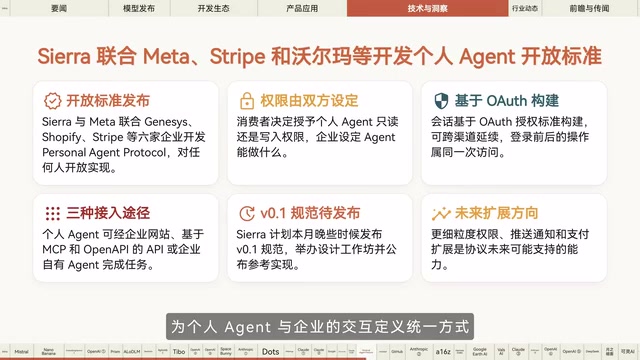
As agents scale up, underlying standards and infrastructure are becoming a new focal point. Sierra and Meta, alongside Shopify, Stripe, Walmart, and others, announced the development of Personal Agent Protocol, an open standard defining how personal agents interact with businesses: consumers decide what permissions to grant their personal agent, and businesses define what those agents can do. Version V0.1 of the spec is expected later this month. With multiple industry heavyweights jointly building this standard, the scenario of personal agents transacting on behalf of users with merchants is clearly drawing near.
GitHub announced it is rebuilding its Git infrastructure to support the load of developers and large numbers of AI agents reading and writing to repositories concurrently. The new architecture reportedly achieves up to 35x higher write throughput than before. As agents become high-frequency visitors to code repositories, infrastructure built for human-scale access can no longer keep up — this rebuild is a telling sign of what's coming.
What Problem Does Personal Agent Protocol Solve? Personal Agent Protocol addresses a fundamental question of identity and authorization: when an AI agent places an order on an e-commerce platform, checks a bank balance, or books a medical appointment on behalf of a user, businesses need a standardized way to verify that the agent has legitimate user authorization — and to define the boundaries of that authorization. Without a standard, every company builds its own interface, making agent-to-merchant interoperability extremely costly and leaving authorization ambiguities that create security vulnerabilities. The V0.1 spec's design places control on both sides — consumers declare what permissions they grant their agent, businesses declare what actions agents can trigger. This bidirectional declarative authorization model shares philosophical similarities with OAuth 2.0 but requires further extension for machine-to-machine interaction scenarios, particularly around identity proof and action granularity.
Capital and Geopolitics: Mega-Rounds and Defense Controversies

The funding news has been dense. Reports indicate OpenAI is in talks with multiple UAE investment funds to close a round of at least $30 billion, with funds including MGX potentially contributing up to $10 billion combined and BlackRock also in discussions — at a valuation of roughly $1.4 trillion. On the domestic front, Bloomberg reports DeepSeekAd is near closing a new funding round of at least 80 billion yuan, with Tencent and CATL among the lead investors, with a total potentially approaching 100 billion yuan, laying the groundwork for an IPO in early 2027. Kuaishou's video generation service Kling AI has also selected CICC, Goldman Sachs, and UBS to prepare for a Hong Kong listing, targeting a raise of at least $1 billion.
Controversy has also surfaced. BBC reporting confirmed the U.S. Department of Defense has ceased using all Anthropic products after designating the company a national security supply chain risk — yet sources revealed that Claude was still being used for intelligence analysis and military operations against Iran as recently as last week. The boundaries of AI's role in defense applications remain deeply contested.
Closing Thoughts
From flagship models to decision APIs, from embedding models to agent protocol standards, this wave of updates reveals a clear direction: model capabilities continue evolving toward multimodality and sparse activation, while the industry's center of gravity is rapidly shifting from "building more powerful models" to "making agents operate safely and reliably at scale." Whether it's GitHub rebuilding its infrastructure or the multi-party collaboration behind Personal Agent Protocol, the groundwork for a future dense with agent interactions is actively being laid.
Related articles

@ai-sdk/vue 3.0.306 Patch Release Syncs with [email protected] Update
@ai-sdk/vue 3.0.306 released, synced with [email protected]. A routine patch release for the Vercel AI SDK ecosystem with no public API changes; the Vue adapter layer stays version-aligned with the core package.

Gemini 4 Argon API Launches: The Era of Million-Token Output Begins
Google launches Gemini 4 Argon with sparse MoE architecture, up to 1M output tokens, and a 68.90% Vals Index score, available across API, AI Studio, and the Gemini app.

DukaanAI: Turning Product Photos into Inventory Lists with Open-Source AI
DukaanAI is an AI inventory tool for small retailers that turns product photos into inventory entries using the open-source Gemma 3 model, with local inference, editable fields, and CSV export.