AI Daily Briefing: Qwen3-Omni Full-Modality Model Launches, Huawei Ascend 960 and Grok's New Model Surface

Qwen3-Omni full-modality model, Huawei's million-processor architecture, and a critical N8N vulnerability headline today's AI briefing.
Today's AI briefing covers three main threads: model capabilities, domestic compute, and safety governance. Qwen launched Qwen3-Omni Flash, a native full-modality model with million-token context and 93%+ lower audio-video costs, while Mozilla reports the open-source/closed-source gap has narrowed to ~4 months. Huawei unveiled a million-processor AI computing architecture and is rumored to release the Ascend 960 chip. OpenAI embedded AI into legal workflows and Microsoft Word. Zhipu's InfraAgent scaled on 100K+ domestic accelerators in under two weeks. N8N disclosed a CVSS 10 vulnerability requiring urgent patching, while China published the world's first AI BCI medical device standard.
This edition of the AI Daily Briefing centers on three main threads: leaps in model capability, the deployment of domestic computing infrastructure, and safety governance. From Qwen's native full-modality model to Huawei's disclosure of a new computing architecture for the AI era, industry momentum remains intense. Here's a breakdown and analysis of the key developments.
Model Capabilities & Open-Source Ecosystem: The Gap Is Closing, Full-Modality Becomes the New Battleground
A 91-page Mozilla report offers a noteworthy finding: the gap between open-source models and frontier closed-source capabilities has narrowed to roughly four months. The data backs this up — Qwen has surpassed 942 million downloads on Hugging Face, and Chinese open-source models now account for more than 45% of traffic on OpenRouter. However, the report also highlights a commercial awkwardness: while open-source models perform at roughly 90% of closed-source capability, they capture only about 4% of total model revenue — a stark gap between capability and monetization.
The headline of this edition is Qwen's native full-modality model, Qwen3-Omni Flash. The model can simultaneously process text, images, audio, and video, and supports million-token context windows. Rather than simply stitching multiple modalities together, its focus is on enhancing an agent's ability to complete tasks — typical use cases include video editing, film/TV narration, and audio-video summarization. Official benchmarks show an average improvement of over 25% across 29 evaluations, and audio-video input costs have dropped by more than 93% — a reduction that carries significant implications for scaling full-modality applications.
Another advance in domestic large models comes from China Telecom. Its open-source Xingchen (StarLight) series adopts a MoE (Mixture of Experts) architecture, supports 256K context expandable to 512K, and was reportedly among the first large models trained entirely on Huawei Ascend 910C hardware. Training throughput improved approximately 96% over out-of-the-box performance. The model primarily targets agentic planning, tool calling, and complex reasoning — developments that echo the hardware initiatives covered later in this report, signaling an accelerating domestic software-hardware integration.
Meanwhile, Xiaomi's MiMo team is live-streaming the reinforcement learning training process for MiMo v2.6. The team lead says their core focus over the past six months has been exploring the scaling limits of reinforcement learning, currently processing roughly 2 billion tokens per step, while expanding compute, agent environments, and evaluation mechanisms in parallel. Making the training process public is also an experiment in research transparency.
A new version of Grok has apparently appeared on Google Cloud GCP quota pages, possibly in preparation for an upcoming release. Elon Musk previously stated its capabilities are roughly on par with top closed-source models, with respective strengths and weaknesses. Both Grok's web and mobile clients will also gradually roll out a voice mode.
What is MoE? MoE (Mixture of Experts) is one of the dominant architectural approaches for scaling large models in recent years. The core idea is to partition model parameters into multiple "expert" sub-networks. During each forward pass, a lightweight router dynamically selects a small subset of experts to activate, rather than engaging all parameters. This allows the model's total parameter count to scale very large (raising capability ceilings) while keeping actual per-inference compute to a fraction of the total (controlling inference cost). Notable models including GPT-4, Mixtral, and DeepSeek all use MoE or similar approaches. For the Xingchen series, the MoE architecture means it can handle ultra-long contexts of 256K to 512K tokens on domestic Ascend hardware at a reasonable compute overhead — a pragmatic choice that balances capability with efficiency.
AI Platforms & Applications: Accelerating Penetration into the Workplace
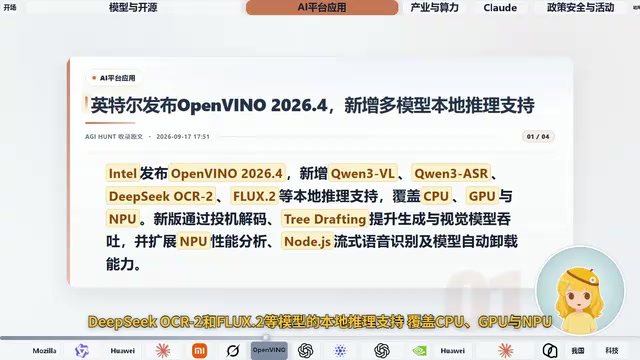
Activity on the application layer is equally intense. Intel released OpenVINO 2026.4, adding local inference support for models including Qwen VL, Qwen ASR, DeepSeek OCR2, and FLUX2, covering CPU, GPU, and NPU hardware. The new version improves generative and vision model throughput via speculative decoding and other techniques, while expanding NPU performance profiling, streaming speech recognition, and automatic model offloading — local inference is becoming a critical lever for edge AI.
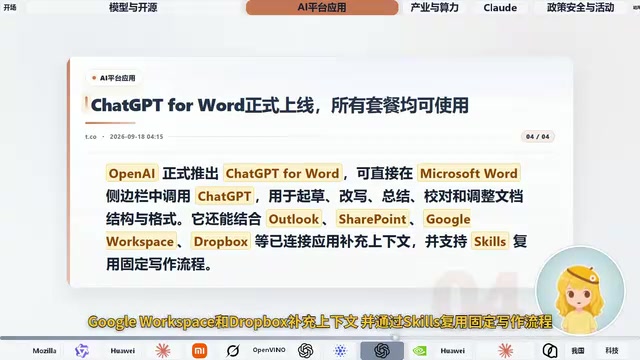
OpenAI has made back-to-back moves in vertical and productivity scenarios. First, it launched Astra for Law, a legal intelligence platform for attorneys and legal tech firms, offering legal analysis, document drafting, and deep research tools. Its legal search index covers U.S. case law, statutes, and regulatory rules, with a search corpus spanning over 230 million web links. Second, OpenAI officially launched ChatGPT for Word, available across all subscription tiers. Users can invoke ChatGPT from a sidebar within Microsoft Word to draft, rewrite, summarize, proofread, and reformat content, with the ability to pull context from connected services including Outlook, SharePoint, Google Workspace, and Dropbox. Embedding AI capabilities directly into mainstream productivity software is a pragmatic path to building stickier usage.
Notable on the domestic compute front: Zhipu disclosed that InfraAgent, powered by GLM, has participated in building production and inference services on a cluster of over 100,000 domestic AI accelerators. The time from first successful run to handling full production traffic was less than two weeks, with end-to-end throughput reaching 3.2× the baseline. This is being cited as a landmark case of AI self-improvement paired with large-scale domestic compute deployment.
Industry & Compute: Huawei Discloses New Architecture and Chip Roadmap
On the compute side, market reports indicate Huawei plans to release a new generation Ascend 960 AI chip this week, with the goal of displacing Nvidia hardware in the domestic market. However, this information originated from third-party accounts, and chip performance details and the exact release timeline remain unconfirmed by Huawei — treat with caution.
More concrete is Huawei's official release of a new computing architecture for the AI era, which plans to scale compute to millions of processors. The architecture uses nested parallelism, unified memory addressing, and peer-to-peer interconnect to enable large clusters to operate like a single massive computer. The core interconnect technology, Unified Bus, can uniformly connect CPUs, NPUs, memory, SSDs, NICs, and switches. System-level architectural innovations like this often determine large-scale training efficiency more decisively than the performance specs of any single chip.
A closer look at Huawei's architecture The "nested parallelism" and "peer-to-peer interconnect" referenced in Huawei's new architecture represent two critical dimensions of large-scale AI cluster design. Nested parallelism means stacking multiple parallel strategies simultaneously — data parallelism, tensor parallelism, and pipeline parallelism — across chip internals, within nodes, and between nodes, to maximize hardware utilization. Peer-to-peer interconnect means processing units across the cluster can directly access each other's memory and data without routing through a central switching node, dramatically reducing communication latency. Unified memory addressing further abstracts CPU, NPU, and storage resources into a single address space, simplifying the programming model. Together, these three elements form the engineering foundation for making the vision of "millions of processors running like one supercomputer" a reality — and represent Huawei's core approach to building autonomous large-scale training capability outside of Nvidia's NVLink/NVSwitch ecosystem.
Cloud & Developer Tools: R&D Pace Made Measurable
Anthropic has introduced a frontier AI development pace measurement framework, focused on tracking three key metrics: AI-led R&D, agentic supervision, and compute allocation. The system uses internal data to observe changes in model capability growth, R&D automation levels, and resource deployment. Quantifying the R&D pipeline reflects leading labs' emphasis on the flywheel of "AI accelerating AI development."

On the developer tools side, Claude Code has launched a Projects feature on both desktop and web, currently available to select Pro and Max users. Users can create projects from conversations, break work into multiple threads for management, with existing projects remaining usable and broader rollout planned. Anthropic also opened a life sciences verification program, allowing review teams to conduct limited biological research, and open-sourced 36 bioinformatics ML inference optimization tools on GitHub covering protein and genomics models.
Policy, Standards & Safety: BCI Standards and a Critical Vulnerability
On the standards front, China's National Medical Products Administration published the world's first AI brain-computer interface (BCI) medical device standard, slated for implementation on September 1, 2027. The standard covers EEG data acquisition, processing, annotation, storage, and access, establishing a unified baseline for data quality, aimed at improving algorithm training and treatment outcomes while strengthening patient safety. As the first standard of its kind globally, its precedent-setting significance is worth tracking closely.
On the security side, a serious warning: the automation platform N8N has disclosed a perfect-score (CVSS 10) security vulnerability, with a public PoC already circulating. Attackers can exploit Content-Type confusion to read sensitive files, forge administrator tokens, and achieve unauthenticated remote code execution. Affected versions should be upgraded immediately to 1.121.0 or 1.120.4 or above. Teams using related automation workflows must audit their systems without delay.
CVSS and PoC explained CVSS (Common Vulnerability Scoring System) is the industry-standard framework for rating the severity of security vulnerabilities, scored on a scale of 0 to 10. A CVSS score of 10 means the vulnerability can be exploited remotely without any authentication, with low attack complexity and extremely wide impact — the highest possible severity. Once a PoC (Proof of Concept) — working exploit code — is made public, even attackers with limited technical skill can repurpose ready-made scripts to launch attacks, drastically compressing the window before widespread exploitation. N8N, as a widely-used low-code platform for internal automation workflows, typically connects to enterprise databases, APIs, and sensitive services. If an attacker gains administrator access or achieves remote code execution, the potential for data breaches and lateral movement is severe. The urgency of this vulnerability should not be underestimated.
Closing Thoughts
This edition traces a clear arc across the industry: model capabilities are evolving toward full-modality and agentic paradigms; domestic software-hardware integration is accelerating; AI capabilities continue to embed into productivity and vertical applications; and standards and safety governance are keeping pace. As technology races forward, architectural innovation and security compliance remain equally non-negotiable foundations.
Related articles

Andrew Ng on Agentic AI: Cutting Through the Hype to Find Real Value in Agent Development
Andrew Ng's Agentic AI course intro: separating hype from real value, exploring agent workflows in customer service, research, law, and healthcare, and why evals and error analysis define expert-level agent development.

The Netflix Microservices Myth: An Architecture Migration Misunderstood by an Entire Industry
The real story behind Netflix's cloud migration and microservices transformation — and why the entire industry copied the solution while missing the actual problem.

Java 27 Deep Dive: How Default Changes Are Quietly Reshaping Production Environments
Java 27 has just 9 JEPs but changes key defaults: compact object headers on by default, G1 as unconditional default GC, Flight Recorder redaction, and built-in post-quantum TLS 1.3.