Claude Sonnet 6 Suspected Leak: Anthropic's Internal Model Acceleration Is Astonishing

Anthropic, OpenAI, Google, and Meta are racing to launch new models as the AI competition enters a new stage.
This article reviews key recent developments in the AI field: Anthropic is suspected of leaking Sonnet 6, and Meter reports that its R&D speed has increased 1.9 times, with AI contributing about 80% of the acceleration; OpenAI released GPT-6 Cyber designed specifically for cybersecurity, surpassing the flagship model on the Exploit Gym benchmark, while rumors of GPT-6.2 Astra's release are heating up; Google launched Gemini Omni 1.2 Flash, topping the text-to-video arena and supporting conversational editing and longer videos; Meta is internally testing stealth models such as Walrus and launched Muse real-time avatar technology. In addition, despite a market sell-off due to regulatory concerns, Google still announced a $17 billion data center investment, indicating that AI investment has not diminished. The article also lists tool updates such as Cursor and Devin and applications such as AI-assisted surgery, outlining an overall landscape of intensifying large model competition and prominent tension between safety and commerce.
Title
Claude Sonnet 6 Suspected Leak: Anthropic's Internal Model Acceleration Is Astonishing
Meta Description
Anthropic suspected leak of Sonnet 6; Meter reports its AI R&D accelerated 1.9x; OpenAI releases GPT-6 Cyber, GPT-6.2 Astra may be coming; Google Gemini Omni 1.2 Flash tops video generation leaderboard; Meta stealth models and real-time avatars unveiled; despite market volatility, Google still invests $17 billion in data centers.
Article Content
The pace of news in the AI field has never slowed. Recently, from rumors of an unreleased Anthropic model leak to OpenAI launching a specialized safety model, and new moves from Meta and Google, a series of events has sketched a new landscape of large model competition. This article sorts out the key developments and analyzes the trends behind them.
Anthropic: Sonnet 6 Leak and Accelerated Internal R&D
According to a tip from the YouTube channel AI NEWS, Anthropic may soon launch a new Sonnet model (tentatively called Sonnet 5.6 or Sonnet 6), which is not the previously rumored Fable 5.5. Tests show that this unreleased checkpoint performs outstandingly in code generation and visual understanding. For example, when asked to generate an SVG of a "pelican riding a bicycle," the model output 26,599 SVG elements, over 6,500 feather strokes, and more than 1,800 lines of Python code, entirely implemented in code without using external images. Compared with the base version Sonnet 5.5, the new model shows clear quality improvements in SVG and 3D output.
Even more striking is the report from independent evaluation organization Meter. Meter estimates that Anthropic's AI R&D speed is about 1.9 times faster than before, with AI possibly contributing about 80% of the acceleration. The report also mentions that Anthropic developed three undisclosed models (Model 2, Model 3, Model 4) between July and October, with the latest Model 4 scoring above 50% on all 15 benchmarks of the Anthropic Capability Index. On the capability index, Model 4 scores 178.6, while the public Opus 5.6 is about 174-175. Although the gap seems small, historically an improvement of 5 points roughly corresponds to a doubling of the duration of tasks AI can complete autonomously.
Anthropic co-founder Sam McCandlish responded that many of Meter's conclusions are consistent with his internal observations, but Anthropic redacted a large amount of evidence in the evaluation, citing the reason of avoiding leaking key factors of accelerated R&D to competitors. This may also explain why the release pace of new models has slowed.
AI Capability Index and Autonomous Task Duration: The "capability index" mentioned in the article is a scoring system that integrates multiple benchmarks (such as code, reasoning, vision, etc.) for horizontal comparison of model capabilities. Historically, every increase of about 5 points on this index corresponds to a doubling of the duration of tasks AI can complete autonomously—this stems from research by institutions such as METR (Model Evaluation & Threat Research): they track capability progress by measuring how long AI can continuously complete tasks without human intervention (measured in human completion time). Therefore, Anthropic's Model 4 being about 4 points higher than Opus 5.6, though seemingly small, may mean that the time span for AI to autonomously execute complex tasks is significantly extended, which is crucial for evaluating the practical utility and risks of models.
OpenAI: GPT-6 Cyber Released, GPT-6.2 Astra Poised to Launch
OpenAI officially launched GPT-6 Cyber, a model designed specifically for advanced cybersecurity research. OpenAI claims that the model has significant improvements in both cybersecurity capabilities and model alignment, and has been used in Linux kernel security research to help identify complex vulnerabilities. Security teams such as Mozilla and Palo Alto Networks are already using it. Currently, GPT-6 Cyber is available to select customers through the Daybreak Red program and is not yet publicly available.
On the Exploit Gym cybersecurity benchmark, GPT-6 Cyber scores 48.5%, surpassing the flagship GPT-6 Astra's 42.4%. Meanwhile, rumors of the release of GPT-6.2 Astra are heating up. Some users discovered GPT-6.2 Astra with "extra high reasoning" in the Codex model catalog, and OpenAI product lead Tibo responded, "The basement is full of miracles," sparking speculation. According to The Information, OpenAI may release the Astra and Sol series as early as Friday.
Exploit Gym Benchmark: This is a testing platform specifically designed to evaluate the cybersecurity attack and defense capabilities of AI models, simulating real vulnerability exploitation scenarios and requiring models to identify, exploit, or fix system flaws. The higher the score, the stronger the model's ability to discover and exploit security vulnerabilities. GPT-6 Cyber scores 48.5% on this benchmark, exceeding the general flagship GPT-6 Astra's 42.4%, indicating that specialized security models have clear advantages in specific domains. Such benchmarks are crucial for measuring the dual-use (defense and attack) risks of AI in cybersecurity, and are also the context for OpenAI's emphasis on improved "model alignment."
Google: Gemini Omni 1.2 Flash Tops Video Generation Leaderboard
Google officially launched Gemini Omni 1.2 Flash, available to all Google AI subscribers in the Gemini app. The model ranks first on the text-to-video arena benchmark, surpassing the previous generation Gemini Omni 1.1 Flash as well as models such as C-Dense 2.0, C-Dense 2.5, and Flux 3 Video.
New features include: editing videos through conversation (such as changing backgrounds, objects, adjusting lighting) while maintaining scene consistency; Ultra subscribers can generate and edit videos up to 15 seconds long, with duration selectable between 3-15 seconds; improved multi-speaker lip sync and camera movement. For developers, video generation costs are reduced by about 30%, and draft generation (360p or 720p) costs only 7 cents per second. In addition, Gemini Omni Pro supporting 4K video generation has been discovered internally.

Meta: Stealth Models and Real-Time Avatars
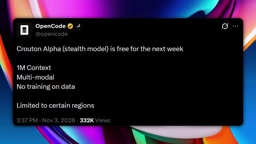
Meta is internally testing a new model codenamed "Walrus," whose output quality is noticeably better than current consumer-grade models. Crouton Alpha, previously stealth-tested on OpenCode, has a 1 million token context window, supports multimodality, and is comparable in speed to GPT-6.1 Terra, though there is still a gap in quality. Another stealth model, Pulse Alpha, outperforms Crouton Alpha in visual and web development output and may be a larger-scale model. These tests indicate that Meta is accelerating its catch-up.
Meta also launched Muse real-time avatar technology, which can transform almost any image into a real-time talking character, supporting animals, cartoon characters, and even everyday objects, allowing users to converse with them in real time. Meta's internal evaluation says users prefer this feature, but actual testing is needed to verify.
Stealth Model Testing: In the AI industry, "stealth models" refer to models that have not been publicly announced and are tested on a small scale through anonymous channels (such as the OpenCode platform), usually to collect real user feedback without revealing the vendor's identity. This practice allows companies to evaluate model performance and adjust strategies before official release, while avoiding premature competitive reactions. Meta's Crouton Alpha and Pulse Alpha fall into this category; their 1 million token context window means the model can process extremely long texts at once (roughly equivalent to 750,000 Chinese characters), and multimodal support indicates it can simultaneously understand inputs such as text and images.
Market Volatility and AI Investment Increasing Rather Than Decreasing
After the U.S. midterm elections, market concerns about AI regulation triggered a sell-off. According to circulating data, AI-related stocks evaporated $3.5 billion from their peak, Nvidia fell about 11%, and Alphabet, Broadcom, Micron, and others also dropped sharply. The Texas governor-elect called for a pause on new data center construction until regulation is clear; Texas accounts for about a quarter of planned data center development in the United States.
However, Google announced a $17 billion investment in Wyoming to build data centers, indicating that tech giants have not slowed down AI investment. Despite the plunge in individual stocks, the S&P 500 pulled back about 3%, and the so-called "AI bubble burst" may be an exaggeration.
Other Notable Developments
- Cursor launched a new feature that allows users to build and deploy real-time applications directly within the IDE, share via links, and automatically handle code generation, database setup, and security checks.
- Devin released Review 2.0, reducing AI code review costs by up to 5 times and increasing speed by 1.5 times.
- Thinking Machines released Inkling 2 Small, scoring 31 on the Artificial Analysis Intelligence Index, and can be fine-tuned through the Tinker platform.
- Antling released Ling 3.2 Flash, adopting a mixture-of-experts architecture with 560 billion total parameters and 25 billion activated, performing well in multimodality and 3D reasoning.
- Agent Desktop: A free tool that allows multiple AI agents to operate computers in parallel in the background without disturbing the user's work.
- AI-assisted mouse brain surgery: Researchers had GPT-6.1-SOL perform three mouse brain surgeries, with the model performing in-context learning through expert corrections. In the third surgery, the time to locate landmarks dropped from 169 seconds to 86 seconds, corrective actions decreased from 4 to 2, and positioning error was halved from 0.6 mm to 0.3 mm.

From Anthropic's internal acceleration to OpenAI's specialized safety model, and to Google's video generation breakthrough, the AI race is entering a new stage. The tension between model release pace, safety considerations, and commercial competition is becoming more apparent, while infrastructure investment shows that this race is far from over.
One-line Summary
Anthropic, OpenAI, Google, and Meta are racing to launch new models as the AI competition enters a new stage.
Paragraph Summary
This article reviews key recent developments in the AI field: Anthropic is suspected of leaking Sonnet 6, and Meter reports that its R&D speed has increased 1.9 times, with AI contributing about 80% of the acceleration; OpenAI released GPT-6 Cyber designed specifically for cybersecurity, surpassing the flagship model on the Exploit Gym benchmark, while rumors of GPT-6.2 Astra's release are heating up; Google launched Gemini Omni 1.2 Flash, topping the text-to-video arena and supporting conversational editing and longer videos; Meta is internally testing stealth models such as Walrus and launched Muse real-time avatar technology. In addition, despite a market sell-off due to regulatory concerns, Google still announced a $17 billion data center investment, indicating that AI investment has not diminished. The article also lists tool updates such as Cursor and Devin and applications such as AI-assisted surgery, outlining an overall landscape of intensifying large model competition and prominent tension between safety and commerce.
Related articles
 Tech Frontiers
Gemini Omni 1.2 Flash: AI Video Moves Toward Draft-Style Editing
Google's Gemini Omni 1.2 Flash update enables conversational, draft-style editing of the same video—swap scenes while keeping products, adjust lighting while keeping characters. Clips up to 15s, 720p costs 30% less than the previous Flash—ideal for e-commerce ads, previs, and short-asset production.

Codex Tutorial: One-Command Install and Run Your First Task
Codex tutorial: one-command install and run your first task. Covers the four Codex forms, sandbox and approval guardrails, AGENTS.md and MCP configs, cloud network policy, and the iron rule of human review—everything you need to get started with this autonomous coding agent.
 Tech Frontiers
Localix: An Open-Source Agentic Development Environment with Multi-Model and Local AI Integration
Localix is an MIT open-source Agentic Development Environment (ADE) supporting seamless Claude Code plugin loading, multi-model cloud and local execution, Mini Apps extensions, and agent context management—an open AI collaboration workbench for developers.