AI Daily: Claude Independently Proves VP≠VNP, OpenAI Follows Within Three Hours

AI stocks slump on valuation rethink while Zhipu, Anthropic, and OpenAI drop major model releases in one day.
November 25 showed a sharply split AI industry: capital markets sold off, with the CS AI Index down 3.98%, Nvidia surging 31.48% on reinstatement then giving back 5.8%, and storage showing HBM4 price hikes alongside CSP order cuts. On the model side, Zhipu released 750B-parameter GLM5.4, Claude proved VP≠VNP in a single-author paper with 73,000 lines of Lean4, OpenAI followed 3h47m later, and Sand.ai launched Majite 2. The market is pricing AI's cash flow, not AI itself.
How split can a single day in the AI industry be? The capital markets voted with their feet, while the model side kept churning out hard goods like dumplings. The November 25 AI Daily happens to put both storylines on the table at once.
Capital Markets: The AI Bill Is Being Recalculated
The A-share AI chain lay flat across the board today. The CS Artificial Intelligence Index closed at 4220.6, down 3.98%, with 48 of its 50 constituents falling; across the whole market, 586 stocks rose and 4926 fell. The ChiNext Index dropped 4.19%, and the STAR Composite fell 5.93%. The money's move was blunt—recalculating the AI bill.
Overseas wasn't much better. The Nasdaq fell 1.48%, the Philadelphia Semiconductor Index dropped 7.88%, and Micron plunged 11% outright. One trigger was BlackRock and IFM considering lowering their acquisition offers for Asia-Pacific data center assets, sending Asia-Pacific AI stocks diving.
Nvidia's plot over the past two days turned faster than a page: on November 23, Jensen Huang returned to his post, shares jumped 31.48% in a day, and market cap gained $952 billion; the very next day it gave back 5.8%, wiping out another $233.5 billion. The reinstatement solved the CEO governance problem, but export controls haven't budged an inch—House questioning on December 1, Senate hearing on December 3, both on export controls. Whether $155 can hold is genuinely uncertain.
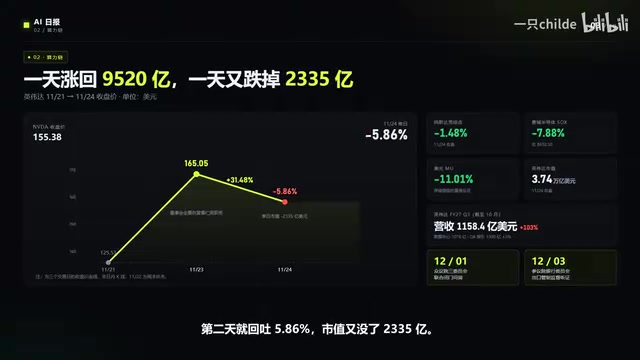
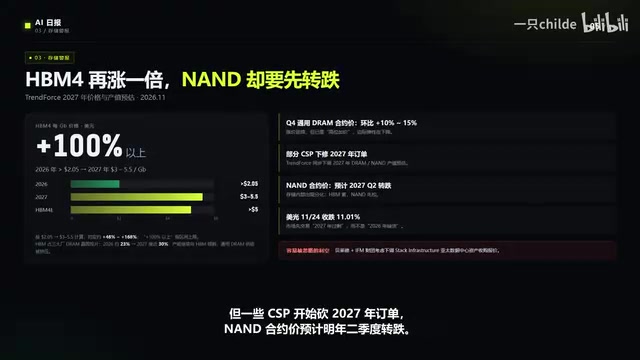
Fundamentals are actually fine. Fiscal 2027 Q3 revenue was $115.84 billion, doubling year over year. But the market isn't looking at earnings now—it's looking at valuation and sentiment. Storage is even more interesting: prices rising while orders get cut. HBM4 is set to rise to as much as $5.5 per GB, more than double, yet some CSPs are starting to cut 2027 orders; NAND contract prices are expected to turn down in Q2 next year. So Micron's 11% drop isn't unfair.
Model Side: Zhipu and Anthropic Drop News the Same Day
Zhipu released GLM5.4, a 750-billion-parameter base model that officially benchmarks against models with 2 to 3 trillion parameters. Context is 1 million, generation speed up to 200 tokens per second, while the chain of thought is actually 10% to 14% shorter. Fewer parameters, more thinking rounds—this path is intriguing.
Anthropic went harder. A 70-page paper with a single author: Claude. It independently proved VP≠VNP, backed by 73,000 lines of Lean4 code, all machine-verified. But hold the hype—no human mathematician has yet reviewed the theorem statement.

Three hours and 47 minutes later, OpenAI also published a similar proof. This problem has been stuck for 47 years; two AIs cracked it in under 4 hours.
OpenAI also released a GPT-6 protein design preprint: 322 designs, 35 binders with a 10.9% hit rate; 5 white matter design preprints, 8 for 8 positive; MotiveBench 43.7%, above EarthDiffusion's 27.8%, but the experimental hit rate is still below EarthDiffusion's originally reported 19%. General models can do specialized models' work, but haven't fully caught up.
Lean4 is a functional programming language and also an interactive theorem prover, led by Leonardo de Moura at Microsoft Research as the successor to Lean3. Its core purpose is to let mathematicians and computer scientists write mathematical definitions, theorems, and proofs in strict code form, which the compiler then machine-verifies line by line—as long as the code passes type checking, the proof is judged logically valid. So when reports say "73,000 lines of Lean4 code, all machine-verified," it doesn't mean the proof's mathematical value has been recognized by academia; it means the code is internally consistent within the formal system, free of syntax and logic errors. In recent years, Lean4 has become important infrastructure for evaluating AI mathematical capability thanks to its performance in math formalization (such as parts of the Fermat's Last Theorem project and the Liquid Tensor Experiment); many "AI proves math problem" results use whether Lean4 code compiles as a hard metric.
VP≠VNP is one of the most famous unsolved problems in computational complexity theory, closely related to P≠NP. VP roughly corresponds to the set of "easily computable functions" (like P), while VNP corresponds to the set of "easily verifiable solutions" (like NP). The conjecture was proposed around 1979 by Leslie Valiant, and its core assertion is that these two polynomial families are unequal—that some functions' results, though easy to verify, cannot be efficiently computed. It is regarded as the most important open problem in algebraic complexity theory, an analogue of P≠NP under algebraic computation models. The report's mention that "this problem has been stuck for 47 years" refers precisely to nearly half a century without a recognized proof since it was posed. If the proof holds, it would directly shake the theoretical foundations of cryptography, combinatorial optimization, and other fields—so the claim of "AI independently proving" it must undergo strict peer review by human mathematicians before academia accepts it.
HBM4, the fourth-generation High Bandwidth Memory, is a standard set by JEDEC that stacks multiple layers of DRAM chips vertically and packages them with the GPU to deliver bandwidth far beyond traditional VRAM. It mainly serves AI training and inference accelerators, and GPU makers like Nvidia and AMD depend on its supply. The report's "up to $5.5 per GB, more than double" reflects HBM capacity tightness amid exploding AI demand and bargaining power tilting toward memory makers. CSP stands for Cloud Service Provider—Amazon AWS, Microsoft Azure, Google Cloud, and the like—the super-large customers for HBM and data center storage. "CSPs cutting 2027 orders" means downstream expectations for long-term demand are turning cautious, forming a classic cyclical signal of "prices rising while orders get cut" alongside spot price increases, which also explains why memory stocks like Micron are under pressure.
Products and Quick News
Sand.ai released Majite 2, a 480-billion-parameter video generation model ranked second globally on the leaderboard. 1080p at 0.5 yuan per second, supporting 50-millisecond-level shot control, 20,000-character prompts, and 20 reference materials. AI video took a step from gacha-style generation toward storyboard production.
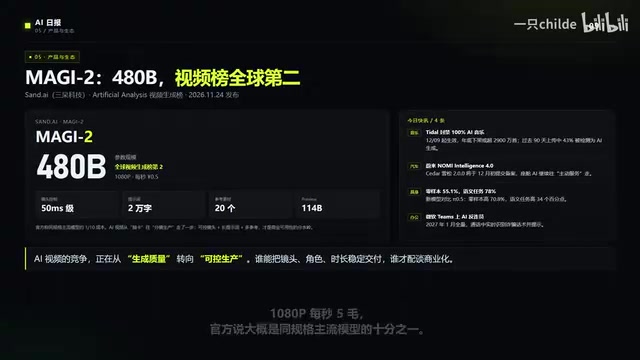
A few quick items: starting December 9, 100% AI music will be banned, with potentially over 29 million tracks taken down by year-end; future Nomi 4.0 and Cedar 2.0.0 filings due in December; Jushen Intelligence's new model hits 55.1% zero-shot; Microsoft Teams will launch AI anti-fraud in January 2027.
Finally, remember three dates: December 1, December 3, December 9. AI gained nearly a trillion dollars in a day, then lost $233.5 billion in a day—the market isn't pricing AI; it's pricing AI's cash flow.
Related articles

Bin's Live Stream Highlights: Hilarious Interactions from "You Came at the Right Time" to "I'll Support You From Now On"
Bin's hilarious live stream highlights: from "You came at the right time" to "I'll support you from now on," featuring Championship skins, wigs, and other game memes that showcase Bilibili's unique streaming culture.

Hunter Rescues Educated Youth: The Mountain-Chasing System Launches a New Warm-Hearted Viral Drama Formula
Bilibili's early-access period short drama *Everyone Thinks I'm a Poor Hunter* opens with a snowy-night rescue of an educated youth. Hunter Chen Shan activates the mountain-chasing system, using realistic hypothermia first-aid details and mutual-probing character dynamics to deliver a warm-hearted period drama without the sleaze.

Riemann Hypothesis Proven by AI? The Truth Has Nothing to Do With Your Reality
34-year-old mathematician Levent Alpöge claims to have proven the Riemann Hypothesis and Generalized Riemann Hypothesis with Claude, releasing 17 million lines of formal verification code. This article sorts out the facts, debunks myths about RSA collapse and new material revolutions, and analyzes the true significance of mathematics-AI collaboration.