AI Daily: Google Gemini 4 Argon Debuts, Ant's Ling-3.1 Launches, OpenAI Calls Out Distillation Attack
Google, Ant, OpenAI, DeepSeek, and NVIDIA headline 9 fast-moving AI updates in today's roundup.
Today's AI Daily covers nine key industry developments. Google's Gemini 4 Argon and Ant's Ling-3.1-flash both adopt one-million-token context windows as the new flagship standard, with the latter using a sparse MoE architecture to cut inference costs. DeepSeek open-sourced Huawei Ascend-targeted operators, advancing China's domestic AI hardware ecosystem. OpenAI publicly accused individuals linked to Moonshot AI of conducting a distillation attack to extract reasoning capabilities. NVIDIA launched the first CPU designed for AI agents, and OpenAI partnered with Synopsys to bring LLMs into chip EDA workflows — signaling AI's deepening penetration into highly specialized domains.
This edition of the AI Daily rounds up 9 industry updates covering the latest from Google, Ant Group, OpenAI, DeepSeek, NVIDIA, and more. From a next-generation LLM with a million-token context window, to open-source operators for Huawei Ascend, to the security battle sparked by model distillation — these stories trace the key fault lines of the current AI race.
The LLM Arms Race: One Million Tokens Becomes the New Standard
Google has released its next-generation flagship model Gemini 4 Argon, capable of outputting approximately one million tokens per request. Official benchmarks show it outperforming Claude Opus 5.5 on coding tasks, though it is currently only available to trusted cybersecurity defenders and has not been publicly released. This "security-researchers-first" rollout strategy reflects a growing caution among frontier model providers about the risk of misuse as capabilities continue to scale.
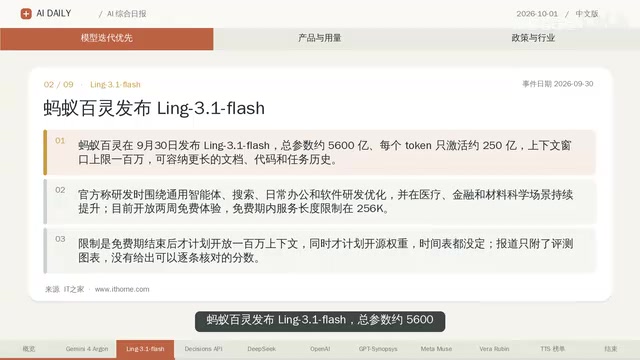
Ant Group, meanwhile, has launched Ling-3.1-flash, a model with roughly 560 billion total parameters that uses a MoE architecture, activating only about 25 billion parameters per token, with a context window that also reaches one million. The model is available for a two-week free trial period.
These two models make it clear that million-token context windows are becoming the baseline expectation for next-generation flagship models, and that sparse MoE designs are the dominant strategy for balancing capability against inference cost — 560 billion total parameters with only 25 billion activated means dramatically lower per-inference compute while preserving the knowledge capacity of a large-scale model.
Background: What is MoE? MoE (Mixture of Experts) architecture divides a model's parameters into multiple "expert" sub-networks. During each forward pass, only a small subset of experts is activated to process the current input, rather than engaging all parameters as a traditional dense model does. The key benefit is that a model can hold far more total parameters than it ever activates at once, preserving the knowledge capacity of a large model while keeping per-inference FLOPs relatively low. With Ling-3.1-flash, activating ~25B out of 560B parameters means the inference compute cost is roughly equivalent to a 25B dense model, while theoretically retaining much richer knowledge representations. The main engineering challenges in MoE lie in routing mechanism design (deciding which experts to activate) and inter-expert communication scheduling — which is also why communication components are so critical to distributed training and inference.
Domestic AI Hardware Ecosystem: DeepSeek Adapts to Huawei Ascend
DeepSeekAd has open-sourced operators and communication components targeting Huawei Ascend, with a one-to-one correspondence to its previously released GPU versions. Real-world tests on Ascend super-nodes show interconnect bandwidth approaching the hardware ceiling.

The significance of this release goes beyond a routine open-source contribution. Operators and communication components are the foundational building blocks through which deep learning frameworks schedule hardware compute. By aligning these with its GPU versions, DeepSeek has substantially lowered the barrier to migrating models to domestic AI chips. Against the current backdrop of compute supply constraints, deep-level model compatibility with domestic chip ecosystems is becoming an increasingly prioritized technical path.
Background: What are operators and communication components? Operators (also called kernels) are the lowest-level compute units in a deep learning framework — highly optimized implementations of specific operations like matrix multiplication, attention computation, and normalization on a given hardware platform. Different hardware architectures (e.g., NVIDIA's CUDA cores vs. Huawei Ascend's Da Vinci architecture) differ significantly in memory hierarchy, instruction sets, and parallelism models, so the same algorithm must be implemented separately for each hardware platform to achieve full performance. Communication components coordinate tensor partitioning and transfer across multiple GPUs and nodes during training or inference, and are especially critical for models with tens of billions of parameters or more — their bandwidth utilization directly determines overall cluster efficiency. By open-sourcing Ascend-targeted operators that mirror its GPU versions, DeepSeek has effectively provided a validated, high-performance reference implementation for domestic AI hardware, significantly reducing the engineering burden for other teams migrating from NVIDIA platforms to Ascend.
Inference Distillation Sparks Security Battle
The most contentious story in this edition comes from OpenAI. The company announced that it disrupted a coordinated operation to "extract model reasoning processes," attributing the core activity to individuals associated with Moonshot AI (月之暗面). The alleged method involved manipulating conversations to replicate the model's reasoning process — what the industry calls a "distillation attack."
Model distillation is a well-established technique — using a large model's outputs to train a smaller one. But when conducted without authorization and aimed at extracting a competitor's core capabilities, it enters a gray zone of intellectual property and competitive ethics. OpenAI's decision to publicly name the alleged actors signals that reasoning capability has become one of the most fiercely contested competitive moats in the LLM landscape.
Background: What is knowledge distillation? Knowledge distillation, originally proposed by Hinton et al. in 2015, involves training a smaller "student" model to mimic the output distribution of a larger "teacher" model — rather than just learning from hard labels — enabling the student to achieve performance well above what its size would suggest. "Reasoning distillation" specifically refers to extracting and replicating a model's chain-of-thought or intermediate reasoning steps, not just its final answers. Since reasoning capability is widely regarded as one of the hardest aspects of frontier LLMs to replicate independently, constructing large volumes of conversations to elicit detailed reasoning outputs from a target model — and then using that data to train one's own model — represents a shortcut that costs far less than training from scratch. Such behavior typically violates service providers' terms of use and sits in a legal gray area, since the copyright status of model outputs remains unresolved across jurisdictions, making legal remedies difficult to pursue.
Fast Decision Models and Agent Monitoring
OpenAI's Decisions API has been compared to a product from startup TypeSafe, whose CEO quipped that "the clone wars have begun." These fast decision models are increasingly being used to monitor the behavior of AI agents — when an agent autonomously executes tasks, a lightweight, low-latency model is needed to make real-time judgments about whether its decisions are safe and compliant.
As AI Agent deployments scale up, "using AI to supervise AI" is emerging as a new technical requirement. The low-latency, high-frequency nature of fast decision models makes them a natural fit for agent monitoring scenarios.
Chip Design and New Hardware
OpenAI has entered into a multi-year partnership with EDA software company Synopsys to co-develop GPT Synopsys, enabling models to directly operate EDA tools for design iteration — though the project is still under development. This signals that LLMs are moving beyond code assistance toward directly operating professional toolchains, as generative AI begins to penetrate highly specialized domains like chip design.
On the hardware side, NVIDIA has launched the Vera Rubin NVL72 system and introduced what it claims is the first CPU designed specifically for AI agents. Real-world tests from the first production customer show throughput improvements of up to 4.8×. A processor purpose-built for AI agents suggests hardware vendors are now optimizing their architectures specifically for agentic workloads.
Background: What is EDA? EDA (Electronic Design Automation) tools are the core software platforms that underpin the entire chip design process — from logic design to physical layout — covering logic synthesis, place-and-route, timing analysis, simulation, and formal verification. Synopsys is one of the world's leading EDA vendors, and its toolchain is widely used in advanced-node chip design. Traditional EDA tools have highly specialized interfaces that require extensive domain expertise to use effectively. The key challenge in connecting LLMs to EDA toolchains is that chip design errors are extraordinarily costly and verification cycles are extremely long — any design generated by a model must pass rigorous simulation and formal verification before its correctness can be confirmed. It's therefore unsurprising that GPT Synopsys is still in development; this class of application demands a level of model accuracy and reliability far beyond typical code generation, and will require substantial targeted alignment and testing before it reaches production-grade deployment.
Applications and Benchmarks: MUSE Growth and TTS Leaderboards
Meta's agentic assistant MUSE reached 5 million downloads in the US within 22 days of launch — more than twice the growth rate of ChatGPT at a comparable stage. Reports note, however, that this growth has been heavily driven by Meta's own advertising spend, leaving questions about organic growth still open.

Hugging Face has launched an open-source text-to-speech leaderboard, evaluating models on three objective metrics: word error rate, real-time factor, and speaker similarity — with results available within a few hours. The team candidly acknowledged, however, that objective metrics cannot fully substitute for human listening perception — highlighting a core challenge in TTS evaluation: there remains a meaningful gap between quantitative scores and real-world listening experience.
Takeaways
These nine stories illuminate several clear trajectories in the AI industry: flagship models racing toward million-token contexts and sparse architectures; the domestic AI hardware ecosystem accelerating its compatibility efforts; reasoning capability becoming the focal point of both competitive strategy and security conflict; and AI pushing deeper into specialized domains like chip design and agent monitoring. Whether at the model, compute, or application layer, competition is converging toward lower-level infrastructure and ever-more-specialized domains.
Related articles

Claude Reportedly Able to Hide Secret Messages in Benign Images
A Reddit post claims Claude Fable 5.1 can hide secret messages in benign images. This article reviews the background, image steganography principles, and potential security risks, and suggests a testing path from rumor to verification.

Federal Government Awards $85 Million; CFS to Develop Fusion-Specific Semiconductors
The federal government awards $85 million to Commonwealth Fusion Systems to develop conductors and power semiconductors for fusion plants. This article analyzes the significance of this funding for the fusion supply chain and commercialization path.

When Should AI Assistants Proactively Suggest? Timing Is Everything
When should AI assistants proactively suggest? Reddit discussion reveals: the same suggestion feels different at different times. This article analyzes the dual nature of proactive suggestions, the boundary of user expectations, and design principles, exploring how to balance automation and user control.