AI Daily: Google Gemini 4 Leads Benchmarks, Micron Q4 Revenue Tops $54.2B
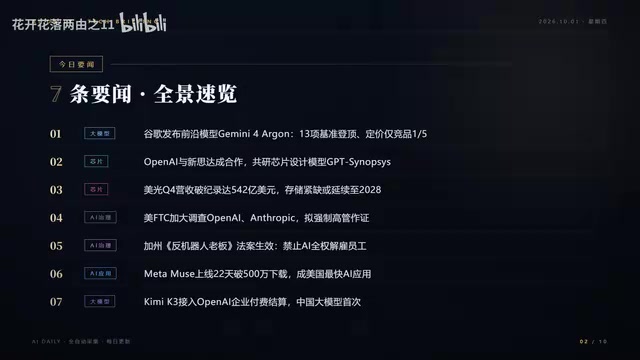
Google Gemini 4 reclaims benchmark lead, Micron sets memory revenue record, regulatory actions and Chinese LLM globalization advance.
In the past 24 hours, AI developments spanned multiple fronts: Google's Gemini 4 topped 13 of 18 benchmarks with aggressive 1%-of-competitor promotional pricing; OpenAI partnered with Synopsys on chip design model GPT Synapses while Micron posted 379% YoY revenue growth with supply tightness forecast through 2028; the FTC escalated AI lab investigations to subpoena-level demands and California banned AI-only employee terminations; Metamuse hit 5M downloads in three weeks; and Kimi K3 became the first Chinese open-source model to enter OpenAI's enterprise procurement ecosystem.
Over the past 24 hours, the AI industry saw major developments across large models, chips, and regulatory governance. Google released the frontier model Gemini 4, Micron posted record single-quarter revenue, and memory shortages may persist for years to come. Here's a roundup and analysis of today's top stories.
Google Gemini 4 Reclaims the Frontier — With an Aggressive Pricing Strategy
Google has released its next-generation frontier model, Gemini 4, which tops 13 out of 18 benchmark tests and raises the output ceiling to the million-token level. According to sources reported by Wall Street Insights, the model is initially available only to cybersecurity partners and is not yet open to the public.
The most notable aspect is its pricing strategy — during the promotional period, it's priced at just 1% of competing products, with prices set to more than double once the promotion ends. This "low price to capture the market, then adjust upward" approach is designed to rapidly win over developers in the short term. For Google, Gemini 4 reclaiming the top benchmark spot represents a critical step in catching up to — or even surpassing — rivals in the model race.
That said, whether the combination of million-token context windows and ultra-low pricing is sustainable long-term depends on underlying compute costs and the pace of monetization — factors that already foreshadow a future price correction.
Chips: OpenAI Partners with Synopsys, Micron Posts Record Results
OpenAI has partnered with Synopsys to co-develop a chip design model called GPT Synapses. Designed specifically for chip design tasks, it's positioned as a "tool-native expert" capable of autonomously optimizing PPA (Performance, Power, Area) and timing. Following the announcement, Synopsys shares surged more than 7% intraday before closing up 4.78%, reflecting strong market enthusiasm.

The convergence of AI and EDA (Electronic Design Automation) is emerging as a new frontier for accelerating chip design. Bringing large models into the chip design workflow means AI is no longer just a consumer of compute — it's beginning to feed back into the development of the underlying hardware itself.
The memory market is equally red-hot. Micron's Q4 revenue reached $54.2 billion, surging 379% year-over-year to an all-time high, with summer guidance beating expectations. While gross margins dipped slightly and price increases are moderating, Micron's CEO made clear that supply-demand tightness in memory will be significantly more acute in 2027 and 2028 than in 2026. This suggests the AI-driven memory demand boom could last for years, representing a long-term tailwind for the entire supply chain.
Background: EDA (Electronic Design Automation) is the core toolchain that takes chips from design blueprints to tape-out and mass production, encompassing complex processes like logic synthesis, place-and-route, and timing analysis. Synopsys is one of the two dominant players in the global EDA market, with its tools used across virtually every major chip's full design flow. PPA (Performance, Power, Area) is the core optimization triangle in chip design — the three dimensions constrain each other, as boosting performance often means higher power consumption or a larger die area, requiring engineers to find the optimal balance. Traditional EDA flows are highly dependent on human expertise and iterative refinement; designing a complex SoC can take years. Introducing large models into this workflow aims to let AI automatically explore the parameter space and accelerate design convergence, compressing development cycles and reducing labor costs. GPT Synapses is positioned as a "tool-native expert," meaning it's not a general-purpose conversational model but rather a vertically optimized model deeply integrated into the EDA toolchain and fine-tuned specifically for chip design tasks.
AI Governance on Two Tracks: FTC Intensifies Probe, California Protects Workers
Regulatory activity is picking up pace. The U.S. FTC is stepping up its investigation into frontier AI labs including OpenAI and Anthropic, drafting investigative demands with subpoena-like authority that are set to be formally issued. According to sources cited by Wall Street Insights, insiders say the investigation will not hinder U.S. AI leadership — a statement that attempts to balance regulatory action with industrial competitiveness.

On the legislative side, California's "anti-robot boss" law has taken effect, prohibiting AI from having sole authority over employee terminations. According to IT之家, employers may not rely exclusively on automated AI decision-making to fire or discipline workers — human oversight and verification are required, and companies must disclose the use of automated systems. Human involvement has become a hard floor for AI-driven employment decisions.
These two parallel tracks — investigation and legislation — reflect a broader shift in the U.S. from debating whether to regulate AI to figuring out how to do so, drawing boundaries between fostering innovation and managing risk.
Background: The FTC is deploying civil investigative demands (CIDs) in this investigation — a legally binding tool that compels the investigated party to submit documents and data by law, with potential legal liability for non-compliance. This is far more powerful than voluntary information disclosure requests. The FTC had previously conducted multiple rounds of informal inquiries with AI companies; this escalation to a quasi-judicial process marks a substantive shift in the regulatory posture. California's AB 1221 (the "anti-robot boss" bill) approaches the issue from a labor rights angle: its core logic is that AI systems may harbor biases or make errors, and consequential personnel decisions should not lack human accountability. This aligns closely with the EU AI Act's framework requiring human oversight for "high-risk AI," reflecting a growing global regulatory consensus around the principle of human fallback responsibility.
AI App Boom: Metamuse Sets New Record for Fastest Growth
Competition in the AI personal assistant space is heating up. Metamuse surpassed 5 million downloads roughly three weeks after launch, topping the U.S. App Store free charts and becoming the fastest-growing AI app in the United States. According to SensorTower data, it dominated the charts within 12 days of launch — outpacing ChatGPT's performance during its comparable early window.

This achievement demonstrates that there is still enormous untapped user demand for AI personal assistant products, and that new entrants with the right product experience and viral momentum can absolutely achieve breakout, phenomenon-level growth in a short period of time.
Chinese LLMs Go Global: Kimi K3 Enters OpenAI's Procurement Ecosystem
A landmark moment for Chinese large models: Kimi K3 has been integrated into OpenAI's enterprise billing system, making it the first Chinese open-source model to enter OpenAI's procurement ecosystem. Through a partnership with Base10, enterprise users can access both Kimi K3 and GLM5.3 via the Codex Responses API.
In terms of scale, Kimi K3 boasts 2.8 trillion parameters and a 1 million-token context window — a formidable technical specification. A Chinese open-source model entering OpenAI's procurement ecosystem for the first time is not just a technical validation; it marks a new chapter in the global expansion of Chinese large models.
Background: The 2.8 trillion parameter figure warrants some context: GPT-4's parameter count is estimated by the industry to be in the ~1 trillion range, Meta's Llama 3 tops out at 405 billion parameters, and GPT-4 is rumored to use a Mixture of Experts (MoE) architecture. If Kimi K3 is indeed a dense 2.8 trillion-parameter model, it would rank among the largest open-source models by any publicly available information; if it also uses MoE, the actual activated parameter count during inference would be significantly lower than the total, making inference costs far more manageable. Accessing OpenAI's Codex Responses API via Base10 — a compute intermediary — means Kimi K3 is not directly competing with OpenAI's own models for front-of-house placement. Instead, it's embedded in the ecosystem as an infrastructure provider. This is a pragmatic globalization path that sidesteps the compliance and brand barriers of going directly to the consumer market.
Summary
This edition's key storylines can be distilled into three threads: Gemini 4 reclaims the frontier; memory market prosperity reaches new highs; and governance alongside global expansion both advance in parallel. The large model race continues to accelerate, the hardware supply chain remains hot due to sustained AI demand, and governance and globalization are emerging as the industry's inescapable long-term themes.
Related articles

Claude Reportedly Able to Hide Secret Messages in Benign Images
A Reddit post claims Claude Fable 5.1 can hide secret messages in benign images. This article reviews the background, image steganography principles, and potential security risks, and suggests a testing path from rumor to verification.

Federal Government Awards $85 Million; CFS to Develop Fusion-Specific Semiconductors
The federal government awards $85 million to Commonwealth Fusion Systems to develop conductors and power semiconductors for fusion plants. This article analyzes the significance of this funding for the fusion supply chain and commercialization path.

When Should AI Assistants Proactively Suggest? Timing Is Everything
When should AI assistants proactively suggest? Reddit discussion reveals: the same suggestion feels different at different times. This article analyzes the dual nature of proactive suggestions, the boundary of user expectations, and design principles, exploring how to balance automation and user control.