AI Daily: T-Head Open-Sources SAIL Software Stack at WAIC, Flurry of Large Model Releases

T-Head open-sources SAIL software stack at WAIC while multiple large models launch and slash prices.
At WAIC, T-Head open-sourced its T-Head SAIL AI software stack to lower the barrier for domestic chip development. Meanwhile, Kimi K3 topped the WebDev leaderboard, Qwen 3.8 Max Preview cut prices aggressively, Moonshot prepared a Hong Kong IPO, and Oracle switched its data center to a Bloom Energy fuel cell microgrid.
T-Head Reportedly Open-Sources AI Software Stack T-Head SAIL at WAIC
According to a bylined report by Beijing News Shell Finance on July 18, T-Head (Pingtouge) open-sourced an AI software stack called T-Head SAIL at the World Artificial Intelligence Conference (WAIC) in Shanghai. Related materials indicate the product targets developers of Alibaba's "Zhen5" series of AI chips, with developer resources distributed across the T-Head developer community and the Alibaba Cloud help center.
Based on the publicly available SDK documentation, T-Head SAIL provides a unified programming interface and supports SAIL ODA compatibility adaptation. To understand the significance of this release, one must first grasp the central role of AI software stacks in chip competition. An AI Software Stack is the critical middle layer connecting underlying chip hardware to upper-level applications, typically comprising drivers, runtime libraries, compiler toolchains, and high-level programming APIs. NVIDIA's CUDA ecosystem is the most mature example to date—its success lies largely not in the GPU hardware itself, but in the lock-in effect created by a developer ecosystem accumulated over more than a decade. Since CUDA was officially opened to the public in 2007, it has amassed over 4 million registered developers, tens of thousands of specially tuned operator libraries (such as cuDNN and cuBLAS), and a complete toolchain spanning deep learning frameworks, scientific computing, and graphics rendering. This ecosystem moat means that even if a competitor releases a chip with comparable or superior hardware performance, developers still face enormous friction costs in re-optimizing operators, debugging toolchains, and rewriting low-level calls when migrating. The core challenge long faced by domestic AI chips is precisely this "software gap": even when hardware performance is close, the lack of mature compilation optimization, operator libraries, and debugging tools makes developer migration costs extremely high.
The design philosophy behind SAIL ODA (Open Device Abstraction) compatibility adaptation resembles the OpenCL standard promoted by the Khronos Group—attempting to mask hardware differences among various chips through an abstraction layer, so that the same code can run on multiple domestic AI chips, thereby forming a cross-vendor ecosystem synergy. The deeper logic of this strategy lies in countering a "single monopolistic ecosystem" with an "open abstraction layer alliance." A single domestic chip vendor's developer base can hardly rival CUDA, but if multiple vendors share the same programming interface standard, the skills and code assets developers accumulate on any compatible chip can be migrated and reused, amplifying the overall ecosystem's scale effect. This mirrors the logic behind the Linux Foundation's push for open-source hardware abstraction layers.
It is worth noting that abstraction-layer strategies like ODA are not without historical precedent: OpenCL was officially released by the Khronos Group in 2009, aiming to unify parallel computing programming interfaces across GPUs, CPUs, and other accelerators, supporting hardware from AMD, Intel, ARM, and others. However, despite being technically feasible, OpenCL's penetration in the deep learning field has never been able to shake CUDA's dominance—the fundamental reason being that NVIDIA's continued dedicated optimization investment in the CUDA ecosystem (hand-tuned operator libraries for specific GPU architectures, deep debugging tools like Nsight) has kept CUDA far ahead of general-purpose abstraction layers in performance benchmarks. This historical lesson holds a warning for T-Head SAIL as well: standardization itself carries costs, and excessive abstraction may fail to fully leverage the hardware characteristics of specific chips, which is especially pronounced in high-performance computing scenarios. This means the software stack aims to build a standardized abstraction layer between hardware and upper-level applications, genuinely lowering the development threshold for domestic AI chips.
As an additional note, current public evidence has yet to verify its independent code repository, open-source license, and full scope of openness—the verifiability of the license and code repository is the key to judging its sincerity toward openness. The differences in commercial application between permissive licenses like Apache 2.0 and MIT versus copyleft licenses like GPL will directly affect enterprise developers' willingness to adopt.
Against the backdrop of the domestic AI chip ecosystem being long constrained by software toolchains, if T-Head can provide a mature, unified programming interface, it will offer substantive support for the deployment and promotion of domestic chips. But the final conclusion still awaits the disclosure of complete open-source details.
Oracle Data Center Cost Overruns Prompt Shift to Fuel Cell Microgrid
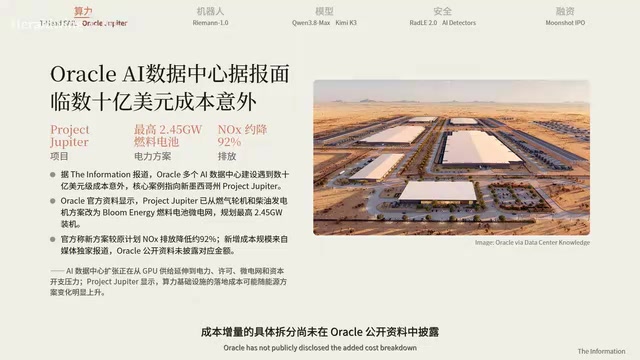
According to The Information, Oracle's AI data center project is facing cost overruns on the order of billions of dollars. Verifiable official materials show that Project Jupiter, located in New Mexico, has updated its power plan: switching from the original gas turbines and diesel generators to Bloom Energy's fuel cell microgrid, with a maximum planned installed capacity of 2.45GW.
A fuel cell microgrid is a distributed energy system that uses hydrogen or natural gas as fuel and generates electricity directly through electrochemical reactions. Its core advantages lie in the absence of a combustion process, high power generation efficiency (exceeding 60%, versus about 40% for traditional gas turbines), low noise, and a relatively compact footprint. Bloom Energy is a representative company in this field; its solid oxide fuel cell (SOFC) products operate at temperatures of 600–1000°C and can directly use hydrocarbons in natural gas for internal reforming, without requiring external hydrogen production infrastructure—an important reason they are favored by data center operators.
Another unique advantage of SOFC is its Combined Heat and Power (CHP) capability—the high-temperature exhaust can be used for data center cooling systems, further improving overall energy utilization. In data center scenarios, cooling typically accounts for 30–40% of total energy consumption, and the CHP mechanism can raise the system's overall energy utilization from 60% (with power generation alone) to over 80%, which carries significant economic value amid continuously rising energy costs. Moreover, SOFC's efficiency degradation under partial load conditions (such as during off-peak nighttime hours in data centers) is far smaller than that of traditional gas turbines, making it better suited for applications with significant load fluctuations like AI inference clusters. For data centers, a microgrid architecture means energy self-sufficiency, independence from the external grid, and can significantly improve power supply stability—particularly important for AI inference and training clusters that run around the clock. However, the initial capital expenditure for fuel cells is far higher than for traditional diesel generators, typically 3–5 times the per-kilowatt cost, and long-term supply chain management for hydrogen or natural gas introduces additional complexity. The planned 2.45GW installed capacity is equivalent to the electricity demand of a mid-sized city, reflecting the disruptive impact of the AI compute arms race on energy infrastructure—for reference, the entire U.S. data center industry consumed roughly 176TWh in total in 2023, while the installed scale of a single AI supercomputing data center cluster is already approaching city-level demand.
Oracle stated that the new plan can reduce related emissions by about 92% compared to the original plan, with Oracle bearing the project's energy costs itself. However, the specific breakdown of the cost increment has not yet been disclosed in official materials.
This case reflects an increasingly prominent contradiction in AI infrastructure construction: the tension between the enormous electricity demand brought by compute expansion and emission reduction goals is becoming ever harder to reconcile. While choosing a fuel cell microgrid substantially reduces emissions, it brings significant cost increases—an energy economics dilemma that all hyperscale data center operators cannot avoid.
Robot World Action Model: Riemann Dynamics Releases Riemann 1.0
According to a bylined report by QbitAI on July 19, Riemann Dynamics officially released Riemann 1.0 at WAIC-2026. The report states that Riemann Dynamics is backed by Kunlun Tech. Riemann 1.0 is defined as a robot's World Action Model, with the goal of achieving cross-embodiment, cross-task, and cross-scenario action generation, and predicting the visual consequences after execution.
The World Action Model is an important paradigm that has emerged in recent years in the field of embodied intelligence. Its core idea stems from the concept of the "World Model"—an AI architecture direction strongly advocated by Yann LeCun and others, which holds that an agent should not merely learn "stimulus-response" mappings, but should build an internal predictive representation of the physical world. This concept can be traced back to the "Predictive Coding" theory in cognitive science: the brain does not passively receive sensory input, but continuously generates predictions about the next moment's world state, and uses prediction error signals to drive learning. In robotics, this means the control policy is no longer a black-box function mapping directly from state to action, but rather first "imagines" within an internal model how the environment will change after executing a certain action, then selects the optimal action based on this prediction—this "think before acting" mechanism offers stronger generalization robustness when facing out-of-distribution scenarios.
From the perspective of technical implementation, the World Action Model typically adopts a video generation model as its backbone architecture—because predicting the "visual consequences after action execution" is essentially a conditional video generation task. Recent representative works such as Google DeepMind's Genie series and UC Berkeley's UniSim all attempt to combine large-scale video pretraining with robot action annotations, training joint models that can simultaneously output "next-frame prediction" and "action instructions." The core challenge of such models lies in maintaining physical consistency in predictions—the generated future frames must not only be visually realistic but also conform to physical constraints such as rigid body dynamics and contact mechanics, otherwise the robot will produce control errors during actual execution due to deviations between prediction and reality. Traditional robot control methods (such as imitation learning and reinforcement learning) often lack the ability to predict action consequences in advance, resulting in insufficient generalization in new scenarios. The World Action Model jointly models visual prediction and action generation, essentially allowing the robot to simulate execution results "in its head" before making decisions, similar to the human mental rehearsal mechanism.
According to the publisher's materials, the total training data scale reaches 232,000 hours, covering human first-person view videos, UMI or exoskeleton glove data, and robot trajectory data. Among these, UMI (Universal Manipulation Interface) is a low-cost data collection solution developed by Stanford University. By integrating a GoPro camera and an inertial measurement unit into a handheld gripper, it can collect human manipulation demonstration data in bulk without requiring a complex robot platform, and maps human hand trajectories to the robot end-effector through coordinate frame transformation. The exoskeleton glove solution captures fine manipulation intent by measuring finger joint angles and contact forces, both aiming to minimize the equipment barrier for data collection. The 232,000-hour scale is relatively large in the current field of embodied intelligence, but the actual effectiveness of cross-embodiment generalization still heavily depends on the diversity of data distribution and annotation quality. The joint modeling approach of "world-action" represents an important direction in embodied intelligence—not only teaching robots to execute actions, but also enabling them to anticipate action outcomes, thereby achieving stronger generalization capability.
It should be noted that the above evaluation figures all come from the publisher's materials, and the status of independent replication and full model openness has not yet been disclosed.
Flurry of Large Model Releases and Price Cuts
Qwen 3.8 Max Preview Goes Live with Aggressive Pricing
The Coder event page shows that Qwen 3.8 Max Preview went live for the event starting July 19. The page states this model is the latest foundation model in the Qwen series, with a parameter scale of 2.4T, and the event covers Coder desktop, JetBrains plugins, CLI, CoderWake, Cloud Agents, and the mobile web.

The 2.4T (2.4 trillion) parameter scale is a typical size for the sparse Mixture of Experts (MoE) architecture—the model's total parameter count is enormous, but each inference only activates a small subset of "expert" sub-networks, so the actual computation is far smaller than the total parameter count implies. The core of the MoE architecture is the routing mechanism (Router): each input token is directed by a lightweight gating network to a few "experts" (usually Top-2 or Top-4), and different experts spontaneously specialize during training to handle different types of semantic content. The inference efficiency gain from this architecture is significant—a 2.4T total-parameter MoE model may have only 300–400B actually activated parameters, with inference computation overhead comparable to a dense model of equivalent activated parameters, yet the model capacity (knowledge storage capability) is far larger.
MoE is not a new concept—as early as 2017, Noam Shazeer and others at Google Brain proposed the modern implementation of sparsely-gated MoE layers in the paper Outrageously Large Neural Networks, but limited by the distributed training infrastructure of the time, engineering large-scale MoE models was extremely challenging. In recent years, with the maturation of high-speed interconnects (such as NVLink and InfiniBand) and hybrid parallel training frameworks, the MoE architecture has truly entered the engineering practice of mainstream large models—Mixtral, the DeepSeek series, and the Qwen series mentioned in this article all adopt this architecture. However, MoE also has inherent challenges: expert load imbalance (some experts are overused while others sit idle), All-to-All communication overhead (in multi-GPU scenarios, different experts may be distributed across different devices, requiring large amounts of cross-device data transfer), and inference memory footprint (all expert weights must reside in memory even though most are not activated most of the time). Behind the continuous decline in inference costs lies the compounding effect of engineering techniques such as quantization compression, Speculative Decoding, and KV cache optimization.
Its pricing strategy is quite aggressive: the Credits billing coefficient during regular hours drops from 0.5X to 0.05X, and can go as low as 0.01X between 10 PM and 8 AM Singapore time. This tiered price reduction is both a means of capturing the developer market—exchanging low prices for developer ecosystem lock-in, then amortizing fixed costs through high-frequency usage has become a standard competitive playbook for Chinese large model vendors—and a reflection of the industry trend of continuously declining large model inference costs.
Kimi K3 Tops the WebDev Leaderboard
The Coder Arena leaderboard (updated July 16) shows that Moonshot's Kimi K3 ranked first in WebDev Overall with 1679 points, with the following competitors at 1631 and 1618 points respectively. Kimi K3 was released on July 16 and integrated into Kimi Code, adopting a 2.8 trillion parameter scale, supporting up to 1 million tokens of context and native visual understanding.

However, the Arena page marks this score as Preliminary, and the leaderboard results reflect human preference on specific front-end tasks rather than a definitive conclusion on overall capability.
Frontier Research: Medical AI and AI Text Detection
Radiology Diagnosis Benchmark RadO 2.0: How Far Is AI from Autonomous Diagnosis?
A technical report (marked July 2026) introduces RadO 2.0, a benchmark for evaluating whether AI systems are ready for autonomous radiological diagnosis. The Decoder's July 19 report paid special attention to the "confident errors" issue in this benchmark.
What makes this benchmark unique is that it not only tallies whether answers are correct, but also incorporates confidence and human handoff capability into its scoring—a design that touches on a core issue in AI evaluation: Calibration. A well-calibrated model's prediction confidence should match its actual accuracy—that is, when the model claims 90% certainty, the true accuracy rate for the corresponding task should also be close to 90%. This property is usually quantified using ECE (Expected Calibration Error); a lower ECE means higher alignment between confidence and accuracy. However, large language models and vision models generally suffer from Overconfidence: giving high confidence to wrong answers, which can lead to serious clinical consequences in high-risk scenarios like radiological diagnosis. This overconfidence partly stems from bias in training data—assertive statements in web text far outnumber uncertain statements, causing models to learn a default style of "always answering with a firm tone."
Technical approaches to addressing overconfidence include: Temperature Scaling (introducing a temperature parameter in the Softmax layer to smooth the probability distribution), Platt Scaling (calibrating after applying logistic regression to model outputs), and Conformal Prediction (generating reliable prediction intervals based on statistical coverage guarantees). However, the effectiveness of these post-processing calibration methods in multimodal medical imaging scenarios remains controversial—if the distribution of the calibration dataset drifts from the actual clinical data, the calibration effect degrades significantly. The RadO 2.0 benchmark's design of incorporating "human handoff capability" into scoring is actually testing the model's perception of its cognitive boundaries—that is, whether the model can output "I cannot confirm; please have a radiologist review" at the appropriate time rather than forcing out a diagnostic conclusion.
The leaderboard shows 16 AI models compared alongside licensed radiologists and trainees, with the best model scoring 758, while the human expert baseline reached as high as 988.7. This gap is not only a gap in capability but also reflects human doctors' metacognitive ability to know to say "I'm not sure, further examination is needed" under uncertainty—that is, accurate perception of the boundaries of their own knowledge—which is precisely the deep weakness of current AI systems. The report notes that some models give medium-to-high confidence on incorrect diagnoses—meaning clinical applications cannot rely solely on accuracy, but must also consider whether the model can recognize its own uncertainty and hand off to specialist physicians in a timely manner.
The Vulnerability of AI Text Detectors: Style Imitation Is the Weak Point
Epoch AI released a data insight on July 15, testing three AI text detectors: Pangram, GPT-0, and Originality.ai. The results show that AI text generated from ordinary basic prompts can almost all be identified, with a maximum miss rate of only 0.7%.
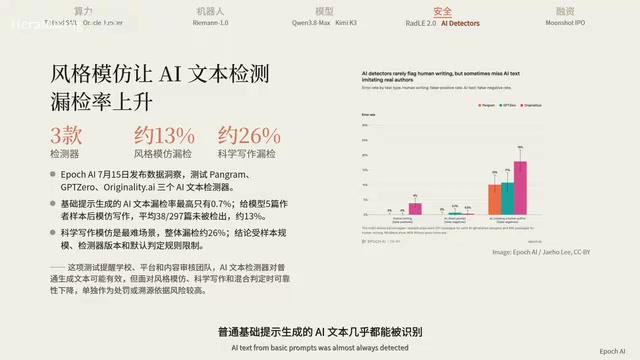
But when the model references five samples from a certain author and imitates their style, the situation takes a sharp turn: about 13% of the text goes undetected by the detectors; in scientific writing imitation scenarios, the miss rate rises even higher, to about 26%. To understand this phenomenon, one must understand how detectors work: mainstream AI text detectors are typically based on statistical Perplexity analysis—AI-generated text tends to choose high-probability tokens in the language model's probability space, exhibiting an "overly fluent" characteristic, which manifests as abnormally low perplexity values. Some detectors also incorporate a "Burstiness" metric, since human writing usually exhibits random fluctuations in sentence length and complexity, whereas AI-generated text tends to be overly uniform.
Notably, the perplexity detection method itself has a fundamental fragility: it relies on the "perplexity difference" between the detector's built-in language model and the model that generated the text being detected. When the detected text is generated by a model with a different architecture or training data than the detector's, this difference shrinks substantially; and when the unique style of a human author is introduced, the text distribution further shifts toward the detector's "human writing range," naturally raising the miss rate. In addition, there exists a class of adversarial attack strategies (such as paraphrasing models like DIPPER and PARAPHRASE) specifically designed to reshape the statistical characteristics of AI text into a distribution closer to human writing while preserving semantics; the existence of such tools makes solutions relying purely on statistical detection even more precarious. And when a model is asked to imitate a specific human author, it introduces that author's unique vocabulary choices, sentence structures, and even non-standard usages (such as colloquial expressions, domain jargon, and deliberately incomplete sentences), thereby increasing the text's perplexity and bringing its statistical characteristics closer to the human writing distribution. The miss rate is particularly high in scientific writing scenarios, partly because academic writing itself has strong template-like characteristics (the fixed abstract-methods-results structure, passive-voice dominance), making style transfer relatively easy, and the high-frequency repetition of specialized terms makes statistical detection harder to work—detectors struggle to distinguish "AI-generated standard academic text" from "human-written standard academic text." Epoch AI also notes that samples, versions, and default judgment rules all affect the final conclusion. This finding suggests that relying on AI detectors as the single line of defense for academic integrity has systemic loopholes, and AI text detection remains quite fragile when facing "style imitation."
Moonshot Prepares for Hong Kong IPO
According to a 36Kr flash report on July 18, Moonshot has notified investors that it is adjusting its corporate structure and preparing for a Hong Kong IPO, potentially completing the listing within six months at the earliest. Bloomberg also reported on July 19 about listing preparations in the same direction.
However, current public information does not yet show that Moonshot has submitted a prospectus to the Hong Kong Stock Exchange, nor has the company publicly confirmed a specific listing timeline. The Hong Kong Stock Exchange's Chapter 18C (listing rules for specialist technology companies), introduced in recent years, provides a listing channel for not-yet-profitable tech companies, allowing pre-profit-stage AI enterprises to list by meeting specific market capitalization and R&D thresholds, making the HKEX one of the preferred destinations for Chinese AI unicorns seeking overseas financing.
Chapter 18C officially took effect in March 2023, and its core innovation lies in introducing "expected market capitalization" rather than profitability as the primary listing threshold: commercial-stage specialist technology companies must meet a minimum market cap of HK$6 billion, while pre-commercial-stage companies must meet a HK$15 billion market cap and accept stricter prospectus disclosure requirements. For AI enterprises, this rule means they can raise capital through the capital markets without having achieved scaled profitability, but at the cost of having to clearly disclose their technology roadmap, commercialization conversion path, and R&D expenditure plans to public investors, which itself constitutes a mechanism that forces greater corporate governance transparency. From a more macro perspective, this listing preparation reflects that competition among Chinese large model companies is extending from model capability to commercialization and capital market validation—technological leadership is merely an entry ticket, and whether a company can gain capital market recognition and prove a sustainable business model to public shareholders will become the key test of the next phase.
Key Takeaways
Key Takeaways
Related articles

Qwen3 27B In-Depth Review: A Powerful Reasoner That Overthinks — and How to Fix It
In-depth review of Qwen3 27B's reasoning capabilities and overthinking problem. Analyzes performance advantages, causes of overthinking, and provides practical optimization solutions.

RL for Reasoning Only Changes 1-3% of Tokens? The Truth and Controversy Behind the Claimed 1000x Compute Savings
RL training for LLM reasoning only changes 1-3% of output tokens, with researchers claiming 1000x compute savings. We analyze the deep implications, non-uniform token distribution issues, and the gap between benchmarks and real usability.

AI Algorithm Engineer Self-Study Roadmap: A Complete Plan from Zero to Landing Your First Offer
A detailed AI algorithm engineer self-study roadmap covering foundations, core algorithms, CV/NLP direction selection, and career transition strategies for landing offers.