AI Design Agents Reshape Content Production: Every Piece of Content Gets Its Own Visual Asset

Design agents are becoming a default step in the content pipeline, reshaping team collaboration.
The article starts from a content creator's share, noting that all visual assets for their team's published content are generated by the same AI design agent, turning design from manual scheduling into a default step in the content pipeline. This eliminates the cadence gap between content and design and shifts offline meeting focus from 'can we get this image made?' to content strategy. The author analyzes that style consistency and brand guideline constraints are key to embedding agents in workflows, while noting that a single share lacks implementation details and quality data. In practice, agents suit high-frequency structured content, while strongly creative core visuals still need human judgment. The takeaway: build design agents as unified infrastructure, but first clarify brand guidelines and review standards.
From Manual Design to Agent-Generated Assets
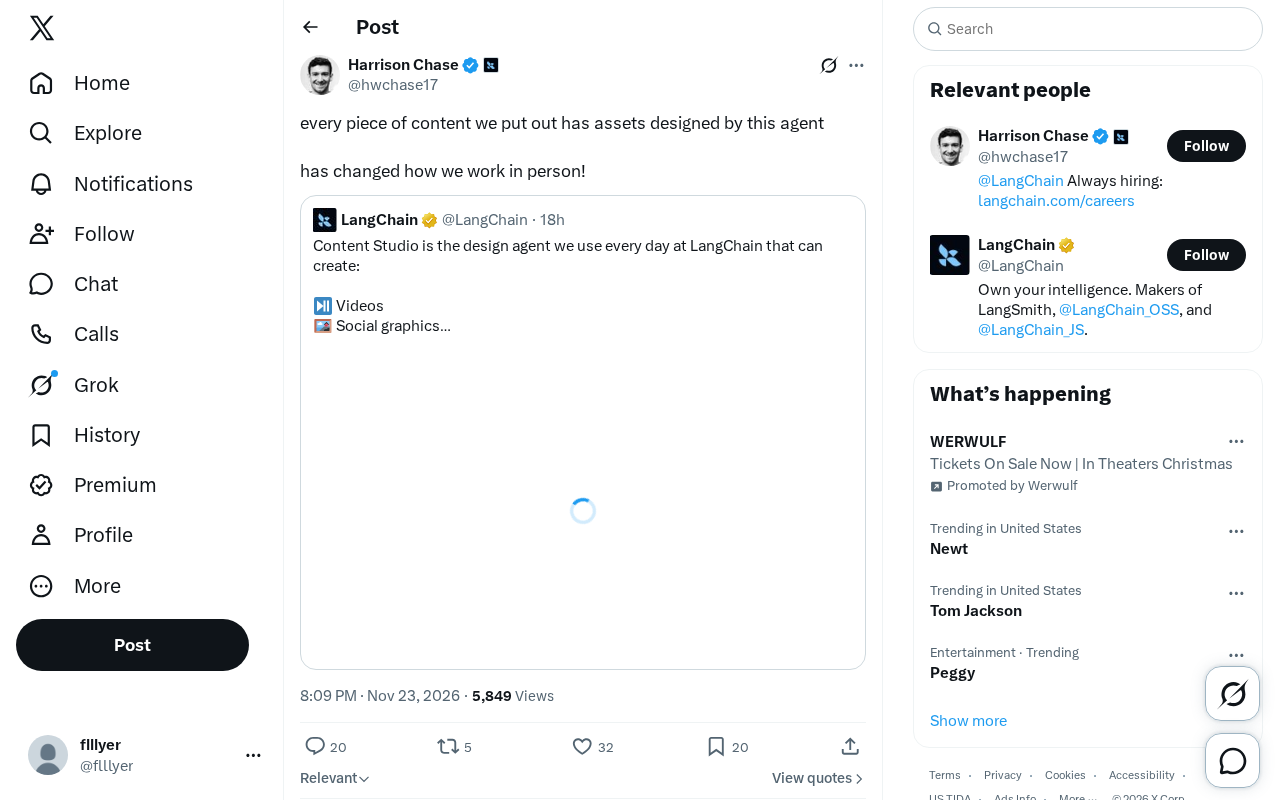
A content creator recently shared a change in their workflow on social media: every piece of content their team publishes now has its visual assets generated by the same AI design agent. The key takeaway from this brief post isn't the launch of some new tool—it's a shift in production dynamics. Design has moved from "manual scheduling" to becoming a "default step in the content pipeline."
In the past, there was a natural cadence gap between content teams and design teams. Copy could be revised the same day, but accompanying visuals had to wait for a designer's availability. The larger the content volume, the more obvious this bottleneck became. Once a design agent is integrated into the content workflow, every piece of content can receive matching visual assets without going through a separate design request ticket.
According to the creator, this change isn't limited to online output—it has also "changed how offline collaboration works." That statement deserves unpacking: when design is no longer a scarce resource, meeting discussions shift from "can we get this image made?" to "what does this piece of content need to communicate?"
Why Design Agents Can Become Part of the Content Pipeline
From Point Tool to Workflow Component
Generative visual tools aren't new. The hard part is embedding them into a stable production process. Generating a single good-looking image is easy; getting an agent to understand content tone, brand guidelines, and publishing cadence is what actually affects efficiency. The creator's emphasis that "every single piece of content" is produced by the same agent implies consistency—visual style remains unified across a large volume of content rather than being a gamble each time.
A design agent is fundamentally different from a single-call generative image model. An agent typically uses a large language model as an orchestration layer, capable of understanding natural language instructions, calling external image generation APIs, reading brand guideline documents (such as color palettes, typography, logo usage rules), and self-correcting through multiple rounds of interaction. It has memory and tool-use capabilities and can be automatically triggered within the content publishing workflow: once a piece of copy is finalized, the agent automatically parses the topic, emotional tone, and format requirements, generates matching visual assets, and returns them. This "workflow component" form requires the agent to be stable and repeatable rather than pursuing the wow factor of a single image. Current mainstream implementations are mostly built on multimodal models plus workflow engines (such as ComfyUI, LangChain, etc.), but dedicated design agents focused on brand consistency are still in an early stage.
Changes in Offline Collaboration
The publisher specifically mentioned changes in offline work patterns—a dimension that's easy to overlook. When visual assets are handled by an agent, the proportion of design reviews in face-to-face meetings decreases, freeing up space for discussions about content strategy and creative direction. Teams no longer spend communication overhead on "waiting for images," and offline time becomes more focused on judgment and decision-making.
Brand-level visual standards typically refer to a documented visual identity system (VI) covering primary and secondary colors, typography hierarchy, graphic language, photography style, layout grids, and prohibited examples. For an agent to produce "brand-level" assets, it must translate these guidelines into executable constraints—for example, through prompt templates, reference image embedding (IP-Adapter), or fine-tuned models to lock in style. The difficulty lies in the many implicit judgments within guidelines—such as "whitespace should feel breathable" or "tones should be restrained"—which are hard to formalize. As a result, an agent's performance on brand consistency depends heavily on how explicitly the team has documented its guidelines. This is why the article emphasizes that "agents can only amplify rules that are already clear": the more structured the guidelines, the more reliable the agent's output; the more the guidelines rely on a designer's tacit knowledge, the more likely the agent is to deviate.
The Real Boundaries of This Model
What needs to be viewed with a level head is that a single-source share doesn't disclose the agent's specific implementation, the tools used, or output quality data. Whether the visual assets meet brand-level standards and how the agent performs under complex creative requirements both lack public evidence.
From industry practice, the value of design agents is concentrated in high-frequency, structured content scenarios—such as social media images, article headers, and basic versions of campaign materials. For core visuals involving strong creativity and strong brand tone, human design judgment remains irreplaceable. Positioning agents as a "default step in the pipeline" rather than a "designer replacement" is more consistent with current capability boundaries.
High-frequency structured content scenarios refer to content types with repetitive demand patterns, limited variables, and low requirements for creative uniqueness—for example, social media images (fixed dimensions and layouts), article headers (clear topics, unified style), and basic campaign materials (banners, poster template fills). What these scenarios share is that inputs can be structurally described (titles, keywords, brand templates), outputs have clear acceptance criteria (dimensions, colors, text readability), and there's a large margin for error. Agents can significantly compress scheduling and communication costs in these scenarios. Conversely, strongly creative scenarios—such as brand refresh key visuals or core concept images for major campaigns—require strategic judgment, cultural context understanding, and cross-media narrative ability, and still depend on human designers' decisions. Positioning agents as a "default step" is essentially acknowledging that they excel at handling long-tail, high-frequency needs while reserving scarce human judgment for high-value creative nodes.
Implications for Content Teams
The real value of this share lies in suggesting an organizational approach: rather than having each step procure AI tools separately, build the design agent as infrastructure for content production. A unified agent means unified style constraints and unified output standards, and the focus of team collaboration shifts upward from the execution layer to the strategy layer.
For teams with continuously growing content volume, the appeal of this model is obvious. But the prerequisite for implementation is first clarifying brand guidelines, content tone, and review standards—agents can only amplify rules that are already clear; they can't define rules on the team's behalf.
One-line Summary
Design agents are evolving from point tools into a default step in the content pipeline, reshaping how teams collaborate.
Paragraph Summary
Starting from a content creator's share, the article notes that all visual assets for their team's published content are generated by the same AI design agent, turning design from manual scheduling into a default step in the content pipeline. This change eliminates the cadence gap between content and design and shifts the focus of offline meetings from "can we get this image made?" to content strategy discussions. The author analyzes that the key to embedding agents in the workflow lies in style consistency and brand guideline constraints, while cautioning that a single share lacks implementation details and quality data. In terms of real boundaries, agents are suited to high-frequency structured content scenarios, while strongly creative core visuals still require human judgment. The takeaway for content teams: build design agents as unified infrastructure, but only after clarifying brand guidelines and review standards.
Related articles

Michael Nielsen Takes Down His Classic Neural Network Textbook, Sparking Community Discussion
Michael Nielsen's classic free textbook Neural Networks and Deep Learning has been taken offline, sparking discussion on Hacker News about the reasons and impact.

Inside the AI Training Data Market: The Trade-off Between Exclusivity and Discounts
G2i founder Gabe Greenberg reveals the dual-track pricing of the AI training data market: labs pay a premium for exclusive data or accept discounts that allow others to buy it.

SessionGraph: Unifying All Coding Agent Sessions in One Interactive Graph
SessionGraph aggregates coding agent sessions into an interactive graph, helping developers review, debug, and manage AI coding workflows across sessions. This article examines its positioning, value, and open questions.